There are already people on the map, each one brought in by someone before them. We've started sending the invitations that bring in the next. It grows one introduction at a time.
The first invitations are being prepared from existing records: contributed work, tested routes, introductions made, and relationships that held through the build.
The public log continues.
ƒxyz maps currency paths:
banks, OTC desks, local rails, stablecoins, records, known counterparties, introductions.
If you helped build or carry part of the earlier map, that context belongs in the graph.
BIS (Apr 2025): OTC FX averaged $9.5T/day.
Dealers match 80%+ of customer trades internally.
Execution: 59% electronic, 38% voice.
https://t.co/ucdYHZHa0c
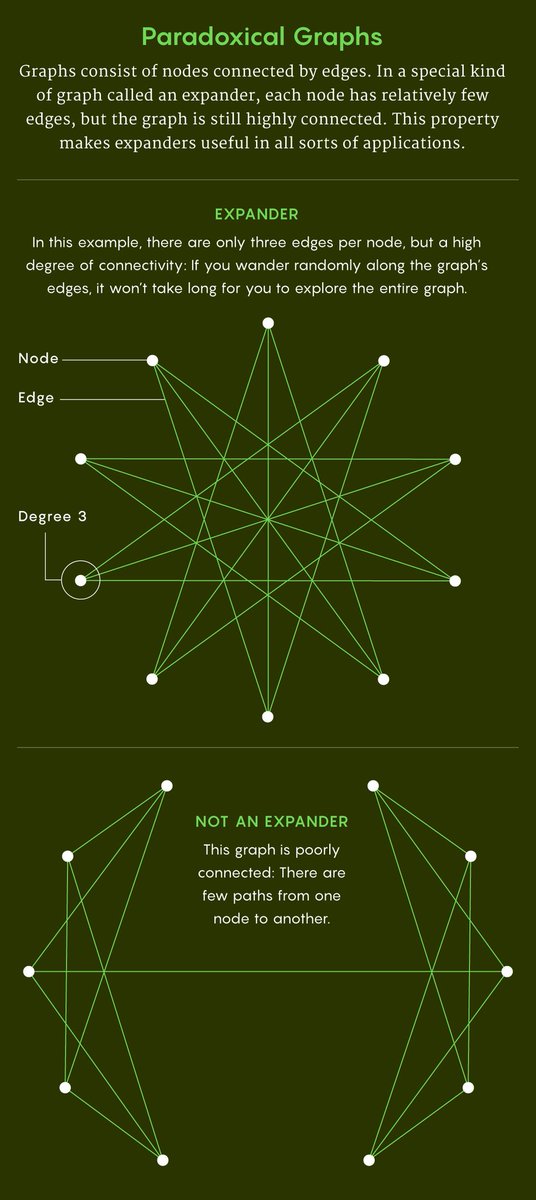
Graphs consist of nodes connected by edges. In a special kind of graph called an expander, each node has relatively few edges, but the graph is still highly connected. This prospect makes expanders useful in all sorts of applications. https://t.co/Jrg4fZb2BL
Physicist Stephen Wolfram's exploration of a theory of everything — and simulating the universe. [Select image to magnify.]
Source:
Stephen Wolfram, "Finally We May Have a Path to the Fundamental Theory of Physics… and It's Beautiful," Stephen Wolfram Writings. https://t.co/MhqAB9E2JB
My contrary opinion: cross border b2b backend crypto settlement is the only thing that will go mainstream in the next 3-5 years, but it will be enormous.
Chinese scientists have developed the best shortest-path algorithm in 41 years! A team from Tsinghua University has broken Dijkstra’s “sorting barrier” — the first improvement since 1984.
The new algorithm runs in O(m \log^{2/3} n) time. Potential applications? Faster shorter waits for route calculations, fewer traffic jams, cheaper deliveries, and more efficient computer networks. And, of course, a need to update computer science curricula :)


![poetengineer__'s tweet photo. visual forms hold the power not just to represent knowledge, but to create it.
[Athanasius Kircher's diagrams] https://t.co/fX3v0iDLkj](https://pbs.twimg.com/media/Gx8Luc5XEAAmbO3.jpg)
![poetengineer__'s tweet photo. visual forms hold the power not just to represent knowledge, but to create it.
[Athanasius Kircher's diagrams] https://t.co/fX3v0iDLkj](https://pbs.twimg.com/media/Gx8LV49XMAAz5mE.jpg)
![poetengineer__'s tweet photo. visual forms hold the power not just to represent knowledge, but to create it.
[Athanasius Kircher's diagrams] https://t.co/fX3v0iDLkj](https://pbs.twimg.com/media/Gx8LS1pWAAAKwsb.jpg)



![pickover's tweet photo. Physicist Stephen Wolfram's exploration of a theory of everything — and simulating the universe. [Select image to magnify.]
Source:
Stephen Wolfram, "Finally We May Have a Path to the Fundamental Theory of Physics… and It's Beautiful," Stephen Wolfram Writings. https://t.co/MhqAB9E2JB](https://pbs.twimg.com/media/G0Sq7WZWcAAkUA5.jpg)

![poetengineer__'s tweet photo. visual forms hold the power not just to represent knowledge, but to create it.
[Athanasius Kircher's diagrams] https://t.co/fX3v0iDLkj](https://pbs.twimg.com/media/Gx8MRnvWwAAzPt7.jpg)


