Formal retailers like PicknPay across Africa face pressure from a growing informal market.
With growing unemployment and youthful nations, this problem shall only get worse.
Gvts need to set long-term strategies to protect both formal and informal industries. #Vision2050
“No retailer is too big to fail.”
Pick n Pay SA CEO Sean Summers, who has the task to turnaround the troubled retail group, warns that even major retailers can fail. He points to once dominant retailers like Stuttafords and Edgars in South Africa as proof that size offers no protection.
Another example? OK Zimbabwe.
“OK was a 10-tonne gorilla” when Pick n Pay entered Zimbabwe in 2010, Summers says. Now, OK is “going to be gone”.
Pick n Pay owns 49% of TM Pick n Pay. Since 2024, it has stopped including the Zimbabwe business in its group results. Had TM Pick n Pay been included in the year to March 2026, Pick n Pay’s share of the losses would have been the equivalent of about US$2.3 million, a narrower loss from the US$3.1 million loss the previous year.
📍 TM Pick n Pay has 73 stores in Zimbabwe, where formal retail is under pressure from informal trade, high regulation and currency distortions.
📍 Separately, in SA, Pick n Pay closed 56 shops over the past year as part of its restructuring.
Arguably, +/- 60% of Kenya's retail is still from informal trading. Yet manufacturer sales remain +/-80% to modern chains with punitive terms.
The book #SellingtoInformalMarkets is now available in Kenya at Bookstop Yaya Centre. Book your order now 👉https://t.co/R4DzEPjfp1
@AbsaTanzania announces at the branch and on their website that they operate on Sunday's. Only to find them conveniently closed after a long drive there. Thank you 👎
My book Selling to Informal Markets is now available online 👉 https://t.co/0WcHDcUDyJ.
This is a practical playbook for entrepreneurs, executives,and investors serious about winning in Africa’s informal economy. Physical copies will be bookstores soon. DM for orders & enquires.
One of the most expensive mistakes people make in any company is blind obedience.
A CEO once walked into a boardroom and said, “This room feels dark.”
Someone replied, “A tree is blocking the sunlight.”
The CEO said, “I wish that tree wasn’t there. Anyway, let's continue our meeting."
A week later, a $20,000 bill arrived. The tree had been uprooted and moved.
The CEO was shocked. His goal was more light. They could have trimmed the branches or added lights for a fraction of the cost. The team followed his words, not his intention.
I’ve had versions of this happen to me a few times over the years. It taught me to communicate and overcommunicate the objective, and to encourage people to think.
There’s a saying I use with new hires: do not be a pipe.
A pipe just carries things from one place to another. It changes nothing. If you pour water in, you get water out. That is a dumb terminal.
Your job is not to carry out instructions. It is to understand the goal, question assumptions, and create something better.
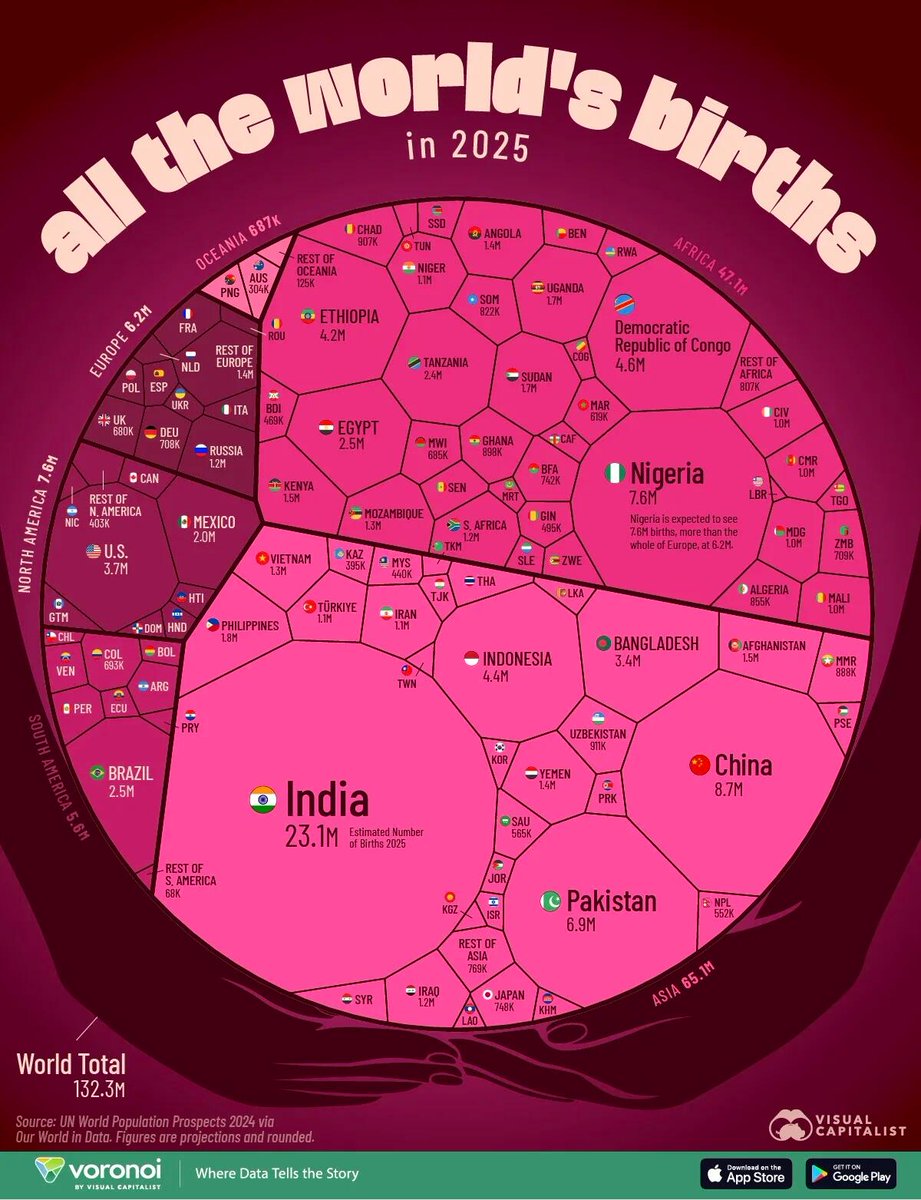
🚨 NIGERIA WILL HAVE MORE BIRTHS THIS YEAR THAN ALL OF EUROPE - THE MAP IS BEING REDRAWN
India: 23 million births in 2025. One in six humans born this year will be Indian.
Nigeria: 7.6 million births. More than Germany, the UK, France, Italy, Spain, Poland, the Netherlands, and Romania combined.
Europe's total: 6.3 million across the entire continent.
Japan, once a demographic powerhouse, will see fewer than 750,000 births. South Korea: 245,000. These aren't rounding errors - they're extinction-level fertility rates for advanced economies.
China is at 8.7 million despite decades of decline.
Africa has eight countries in the top 30 for births, and the Democratic Republic of Congo alone will produce 4.6 million - more than the entire United States.
Here's what the data actually means: economic power, military capacity, consumer markets, and geopolitical influence follow population over the long term. Europe is debating pension reform while Africa is building the world's youngest workforce.
Germany can't staff its factories. Nigeria can't employ its youth. One has capital and aging infrastructure. The other has surplus labor and resource wealth.
The 21st century's power map isn't being drawn in boardrooms - it's being determined by maternity wards in Lagos, Kinshasa, and Delhi.
Demographics aren't destiny, but they're a hell of a down payment.
Source: Visual Capitalist, UN World Population Prospects
Hi. I'm having no problem getting money into my @PayPal account, but I cannot withdraw or transfer it out within #Kenya or other African countries that I've tried. Help @Safaricom_Care
@LMudachi I would argue that the Kenyan (East African) small-scale dairy model is resoundingly better than having a few large-scale dairy farmers. The key is a strong cooperative model with national monitoring standards. Yes, cracks exist, but which scenario aren't there.
Tanzania has imposed new taxes on Kenyan eggs, dairy, meat, and biscuits, disrupting EAC trade rules.
Kenyan manufacturers say this has led to a Sh4 billion drop in exports to Tanzania.
This is an unbelievably bad deal!
A chinese firm gets 30 years management of @TAZARAHQ railway line from #TANZANIA to landlocked #Zambia for $1.4 billion?
What is the lifespan of the equipment they are buying - 10 to 15 years?
This was worth 5 years!
https://t.co/dtwOPQ0bZf