If you're interested in GambleFi, you should already know about ethereum:0x8881562783028f5c1bcb985d2283d5e170d88888
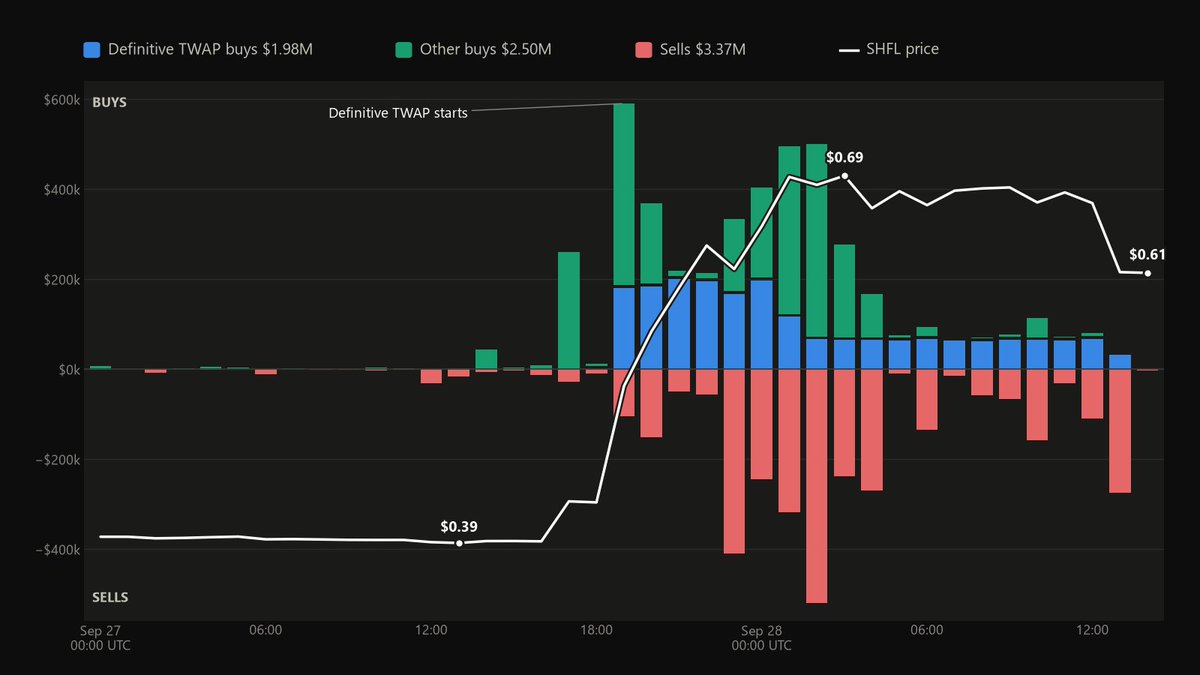
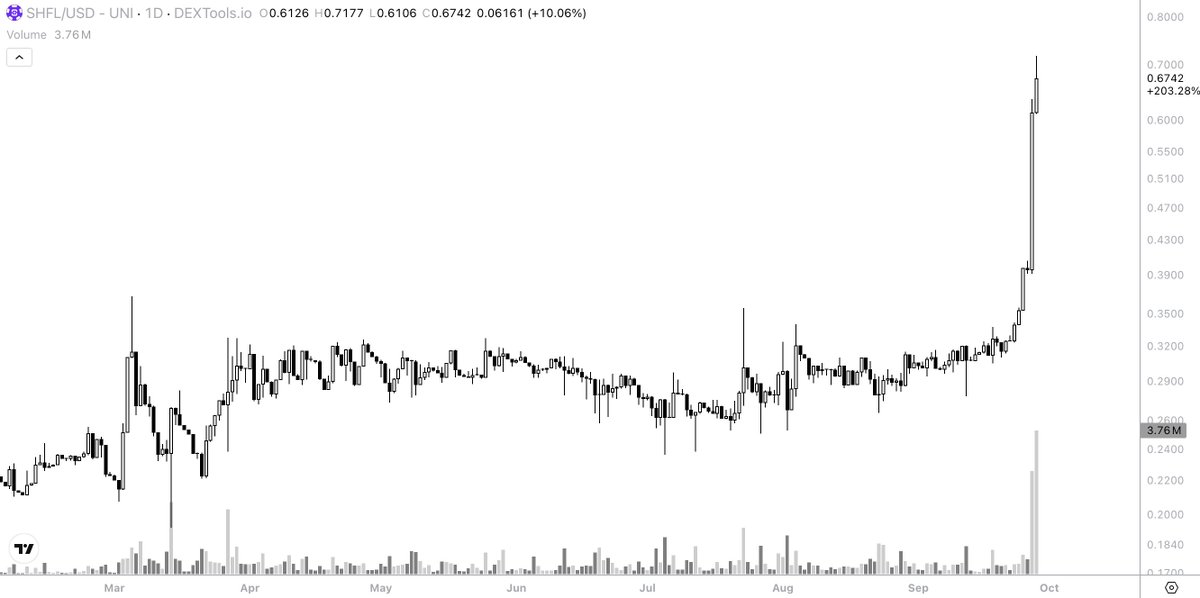
The price went from $0.39 to a peak of $0.72 in about 10 hours on Sep 27. On-chain, roughly ~$4.48M in buys vs ~$3.37M in sells since then, about $1.1M net in.
The biggest buyer withdrew $2.2M USDC from Binance and ran it through a Definitive TWAP vault. It bought ~$1.5k of SHFL every 24 seconds for 19 hours straight, ~$1.98M total, and consolidated 3.24M SHFL into one wallet.
Separately, well-known trader izebel.eth used two wallets to buy $438k and deposited all 1M SHFL straight into Shuffle.
Staked SHFL unlocks after Friday's lottery draw, and over the last 12 weeks about 69% of what gets withdrawn that weekend was sold on-chain within 72 hours. If I had to guess I'd say it will be a fist fight for sellers come Friday.
First $GRASS, now ethereum:0x8881562783028f5c1bcb985d2283d5e170d88888.
I don't just love how these businesses are bringing more transparency and trust to their tokens and underlying businesses through external audits. I also love how aggressively the market reacts to it.
Interestingly, there's a ton of interesting crypto businesses out there all sitting in the same boat: genuinely compelling value proposition, already doing decent revenue from real world clients and users, but the token doesn't move an inch because people either don't trust it or don't even know it exists.
I think there's a massive opportunity here for those actually willing to put in the work, dig deep to find these businesses, and do the diligence on how committed these teams really are to their token. Do that, and you can front-run massive repricings before the market wakes up.
As more transparency and initiatives like Blockworks TTF become the standard, I expect this opportunity to fade and the market to get more efficient at pricing in offchain revenue too. But for the next 1-2 years, this is literally a window of free money.
We’re just getting started. Once the onchain casino launches we’re zooming past $1. Buy now and thank me later. ethereum:0x8881562783028f5c1bcb985d2283d5e170d88888
@photofinishgame@SangudoStables
It's Season 45 in PFL and breeding just opened today. I've gone bigger than ever on breeding, buying horses and racing over the last few seasons. Figured I'd write a post to share my thoughts on the current state:
1/ PFL is far more accessible than ever. You can start with basically no budget, learn the game, and slowly scale up. There are many ways to play and learn the game. This was definitely not the case when I started.
2/ You can literally play for free and build up a small bankroll to deploy on your actual paid racing stable. Learn the mechanics, understand attributes/race selection, and win $rDERBY without spending anything.
Then move to low-stakes paid racing where you can buy, breed and race for just a few bucks.
3/ The progression is key. PFL is now far more accessible than early days where you needed multiple $1000s just to buy a crappy mare.
Now you can start free → low stakes → build a paid stable → eventually compete at the Major/top level.
Don’t start at the top. I highly recommend learning in free and low stakes paid segments.
I just recently started to try and compete for Majors after 30 seasons, so there is no rush, in my opinion. I built up a small bankroll and now actively look to invest to compete at the top over the next few seasons.
4/ You don’t have to play the same way I do, or the way anyone else does. There are a lot of angles and niches.
Breed.
Race in under-loved or overlooked segments.
Chase free rolls.
Flip horses.
Trade.
Build lineages.
Hunt for undervalued horses.
Specialize in certain distances/classes.
There are a lot of different angles and infinite ways to find an edge.
5/ There is legitimate asymmetric upside if you figure out how to scout, race and breed strategically. Every season there are diamonds in the rough that deliver 50x–100x there cost over their career.
Obviously most horses won’t do that, which is what makes finding one fun.
6/ The team keeps building. New features. Gameplay improvements. Quality-of-life upgrades.
Bryce deserves a ton of credit. The guy is a saint. Super responsive whenever there’s an issue and genuinely cares about the player experience.
7/ PFL already has a really good, loyal core player base. That’s why I think the opportunity is interesting now.
The game doesn’t need 100,000 new players to change the ecosystem. Even a relatively small increase in active players goes a long way.
8/ If you tried PFL a year or two ago and moved on, I’d strongly recommend giving it another look.
If you’ve never played, start with the free races. There’s almost no barrier to learning the game anymore.
With Zed Run gone, PFL is easily my favorite Web3 game.
More bullish on it now than I’ve been in a long time.
I'm a cardiologist. Something just happened today that I genuinely did not see coming — and it could change the future of preventive medicine more than anything I've written about on this platform.
Midjourney — the AI company that became famous for generating images from text prompts — just announced a medical hardware division and unveiled a working prototype of a full-body scanner unlike anything that's ever existed.
It's called the Midjourney Scanner. And it works like this.
You step into a shallow pool of water. You stand on a platform that slowly descends — about two inches per second — through a ring containing roughly half a million tiny ultrasonic transducers, each the size of a grain of sand. Every one of them acts as both a speaker and a microphone, sending ultrasonic waves through your body from every angle and recording what comes back.
60 seconds later, you step out. The scan is done.
No radiation. No magnets. No claustrophobia. No IV contrast. Just sound, water, and an almost incomprehensible amount of computing power — roughly 2 petaflops processing 17 gigabytes per second of raw acoustic data — reconstructing a 3D map of your entire internal anatomy down to half a millimeter resolution.
Organs. Tissues. Blood vessels. Bones. Muscle. Fat distribution. All segmented by AI in real time.
As a cardiologist who has spent months writing about how the standard screening playbook misses the majority of future heart attacks — this is the technology I've been waiting for without knowing it existed.
Here's why this matters for the future of your heart.
Right now, getting a detailed look inside your cardiovascular system requires either a CT scan (radiation), an MRI (magnets, claustrophobia, 45-60 minutes, $1,000+), or a coronary CT angiogram (radiation, IV contrast, limited availability). These are powerful tools. I order them regularly and they save lives.
But they're reactive. You get them when something is already suspected. They're expensive. They're uncomfortable. And for most people, they happen once — maybe twice — in a lifetime.
Imagine instead: a 60-second scan with no radiation that you could repeat monthly or quarterly. Tracking cardiac structure over time. Watching body composition shift. Detecting changes in organ size, fluid distribution, or vascular architecture before symptoms ever develop. Building a longitudinal dataset of YOUR body that AI can analyze for patterns no single snapshot would reveal.
That's what Midjourney is building toward.
The company plans 50,000 scanners worldwide over six years, with capacity for a billion scans per month. The first location — the "Midjourney Spa" in San Francisco — opens at the end of 2027 with 10 scanners alongside saunas, cold plunges, and a gym. The scan costs a few dollars. The experience is designed to feel like wellness, not medicine.
The technology is built on Butterfly Network's ultrasound-on-chip platform — 40 modules per scanner — combined with Midjourney's own AI segmentation and reconstruction stack. David Holz, the founder, claims the system aims for image quality comparable to MRI in many aspects but at nearly 100x the speed with zero radiation.
Now the caveats — because I'm a physician and the caveats matter enormously.
This is a Gen 1 prototype. About a dozen people have been scanned so far. Current scan time is actually closer to 20 minutes, not 60 seconds — the system is bottlenecked by bandwidth and reconstruction algorithms. The 60-second target is aspirational for future hardware generations.
It is not FDA-cleared for diagnostic use. Midjourney is starting with body composition maps — a category below diagnostic imaging in the regulatory hierarchy. The path from "beautiful 3D body scans" to "clinically validated diagnostic tool that your cardiologist can act on" runs through years of clinical trials, comparative studies against MRI and CT gold standards, and FDA review.
No independent clinical validation has been published. The imaging claims come from Midjourney's own demonstrations. Comparative data against established modalities does not yet exist.
And the privacy implications of full-body internal scans at planetary scale — a billion scans per month — is a conversation that hasn't even started yet.
So I want to be precise. This is not ready for clinical medicine today. It may not be ready for years. Many ambitious medical hardware projects have failed in the gap between prototype and product.
But.
The fact that a working prototype exists — producing real segmented 3D anatomy from sound waves and compute alone — means the physics works. The engineering works. The question is no longer "is this possible" but "how fast can it be validated and scaled."
And if it is validated — if the resolution holds up against MRI, if the AI segmentation proves reliable, if the regulatory path clears — then what we're looking at is the most significant new imaging modality in 50 years.
For my entire career, preventive cardiology has been limited by the fact that seeing inside the body is expensive, slow, uncomfortable, and infrequent. We catch disease late because we image rarely. We image rarely because imaging is hard.
A 60-second, no-radiation, spa-based full-body scan that costs a few dollars would demolish every one of those barriers.
I've written about AI detecting inflamed arteries. About gene editing curing cholesterol. About GLP-1 drugs rewriting metabolic medicine. About cellular reprogramming reversing aging.
This is the missing piece: the ability to see inside every human body, routinely, safely, and affordably — so all of those interventions can be deployed before the disease arrives instead of after.
The company that taught AI to generate images from imagination just built a machine that generates images from the human body.
The future of medicine showed up today from the last place anyone expected.
JUNE 2028.
The S&P is down 38% from its highs. Unemployment just printed 10.2%. Private credit is unraveling. Prime mortgages are cracking. AI didn’t disappoint. It exceeded every expectation.
What happened?
https://t.co/JzzwCrbJgS
Just this past summer, I spoke with @lexfridman about not letting AI write any code directly, but it turns out half the resistance was simply that the models weren't good enough yet! I spent more time rewriting what it wrote than if I'd done it from scratch. That has now flipped.