@AbiyAhmedAli You and your idiotic photo op…because of you, this great nation is in turmoil. The whole of East Africa is in chaos. Step down already አንተ ህጻን።
Coherence After Attrition: Amhara Unity and the Burden of History in the Horn of Africa
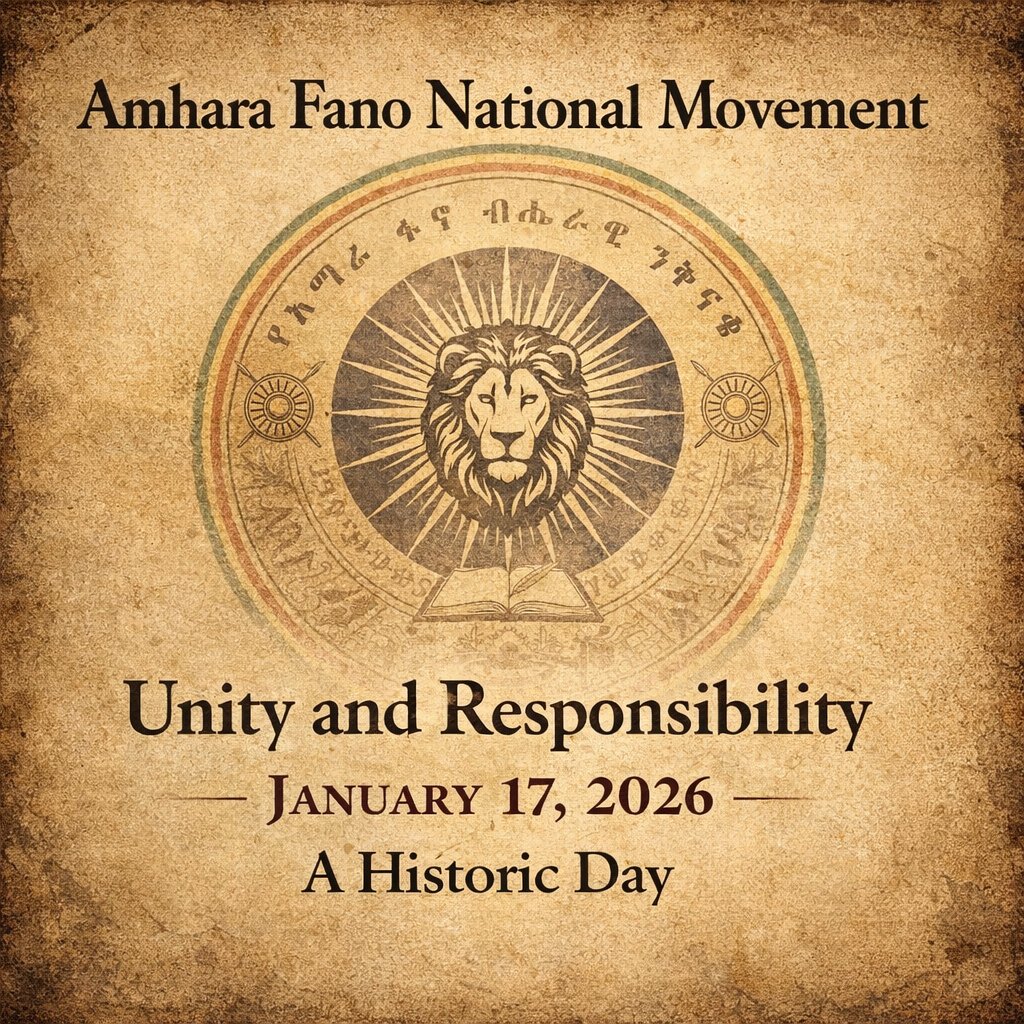
January 17, 2026
January 17, 2026 marks a consequential moment in Ethiopia’s contemporary history. On this day, the two principal Amhara Fano factions formally came together and established a unified organization, the Amhara Fano National Movement. This convergence followed years of fragmentation produced not by ideological division but by survival under sustained pressure. It represents a transition from dispersion toward coherence and signals the opening of a far more demanding historical phase in which unity carries responsibility rather than relief.
The current moment cannot be reduced to the last three or four years alone. The Amhara have long occupied a central role in the political history of the Horn of Africa, serving as the principal architects of state institutions, imperial administration, and collective defense across centuries. That foundational role made the Amhara an anchor of political order not only in Ethiopia but in the wider region, and one of the most consequential state-building populations in the history of sub-Saharan Africa. It also rendered them uniquely vulnerable when governance shifted from civic responsibility to ethnic exclusion. Persecution did not begin recently. It was institutionalized decades ago with the rise of the Tigray People’s Liberation Front, whose capture of the state after 1991 entrenched an ethnicized constitutional order that recast the Amhara from builders of the polity into structural outsiders within it. Federal boundaries, administrative authority, and political legitimacy were reorganized in ways that normalized marginalization, territorial dispossession, and demographic erosion.
The assumption of power by Abiy Ahmed Ali in 2018 did not reverse this trajectory. It has intensified it. Emerging from within the political architecture shaped by the TPLF, Abiy inherited and weaponized its constitutional logic while presenting himself as its reformist alternative. Under his rule, long-standing structural marginalization entered its most violent and explicit phase. Mass killings, drone strikes, forced displacement, and the erosion of all remaining protections transformed institutional exclusion into open physical annihilation. The most serious and bloody period of persecution unfolded after 2018, but it did so on foundations laid much earlier. The present crisis is best understood as the culmination of a prolonged political project rather than a sudden rupture.
Within this historical continuum, the emergence of Fano must be understood as defensive rather than insurgent. It arose not as a project of conquest or secession, but as a localized response to existential threat in a region defined by vast highland massifs, escarpments, rivers, and dense kinship networks that resist centralized command imposed from afar. Early fragmentation reflected the decentralized logic of survival rather than political incoherence. The formation of the Amhara Fano National Movement therefore marks a deliberate shift from necessity-driven dispersion toward strategic coherence, an effort to translate survival into collective purpose.
History offers little tolerance for unity that remains rhetorical. The period immediately following consolidation is often the most perilous, as expectations outpace institutional capacity and external pressure intensifies. Unity must therefore be matched by discipline, ethical clarity, and strategic patience. For a people whose historical role has been inseparable from the maintenance of political order in the Horn of Africa, responsibility does not end with resistance. It begins with the hard work of governance, restraint, and institutional credibility.
This moment now extends beyond Ethiopia’s borders. The single greatest source of instability and disorder in the Horn of Africa is no longer merely domestic fragmentation but the continued rule of Abiy Ahmed Ali, whose governance has increasingly functioned as a destabilizing node across the region. His regime has aligned itself as a proxy within broader external power contests, including deep entanglements with the United Arab Emirates, while simultaneously enabling and facilitating atrocities beyond Ethiopia’s borders, most notably through complicity in the genocide unfolding in Sudan. What presents itself as statecraft has in practice become the export of chaos, the normalization of violence, and the steady erosion of regional norms.
This destabilizing pattern is compounded by belligerent and reckless rhetoric directed at neighboring states, including Eritrea, whose decisive intervention was instrumental in preventing the collapse of his own regime, as well as Somalia, Kenya, and Djibouti, all of which have been subjected to expansionist language that revives irredentist anxieties rather than cooperative regionalism. Such conduct has transformed Ethiopia from a historical anchor of regional equilibrium into a source of persistent insecurity, antagonizing nearly every state in the Horn of Africa and substituting diplomacy with provocation. The cumulative effect is a region increasingly organized around containment rather than cooperation, a condition incompatible with peace, stability, or collective prosperity.
For this reason, the formation of the Amhara Fano National Movement carries significance not only for Ethiopians but for all peace-loving states, polities, and peoples of the Horn of Africa. Stability in the region cannot be achieved through accommodation of a regime that thrives on fragmentation and external sponsorship. It requires coordinated political, diplomatic, and moral collaboration with forces committed to restoring accountability, dismantling systems of proxy warfare, and ending a cycle in which civilian lives are treated as expendable instruments of rule. The responsibility borne by the Amhara today is therefore not parochial. It is regional in scope and historical in weight.
January 17, 2026 will be remembered not for the declaration itself, but for what followed. The formation of the Amhara Fano National Movement opens a chapter defined by coherence after attrition. The road ahead will be long, exacting, and costly. But for the first time in years, it begins with unity anchored in history rather than illusion. That alone makes this day historic.
@AfricanUnionUN@UN@AP@BBCAfrica
@breaking_bre Again, with a made-up story. No dates, no verified sources, no locations, just recycled photos and vague claims. በቃ propaganda machine ሆነህ አረፍከው። The reality on the ground is that your regime is crumbling by the minute, inflation is inflating, and people are dying.
@AbiyAhmedAli@EmmanuelMacron አንተ ቀልድ በዚች ምስኪን ሀገር። I feel so disgusted known that this beautiful country is represented by you and your goons. Ethiopia deserves better!!
@AbiyAhmedAli@KGeorgieva Your so-called economic reform has brought nothing but deep instability, rising food insecurity, and ongoing humanitarian crises. This is all documented by international agencies. Your incompetency is another level. ከየት ነው የበቀልከው መሀይም።
@breaking_bre@AbiyAhmedAli Nice words haha, but let’s be real, that’s standard diplomatic flattery. #Abiy’s actual record includes inflation, $$ shortages, conflict throughout 🇪🇹 , famine, and human rights abuse. Not exactly the ‘remarkable progress’ they’re selling in the photo-op. @anwaribrahim
@isaias_afwerki Because the foreign media refused to give him their questions in advance and refused to let him use a teleprompter…The dude is the most uneducated leader in #Africa. It still boggles my mind how he managed to get this far without being exposed.
@AbiyAhmedAli I am not sure if you’ll be around to watch it, though… people are revolting!! No government in the world survives when its own people revolt against it!! አንተ ህጻን። #AmharaGenocide#COP30
@breaking_bre ምነው ፈራቹሳ…Absolute nonsense.#Fano, #Shane, and #TPLF don’t even align ideologically, let alone sit together to talk. Pretending they’re teaming up is just paranoia… And if they ever wanted to meet, they wouldn’t need 🇪🇷&🇸🇩. Your government doesn’t even control most of 🇪🇹.
@HeranTigray Your illusory truth effect won’t work here. 👇 is the fact!! ሐሳዊት!!
In summary, amnesty found that hundreds of civilians were massacred in Mai Kadra on Nov 9 2020, mainly by Tigrayan youth and local forces linked to the TPLF.
https://t.co/R0tdov6fFi
@ProfBrookHailu What Ethiopia needs is people like you to not enable and embolden this genocidal government with this BS. You, of all the people, should know better.
@TheRealTigray@HeranTigray Your so-called western Tigray is up to Tekeze…Tekeze Milash!! It never bordered Sudan, and now it’s back to its rightful owner, namely Amhara. ሀላይሲ ሐንቲ ደርፉ። Your energy should be on PP, who’s ready to wipe the ሰሜናውያን። በተቀደደልህ ቦይ አትፍሰስ።
@breaking_bre Spare us the double standards. #Abiy has been arming militias, moving drones, and expanding forces nonstop. Pretending that only the TPLF is violating Pretoria is pure hypocrisy. Abiy should stop and think twice. Fano, TPLF, and Eritrea are coming for him in full force.
@breaking_bre Oh, that’s rich, the boy king telling others to stop destabilizing the region? That’s like the fox writing a memo to the chickens about security measures. ፈሳም በለው። Also, while you’re at it, tell him that he is irrelevant…
@rasDemi@sonofagazi How about, #Fano is using your so called Tour De Fools (TDF) to defeat PP and use you as a bridge to get weapons from Eritrea. ጉማማ…ወያል። Stop being pretentious…