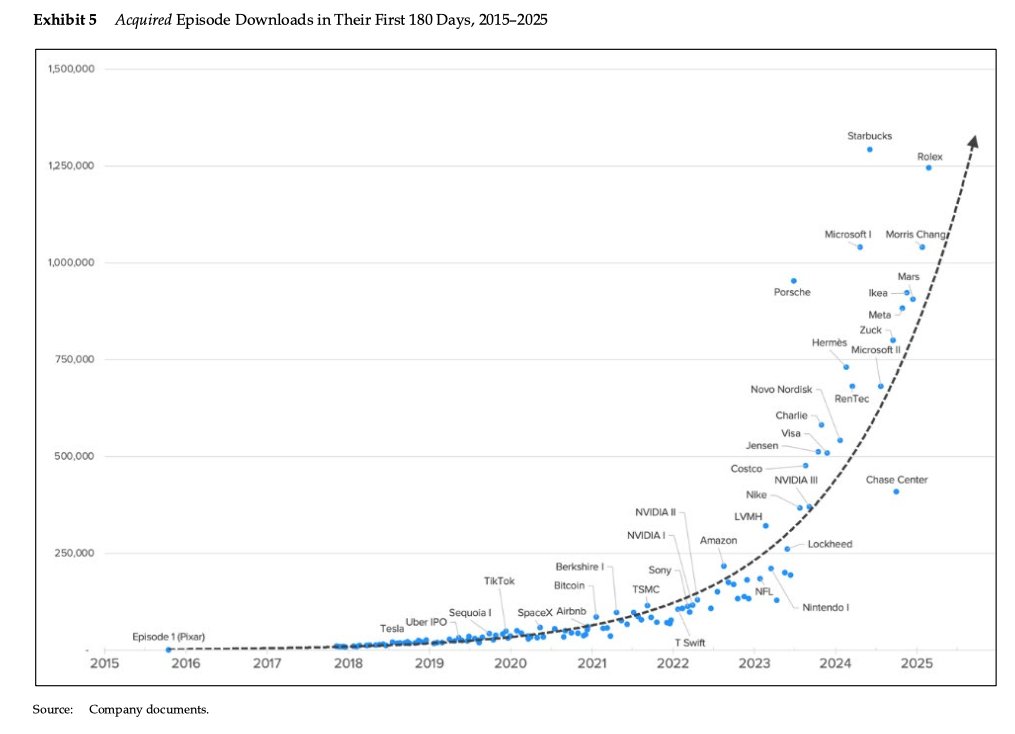
Pretty incredible to see how far @AcquiredFM has come, great read from @HarvardHBS
- 2021: $100k presenting sponsor, $40k mid-roll
- 2025: $1.5M presenting sponsor, $1M mid-roll
Absolutely wild growth, inspiring story @gilbert & @djrosent.
A number of people are talking about implications of AI to schools. I spoke about some of my thoughts to a school board earlier, some highlights:
1. You will never be able to detect the use of AI in homework. Full stop. All "detectors" of AI imo don't really work, can be defeated in various ways, and are in principle doomed to fail. You have to assume that any work done outside classroom has used AI.
2. Therefore, the majority of grading has to shift to in-class work (instead of at-home assignments), in settings where teachers can physically monitor students. The students remain motivated to learn how to solve problems without AI because they know they will be evaluated without it in class later.
3. We want students to be able to use AI, it is here to stay and it is extremely powerful, but we also don't want students to be naked in the world without it. Using the calculator as an example of a historically disruptive technology, school teaches you how to do all the basic math & arithmetic so that you can in principle do it by hand, even if calculators are pervasive and greatly speed up work in practical settings. In addition, you understand what it's doing for you, so should it give you a wrong answer (e.g. you mistyped "prompt"), you should be able to notice it, gut check it, verify it in some other way, etc. The verification ability is especially important in the case of AI, which is presently a lot more fallible in a great variety of ways compared to calculators.
4. A lot of the evaluation settings remain at teacher's discretion and involve a creative design space of no tools, cheatsheets, open book, provided AI responses, direct internet/AI access, etc.
TLDR the goal is that the students are proficient in the use of AI, but can also exist without it, and imo the only way to get there is to flip classes around and move the majority of testing to in class settings.
As it stands, levels of financial literacy among the general public have made scant progress in recent years. Having a better understanding of this field helps individuals make good decisions to build their wealth over time, it could also help create a larger pool of assets for advisors to manage.
Want to know more? Read more at https://t.co/kzawNCOr7s
We released gta San Andreas 20 years ago. October 26, 2004.
Game releases were different back then.
It took 6 weeks for the DVDs to be produced, boxed and distributed. Patches over the internet were not yet a thing.
For us, all of the stress had happened at the cut-off point, 6 weeks prior. No big issues had come up.
Most devs had taken a holiday and we were already thinking about our next project.
Digital distribution didn’t exist yet. Games were typically released on a Tuesday/Wednesday in the US and Fridays in the UK. Same for SA.
The internet was crap and apart from a couple of trailers, gamers didn’t know too much about the game.
For big games, stores would open at Midnight before release day so that pre-orders could be picked up.
I only later found out, the publisher has to pay the stores to make these late openings happen.
I went to the biggest store near the R*North offices, which was HMV on Princess Street, Edinburgh. Even though it was a drizzly night, the line meandered all through the store and spilled out onto the street.
It was mind-blowing to see all those people so excited, going home to play the game all through the night.
"I'm in a cheap hotel in California which doesn't have a good internet or phone connection. I was going to have an MRI scan today but I'll have to cancel that!"
- New physics laureate Geoffrey Hinton speaking at today’s press conference where his #NobelPrize was announced.