Môi trường bị ô nhiểm làm ảnh hưởng đến những động vật xung quanh, nhìn thấy cụ rùa bị mắc kẹt cổ trong vòng nhựa chắc đã lâu lắm rồi, tôi ước người ta có thể phát hiện sớm hơn để cắt vòng nhựa để cứu cụ rùa
Everybody keeps talking about “the next airdrop” like it’s a salary.
Meanwhile creators are out here posting 40-thread weeks, farming points, joining spaces at 2AM, refreshing dashboards, praying some protocol remembers them at TGE.
That whole system is cooked.
A friend of mine casually showed me their payouts from @RallyOnChain and I genuinely thought they were trolling.
Stablecoins.
Already paid.
For posting content.
No cliff.
No vesting chart.
No fake engagement quests.
No “stay active for future rewards” nonsense.
Just actual money landing while the rest of the timeline is still grinding for screenshots and promises.
And the craziest part?
The people winning on Rally aren’t always the biggest accounts. The platform actually rewards content quality instead of worshipping follower counts like every other broken creator system in Web3.
That hit me hard.
Because how many cycles have creators wasted posting into the void hoping an allocation someday makes the grind worth it?
While Rally is literally paying people right now.
New campaigns keep dropping.
Creators are stacking stables.
And most of CT still has no idea this is happening.
Feels like we’re watching the beginning of a massive shift in real time and people are going to pretend it was “obvious” later.
It isn’t obvious now.
That’s why the opportunity still exists.
Most people think finance scales because it is efficient.
In reality, it scales because institutions have spent decades building procedures to manage inefficiency.
The global system clears enormous volumes every day: cross-border payments, FX transactions, securities settlement, treasury flows, collateral transfers. Yet much of that activity still depends on fragmented ledgers, delayed messaging, reconciliation teams, and capital parked in the wrong places at the wrong time.
Traditional finance works. But it works with friction.
Take correspondent banking. Funds are often pre-positioned across networks of nostro and vostro accounts so payments can settle internationally. That model preserves trust across jurisdictions, but it also ties up liquidity that could otherwise be deployed productively. The Bank for International Settlements has repeatedly highlighted how cross-border payments remain costly, slow, and operationally complex.
This is the core misunderstanding around modernizing finance:
the problem is not transaction demand. The problem is coordination architecture.
When systems cannot share a synchronized source of truth, they compensate with buffers:
Extra capital
Extra intermediaries
Extra time
Extra controls
Extra reconciliation layers
Those buffers are expensive.
Moving finance onchain changes the operating model because verification becomes native infrastructure rather than an after-the-fact process.
Instead of multiple institutions maintaining separate records and reconciling differences later, counterparties can transact against shared state with deterministic settlement logic. Instead of messaging first and finality later, execution and settlement can become part of the same process. Instead of trapped liquidity across fragmented rails, capital can move through programmable systems with greater precision.
But institutions cannot simply migrate sensitive financial activity onto open public blockchains as they exist today.
Banks, asset managers, and payment firms need three things simultaneously:
Privacy: transaction data, positions, and client activity cannot be broadly exposed.
Control: execution environments must satisfy policy, governance, and compliance requirements.
Verifiability: counterparties need assurance without depending solely on bilateral trust.
Most systems offer only parts of this triangle.
That is where Prividium becomes relevant.
Prividium, built within the @zksync ecosystem, is designed around a more realistic institutional requirement set: private execution environments combined with cryptographic verifiability, while retaining connectivity to broader liquidity and settlement infrastructure through Ethereum.
This matters because privacy without interoperability becomes another silo.
Public composability without confidentiality is unusable for many regulated flows.
Trusted private databases without independent proof recreate legacy dependency models.
Zero-knowledge systems introduce a different path: prove that rules were followed without exposing the underlying sensitive data.
That is not a cosmetic improvement. It is a structural one.
It means compliance processes can be embedded into execution logic.
It means counterparties can verify outcomes mathematically.
It means settlement can inherit the security and neutrality of Ethereum while operational workflows remain fit for institutional use.
The opportunity is therefore larger than “crypto adoption.”
It is the re-engineering of financial plumbing:
Lower idle capital requirements
Faster settlement cycles
Reduced reconciliation overhead
More direct market coordination
Stronger auditability with less disclosure
Finance has historically scaled by adding layers around mistrust.
Onchain finance can scale by reducing the need for those layers.
That is why the migration matters. And that is why infrastructure like Prividium may matter more than any single application built on top of it.
Liquidity in DeFi has always been fast money.
Hot pools, high APR, zero loyalty.
Lowkey… that model was never built to last.
A veDEX changes the rules by forcing one thing the space usually avoids: commitment.
Instead of just farming and dumping, you lock tokens into a vote escrow system, receive veTokens like veMARB, and actively decide where emissions go.
No passive yield here. If you want upside, you help shape it.
That is why MarbMarket’s upcoming fair launch on MegaETH actually matters.
No presale.
No VC allocations.
No early advantage games.
Just a clean start where liquidity, governance, and incentives form in real time with the community.
https://t.co/Bj00JePBzO
Here is the structure in plain English:
• Vote escrow (veMARB)
Lock MARB, gain voting power, direct emissions
Longer commitment means stronger influence and better positioning
• LP farming, but directed
Provide liquidity, earn fees
But emissions are not random, they follow votes
• Bribes
Protocols compete for your attention by rewarding your votes
Your governance power becomes a yield layer on its own
So instead of chasing yield, you position yourself where yield is going next
Now the interesting part, the MARB flywheel ve(3,3)
Think of it like a loop:
Liquidity comes in → fees are generated
Fees and incentives attract voters
Voters lock MARB → gain veMARB → direct emissions
Protocols offer bribes to capture those votes
More rewards lead to more locking
More locking strengthens control over emissions
Which attracts even more liquidity
And the cycle keeps reinforcing itself
What stands out to me is the shift in mindset
This is not about finding the highest APR today
It is about understanding where you sit in the system over time
MarbMarket feels less like a farm
and more like a coordination game where positioning matters
So real question
Are you still rotating farms
or are you starting to play the meta
Early positioning in DeFi usually comes with a catch. Insider rounds, private allocations, and capital advantages that most users never see. MarbMarket is choosing a different path.
With MarbMarket’s fair launch, there is **no presale and no VC backing**. No discounted entries for a select few. No hidden wallets waiting to influence governance later. From the first block, access is open and participation is earned, not reserved.
For those active in liquidity provision and yield strategies, this changes the dynamic entirely. A fair launch means the distribution starts with the community, not after it. Liquidity providers are not just supporting the system, they are shaping it from the ground up. Governance is not an afterthought, it is native to the participants who actually show up.
Traditional VC-backed models often introduce misalignment. Early capital gets priority, and the broader community enters later with less influence and less upside in terms of control. MarbMarket flips that structure by removing the layers between users and opportunity. The result is a cleaner, more transparent environment where contribution matters more than connections.
If you understand how important early liquidity, emissions, and governance power can be, then you already see the difference. This is about being present at the moment value begins to circulate, not after it has been segmented.
Join the community and follow the build: https://t.co/XVeWNdYYph
https://t.co/2BxmrC2bJg
Didn’t expect to get pulled into another waitlist, but Fragments and BTC-Jr made it interesting enough to click.
From what I’ve seen, BTC-Jr is trying to rethink Bitcoin exposure in a more flexible, composable way, not just the usual buy and hold mindset. Fragments looks like it’s building the layer that makes all of that possible, and honestly it feels pretty well thought out.
So yeah, I signed up 👉 https://t.co/bFntdDYssm
Also, quick heads up. During April, they’re running a giveaway where 10 random waitlist signups get $200 each, $2,000 total. Not huge, but definitely a nice surprise if it hits.
If you’re even slightly curious, might be worth a look.
And probably a good move to follow @FragmentsOrg too, feels like one of those early communities where being active could actually pay off later.
Anyway, just sharing what caught my attention today.
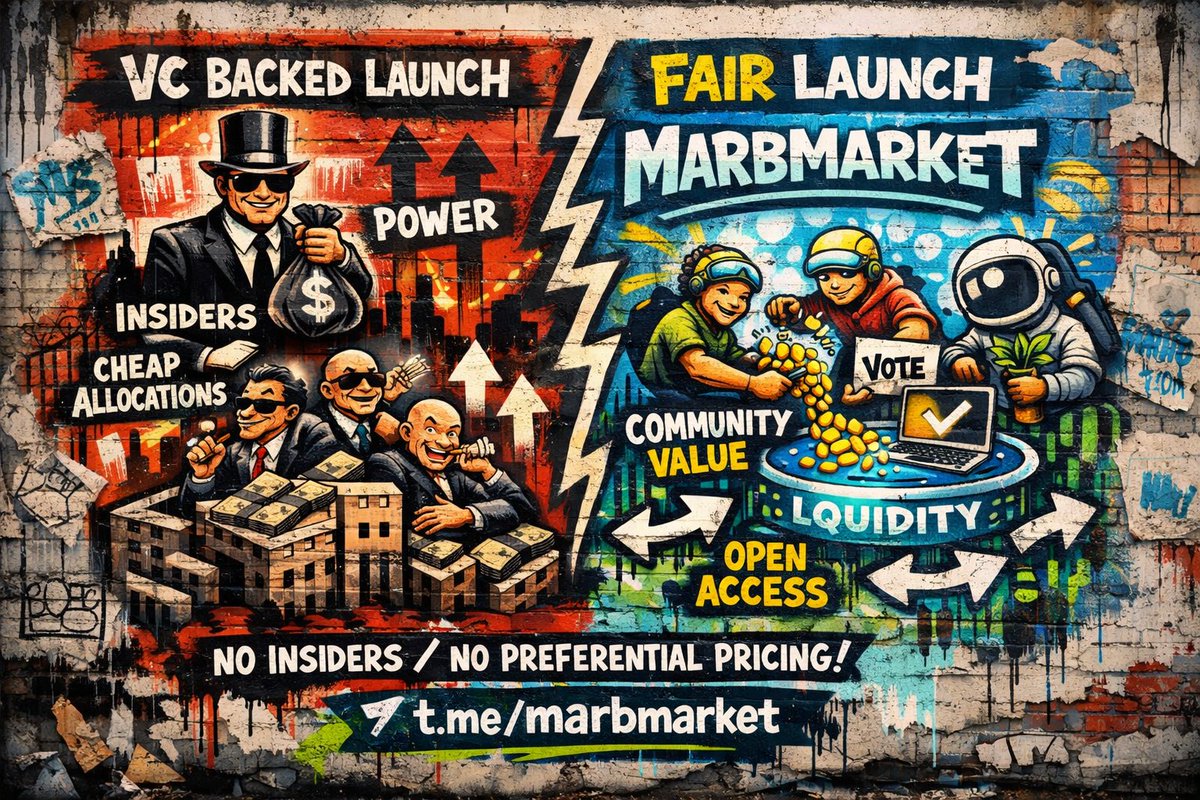
Traditional VC-backed launches often concentrate power early with cheap allocations and asymmetric upside. MarbMarket takes a different route.
With a fair launch, value flows to those who actively participate: providing liquidity, engaging in governance, and supporting the ecosystem. No insiders, no preferential pricing, only open market dynamics shaped by the community.
👉 https://t.co/2BxmrC2bJg
Just joined the waitlist for BTC-Jr on @FragmentsOrg, partly curiosity, partly FOMO, partly “this might actually be interesting??”
From what I understand, Fragments is trying to make BTC exposure more flexible and easier to interact with, with BTC-Jr as one of the entry points. It is not trying to replace Bitcoin, just making it more usable in everyday ways, which honestly feels overdue.
Keeping expectations grounded, but the idea is clean and the overall vibe feels surprisingly genuine.
Also, small perk, they are running an April giveaway. 10 random people from the waitlist get $200 each, $2,000 total. Not life changing, but definitely not nothing.
If you are even a bit curious:
👉 https://t.co/R6FIxi68fu
Anyway, I am in. Following @FragmentsOrg to see how this plays out, and probably lurking in the community too. That is usually where the real alpha or chaos shows up.
Spent last night actually using @grvt_io instead of just clicking around for a minute, and something surprised me
I didn’t feel the need to double check myself
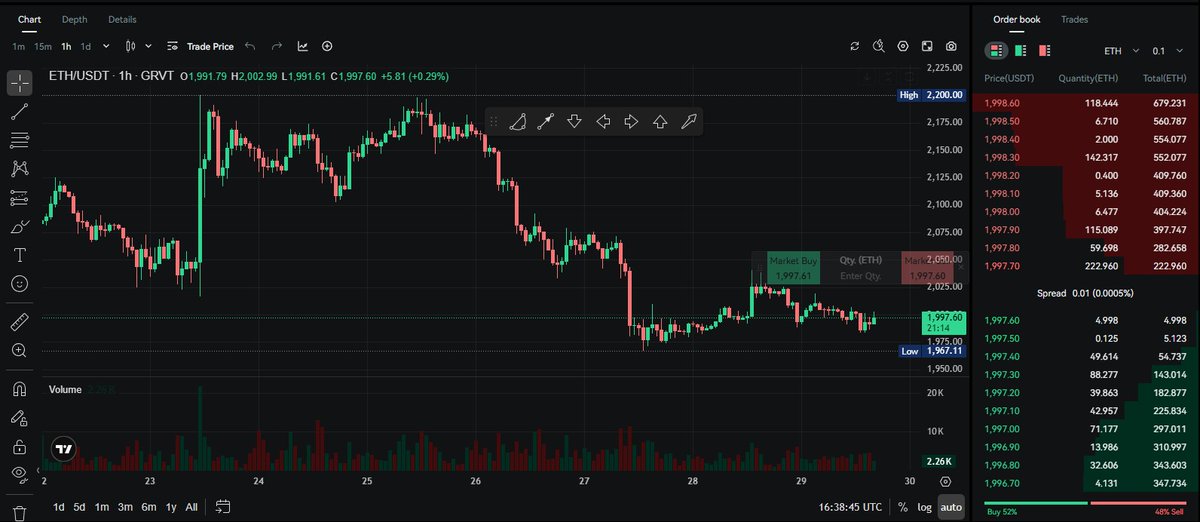
Usually when I try a new trading app, I slow down a lot. I re-read buttons, I hesitate before placing anything. But here, I caught myself just… acting. Deposited, opened a position, checked it in Portfolio without breaking focus
The part that really stuck with me is how the order panel behaves while trading. It updates fast enough that I never felt out of sync with the market, which is where most apps lose me
At one point I switched from checking my balance to adjusting a trade, and it didn’t feel like I “left” anything behind. Everything stayed connected in my head, which is rare
Dropped a screenshot below from one of those moments
It’s not trying to impress you loudly, but after using it for a bit, it just feels natural to stay longer than you planned
Season 2 of @grvt_io introduces a +6% additional community allocation, while all existing points remain fully protected.
From a strategic perspective, this update directly addresses dilution concerns for point earners. With a larger allocation pool, the value per point is better maintained, preventing rewards from being diluted as more participants join. At the same time, safeguarding existing points ensures that early and consistent farming efforts continue to hold real value.
This combination of increased allocation and point protection reflects a thoughtful growth approach. It supports ecosystem expansion without compromising the interests of current participants, reinforcing stronger long-term incentive alignment.
@dimqtdl@grvt_io The resilience here is notable. Even when attention shifts elsewhere, maintaining upward trends suggests a platform with real staying power.
Right now while most of the market feels quiet @grvt_io is still pushing forward with real momentum
TVL has already crossed 100M and cumulative perpetual volume is above 200B which is not something you see from a platform that is slowing down
What stands out to me is how trading volume and open interest keep rising in a steady way not just random spikes but consistent growth that usually signals real users staying active
In a space where attention disappears quickly this kind of traction matters Grvt is not just moving it is steadily gaining ground while others slow down
@Karyn_web3@grvt_io The combination of increased allocation and point protection creates a stronger psychological incentive to keep participating rather than waiting on the sidelines.
A recent update from @grvt_io introduces meaningful improvements that farmers and point holders should pay close attention to.
The introduction of a +6% additional community allocation is a strong signal that the team is actively addressing one of the biggest concerns among point earners: dilution. By expanding the allocation pool, the relative value of each point is better preserved, which ultimately supports fairer distribution outcomes.
Equally important is the confirmation that existing points remain protected. This reinforces trust. For those who have been consistently farming, engaging, and contributing over time, it ensures that prior effort is not devalued or reset. Continuity matters, especially in systems where participation compounds over time.
From my perspective, these two updates work together:
The increased allocation helps maintain a healthier token per point ratio
Protected points safeguard early and consistent contributors
Overall, it creates a more balanced and sustainable reward structure
For farmers and point holders, this is not just a minor adjustment. It is a reassurance that participation today still carries weight tomorrow.
Curious to see how this shapes behavior going into Season 2.
@Karyn_web3@arguedotfun It’s interesting to think about how incentives shape conversations. If people benefit from being right, maybe we’ll see fewer low-effort takes and more thoughtful contributions.
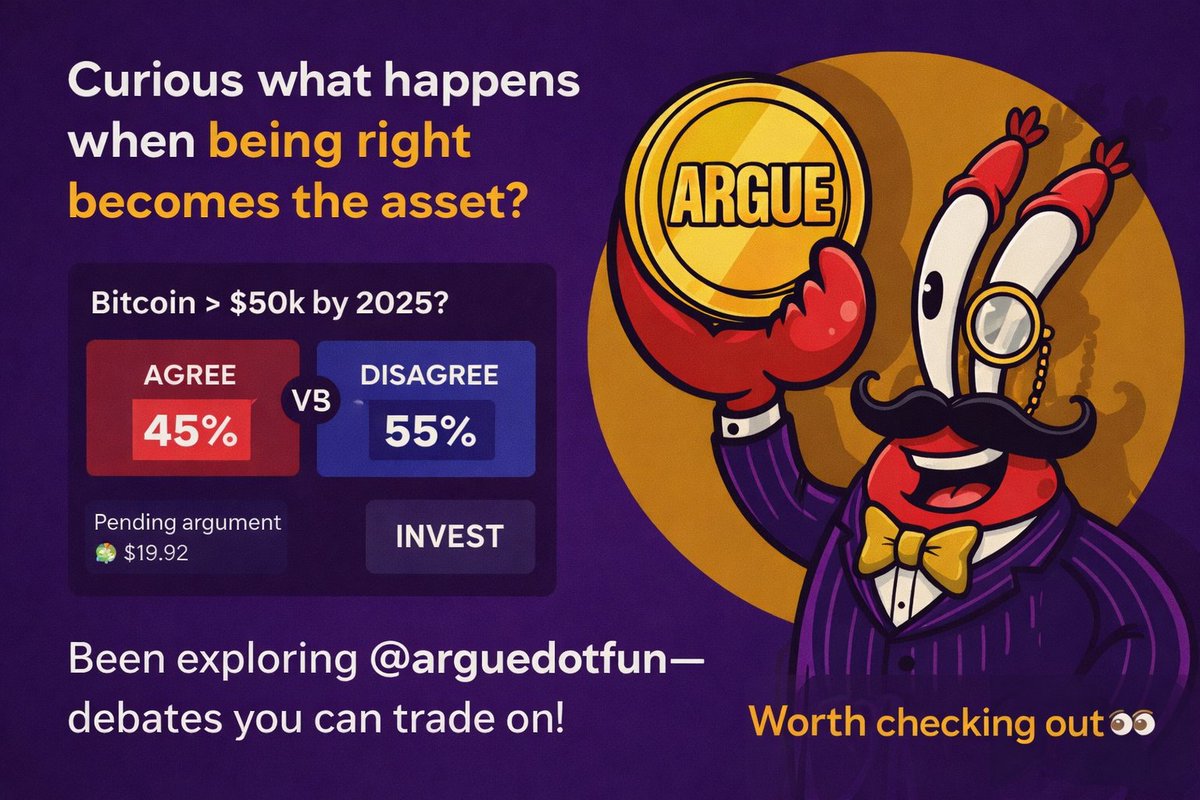
Curious what happens when being right becomes the asset?
Been exploring @arguedotfun where debates aren’t just noise, they turn into something you can actually take a position on. It’s a fresh take on how ideas compete, and it might change the way we think about arguments online.
Worth checking out
@0xlovelive The interoperability aspect is key. Institutions are not locked into a closed system but remain connected to Ethereum’s liquidity, applications, and broader network effects.
“The Bank Stack of Ethereum” emerges where privacy meets shared security.
With Prividium, institutions can build private, permissioned infrastructure tailored to their regulatory and operational needs. Transactions can remain confidential, governance can stay internal, and yet the system is not cut off from the broader ecosystem.
Instead of settling in isolation, state updates from these environments are proven and anchored to @Ethereum. This anchoring provides a neutral settlement layer and cryptographic finality while sensitive institutional data remains private.
Through the ZK Stack, these infrastructures stay interoperable with the wider @zksync network. That connection allows institutions to access Ethereum liquidity, applications, and settlement coordination without sacrificing privacy or operational control.
This structure is fundamentally different from isolated private chains or alternative L1s. Security and settlement are inherited from Ethereum, and liquidity remains connected rather than fragmented.
In this sense, @zksync does not attempt to replace @Ethereum. It extends Ethereum’s architecture to support institutional systems, forming what can be described as The Bank Stack of Ethereum.
@Wendy_WendyU@arguedotfun This could become the training ground for serious AI agents. If your agent can consistently win arguments with money at stake, that’s a strong signal that its reasoning is actually valuable.