Très heureux et très fier de voir Scaena lancé aujourd’hui ...
Beaucoup de travail, d’énergie et de conviction derrière cette étape !
Si vous voulez découvrir le produit, demander une démo ou tester l’application gratuitement et sans engagement : https://t.co/EL8PSJSF59
https://t.co/fzAmplN0Uu
To celebrate 20 years of Symfony, I've crunched a bunch of numbers and share some memories of Symfony development since the 2.0 release in 2011.
Microservices is the software industry’s most successful confidence scam. It convinces small teams that they are “thinking big” while systematically destroying their ability to move at all. It flatters ambition by weaponizing insecurity: if you’re not running a constellation of services, are you even a real company? Never mind that this architecture was invented to cope with organizational dysfunction at planetary scale. Now it’s being prescribed to teams that still share a Slack channel and a lunch table.
Small teams run on shared context. That is their superpower. Everyone can reason end-to-end. Everyone can change anything. Microservices vaporize that advantage on contact. They replace shared understanding with distributed ignorance. No one owns the whole anymore. Everyone owns a shard. The system becomes something that merely happens to the team, rather than something the team actively understands. This isn’t sophistication. It’s abdication.
Then comes the operational farce. Each service demands its own pipeline, secrets, alerts, metrics, dashboards, permissions, backups, and rituals of appeasement. You don’t “deploy” anymore—you synchronize a fleet. One bug now requires a multi-service autopsy. A feature release becomes a coordination exercise across artificial borders you invented for no reason. You didn’t simplify your system. You shattered it and called the debris “architecture.”
Microservices also lock incompetence in amber. You are forced to define APIs before you understand your own business. Guesses become contracts. Bad ideas become permanent dependencies. Every early mistake metastasizes through the network. In a monolith, wrong thinking is corrected with a refactor. In microservices, wrong thinking becomes infrastructure. You don’t just regret it—you host it, version it, and monitor it.
The claim that monoliths don’t scale is one of the dumbest lies in modern engineering folklore. What doesn’t scale is chaos. What doesn’t scale is process cosplay. What doesn’t scale is pretending you’re Netflix while shipping a glorified CRUD app. Monoliths scale just fine when teams have discipline, tests, and restraint. But restraint isn’t fashionable, and boring doesn’t make conference talks.
Microservices for small teams is not a technical mistake—it is a philosophical failure. It announces, loudly, that the team does not trust itself to understand its own system. It replaces accountability with protocol and momentum with middleware. You don’t get “future proofing.” You get permanent drag. And by the time you finally earn the scale that might justify this circus, your speed, your clarity, and your product instincts will already be gone.
If you're using EasyAdmin in the backends of your Symfony apps, upgrade to the latest version to get the new pretty URLs feature:
https://t.co/pd47qMhTvS #symfony#php
🧟 FrankenPHP 1.2.5 is now available!
This version once again significantly improves performance (~20% improvement since 1.2.4). We've also published a detailed performance guide to get the most out of your favorite monster (in English and French).
https://t.co/Muz4SSI4Ly
C'est faux.
Ce sont deux jobs différents.
Parler d'argent c'est bien, parlons des milliers de personnes qui galèrent déjà à trouver leur premier job en tant que dev, et qui auront encore moins de chance en tentant le freelancing.
Parlons des benefits d'un salarié.
👇
Laravel is becoming the new Wordpress of PHP
Extremely large user base, turnkey solutions for a variety of problems, detached from the rest of PHP communities, socials flooded with basic tutorials for everything, good to start and then with $$$ will be migrated to something else
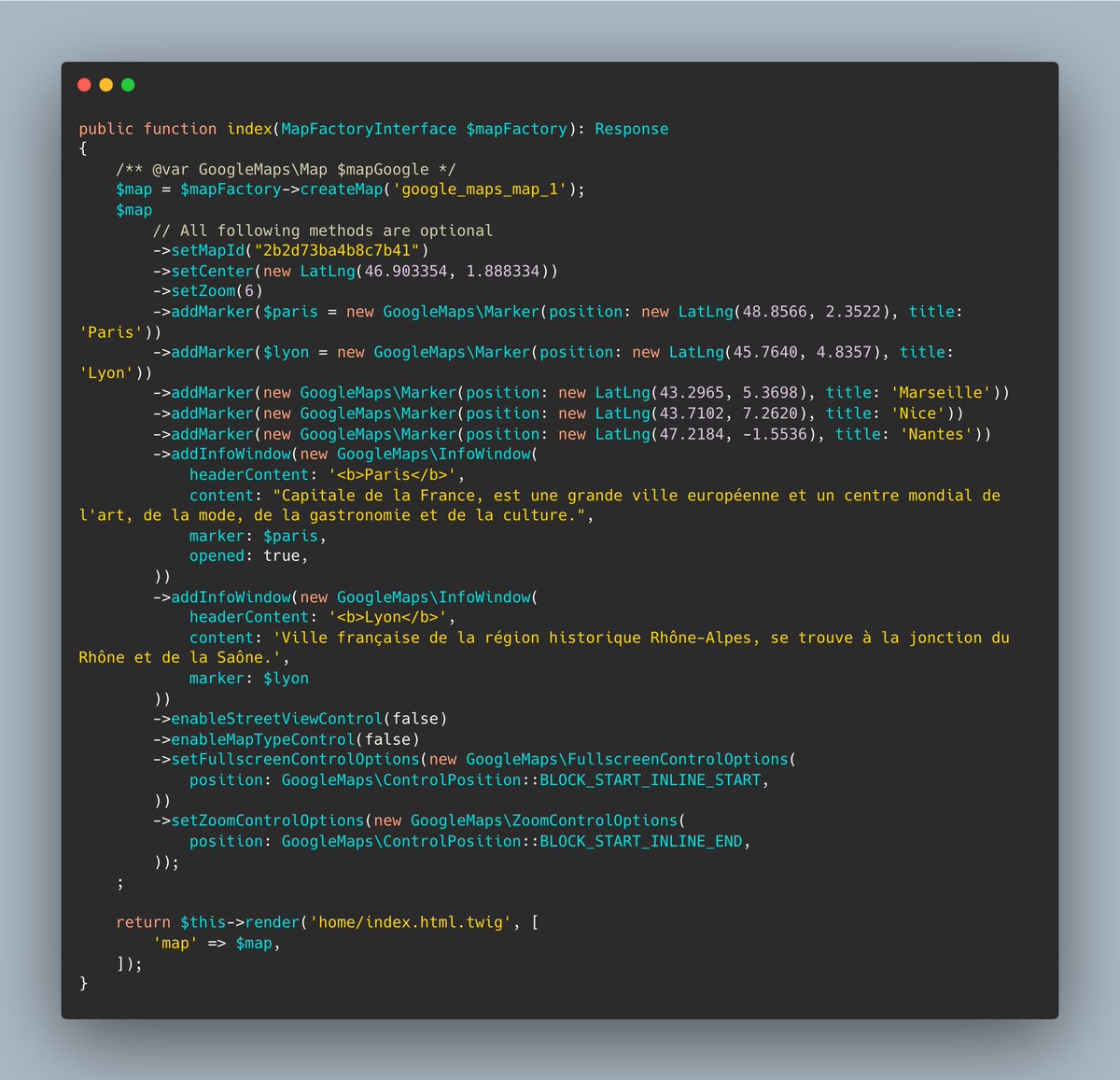
Finally! Introducing a new component for Symfony UX: "Map"
It makes it easy to create, customize and use interactive JavaScript maps, and supports Google Maps and Leaflet for the moment.
Code reviews are welcome :)
➡️ https://t.co/jJupQ6O5ss
cc @SymfonyUX
Il y a tout juste un an, je me lançais un défi audacieux : développer, seul, la meilleure application de tourisme au monde (rien que ça) avec des moyens limités, pour me remettre dans les conditions de mes débuts avec CommentCaMarche il y a 25 ans... 1/12
Un nouvel outil est disponible pour les développeurs Symfony et nous l'avons très vite adopté, il s'agit du DbToolsBundle de @makina_corpus !
Aujourd'hui sur le blog, @welcoMattic vous montre comment travailler avec une copie de la BDD de production !
➡️ https://t.co/EMMysHf2Av
@Swile_Help_FR je n’arrive plus à passer commande avec ma carte Swile sur le site Internet de @BurgerKingFR alors que ça fonctionne en restaurant. Une idée du problème ?
I didn’t know this kind of speed was possible in PHP. The author starts off with an execution time of 25 minutes to handle one billion rows and then shows us how he got it down to 27 seconds. Absolutely remarkable.
https://t.co/IVidY3L4nw
1/ Comment fonctionne un LLM ? ⚙️
Un LLM c'est avant tout un *réseau de neurone*, à qui il va falloir fournir des paramètres.
Ceux-ci sont calculés à partir d'un *corpus* de texte :
- des pages web
- des documents
- des livres
- ...
Et du code pour interagir avec.
The solution is simple. Don’t mock what you don’t own. Introduce your own interface and mock its behaviour. Write a contract test for the implementation of the interface. The contract test should actually call the API and at least confirm mocks’ assumptions.
@weaverryan I migrated a home made admin backend from Encore to AssetMapper last week. The best part was when I installed StimulusBundle and removed the weird bootstrap.js file 🙂