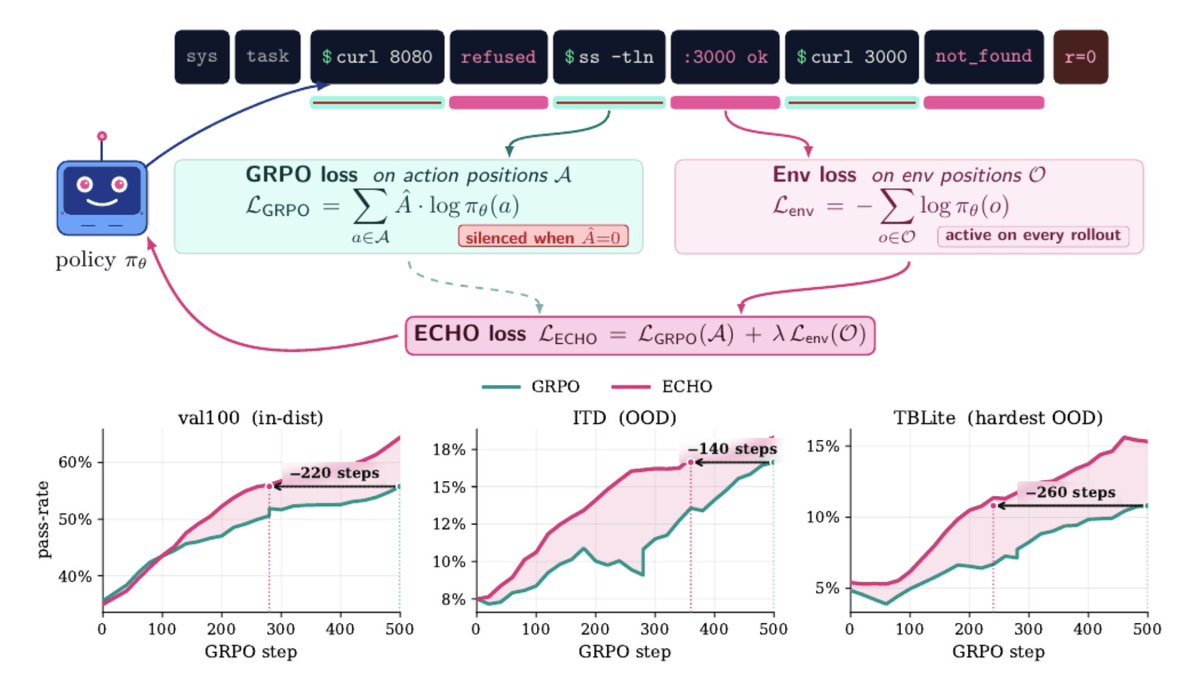
Very rarely you stumble on a method that's simple, obvious in hindsight, free, and touches on every problem you care about: CLI agents, continual learning, self-improvement, world models.
ECHO is one of those
The co-inventor of Looped Transformers defended her PhD thesis yesterday and is heading to an incredible new role soon :) congratulations @AngelikiGiannou 🥳 🎉🎈
Why I got back into research a decade ago: I read the 2015 “neural nets = spin glasses” paper by @ylecun, "The Loss Surfaces of Multilayer Networks". 𝐓𝐡𝐢𝐬 𝐢𝐬 𝐭𝐡𝐞 𝐰𝐨𝐫𝐬𝐭 𝐀𝐈 𝐭𝐡𝐞𝐨𝐫𝐲 𝐩𝐚𝐩𝐞𝐫 𝐢𝐧 𝐡𝐢𝐬𝐭𝐨𝐫𝐲.
It’s bad enough to not properly cite @SchmidhuberAI ; JEPA might actually be useful.
This work has misled the field for a decade.
Back in 2015, I was having coffee with my late PhD advisor Karl Freed (postdoc with Sam Edwards, who invented spin glasses!) while he was visiting SF. Karl was advising John Jumper at the time, who, less than 10 years later, won the Nobel Prize for AlphaFold in 2024.
We were discussing John's thesis work, and some of the early, overly simplistic generalized spin glass models of protein folding.
Karl remarked to me how Edwards was actually disappointed that no one followed his other work, and that so many people used spin-glasses in totally inappropriate ways. And that’s putting it kindly.
So what’s so bad about this 2015 spin-glass paper by LeCun ?
The paper naively modeled a toy feedforward net as a Gaussian spin glass. Specifically, a Gaussian p-spin spherical spin glass Hamiltonian (via the CLT on randomized , etc.). They just assumed independence + uniformity + redundancy, then forced the loss to look like what felt like a good story.
But it never checked the core assumptions. And anyone who actually knows start mech also knows that there are a wide range of spin glass models. Small changes in the disorder distribution (Gaussian vs heavy-tailed Lévy couplings) completely alter the landscape, critical points, and minima structure.
Importantly, strongly correlated systems can live in a completely different universality class from random Gaussian objects! This is elementary disordered systems physics (Bouchaud, Galluccio et al., late 90s).
The paper skipped that homework entirely. It told a good story. But it was more politics than science.
It’s one thing to be a misinformed idiot (his words, not mine)....It’s far worse to slap your name on a paper outside your depth, promote it as serious theory, and make the whole field dumber.
I guess I should thank @ylecun. Back then, I was a scientific advisor to Larry Page’s family and had some free cycles.
I realized I could do better work than this in my spare time, and with no funding. Science self-corrects slowly.
Stay tuned while I explain the difference between @ylecun politicking and the actual theory behind why AI works.
Die Washington Post, sicherlich nicht der unkritischen Miliei-Verehrung verdächtig, zieht ein bemerkenswertes Zwischenfazit zu Mileis Kurs:
- Armutsquote gon 53% auf 28% gefallen. Durch echtes Wirtschaftswachstum von +4,4% im letzten Jahr.
- erster StaatsbudgetÜBERSCHUSS IN 123 Jahren
- Inflation von 200% auf 33% gesunken (und weiter fallend)
- Abschaffung von 14000 Gesetzen und Regulierungen, um die Freiheit des Markts wirken zu lassen.
Fazit: „Argentina’s rapid transformation from nearly a century of socialism to free market capitalism continues to prove the superiority of the latter. It is rare that we get to witness such a radical experiment in real time. It is no surprise, however, that it’s working.“
https://t.co/n6qOMQkCaJ
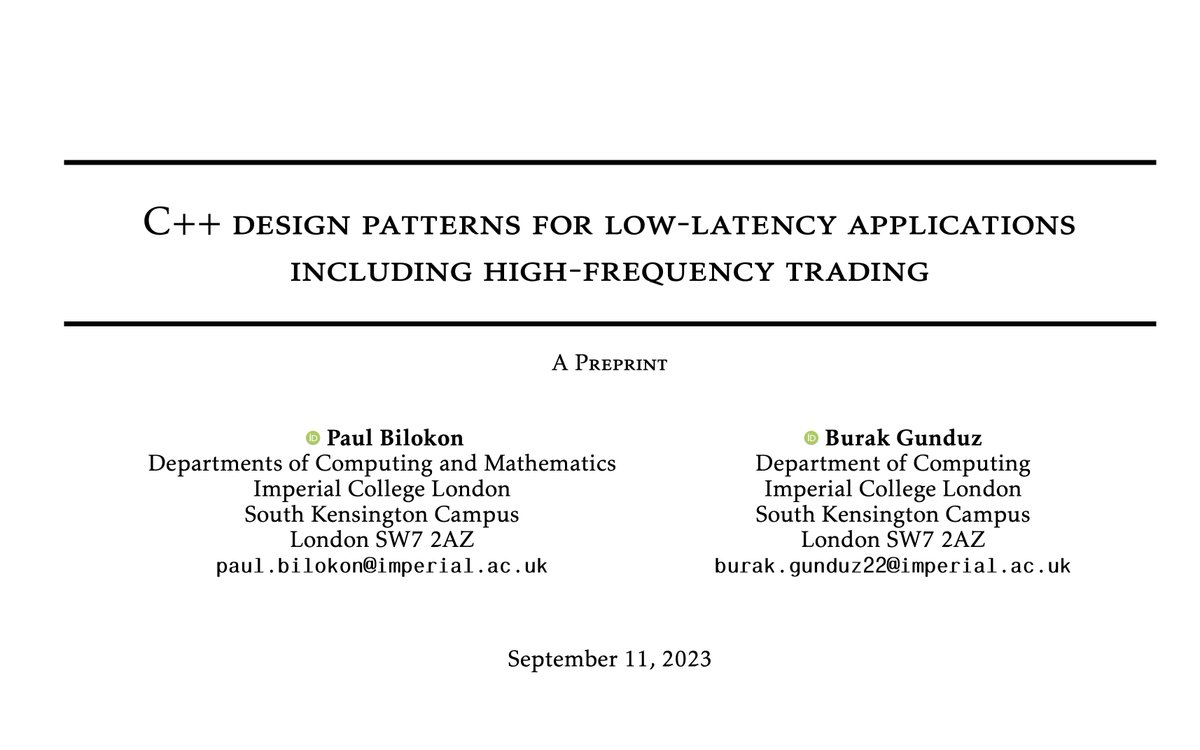
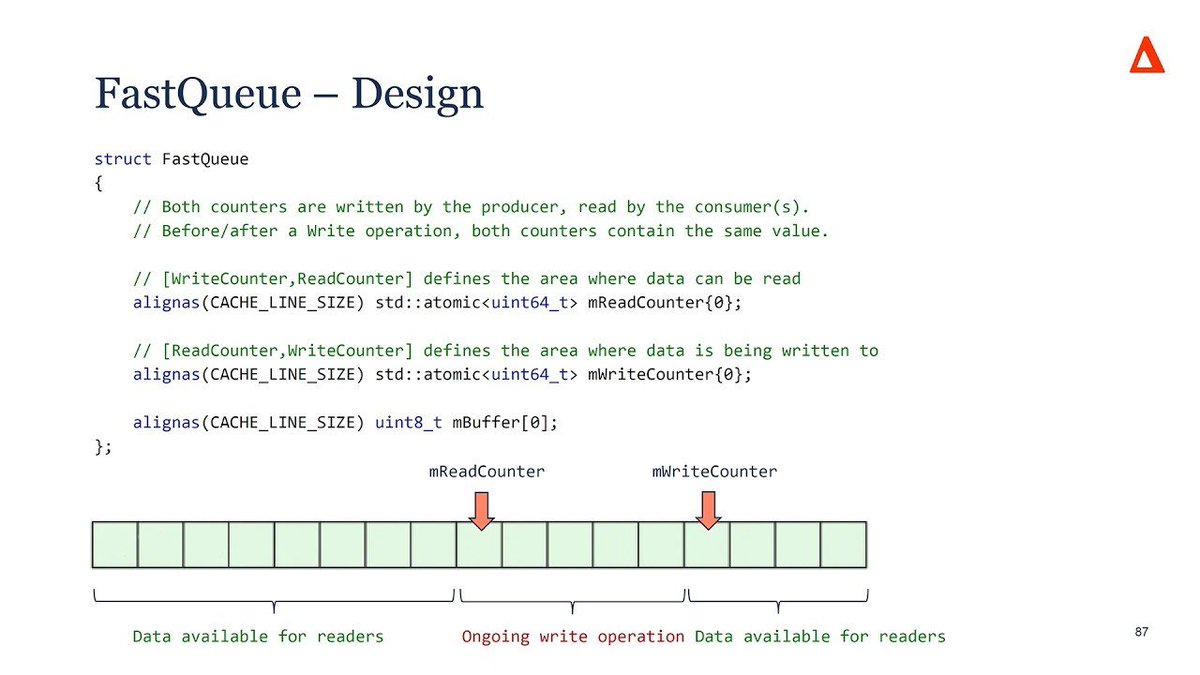
C++ design patterns for low-latency applications, including HFT.
Mostly perf optimizations familiar from advanced compilers/OS courses - still a good intro if you're trying to build intuition around performance.
https://t.co/vOpNKg6iCY
Ultrafast Trading Systems in C++ by David Gross
"While low-latency programming is sometimes seen under the umbrella of 'code optimization', the truth is that most of the work needed to achieve such latency is done upfront, at the design phase."
https://t.co/FYv8Iml9aM
Those who don't know, I was an NSF postdoc with @SchmidhuberAI PhD's advisor (Schulten) back in the 90s. 1 of 2 in the country. And my PhD groupmate recently won the Nobel prize for AlphaFold. So I have some qualifications here to say 𝐲𝐞𝐚𝐡 𝐭𝐡𝐢𝐬 𝐢𝐬 𝐩𝐫𝐞𝐭𝐭𝐲 𝐚𝐜𝐜𝐮𝐫𝐚𝐭𝐞.
The core learning principle behind JEPA is predicting one representation from another in latent space. And this was already explicitly formulated in the early 1990s PMAX work. PMAX does not merely hint at this idea; it sets up the same structure: two related inputs are encoded, and a predictor learns to map one latent representation to the other, while the encoder is trained to make this prediction possible without collapsing the representation.
That is exactly the defining mechanism of JEPA. When you strip away modern terminology and architectures, both are instances of the same objective: learn representations by maximizing cross-view predictability under constraints that preserve information.
What JEPA adds is not a new theoretical framework. It's just larger models, better architectures, and scaling. Of course, we could not do that in the 90s.
In that sense, Jürgen Schmidhuber made the real and original conceptual breakthrough: non-generative, latent-to-latent predictive learning
This is typical of @ylecun 's work; it's mostly derivative of others' ideas, scaled up and promoted. In contrast, @SchmidhuberAI really did pioneer a lot of these ideas. The JEPA work should have cited him.
Politics >> Integrity.
Oleksandr Yakovenko, the founder of TAF Industries, one of Ukraine's largest drone makers wrote a good response to @RheinmetallAG's Papperger's irritating statement. I used AI to translate it for you. It is worth reading in full.
"Dear Mr. Armin Papperger, CEO of Rheinmetall,
When you called Ukrainian drone manufacturers “Ukrainian housewives with 3D printers in their kitchens,” you demonstrated how deeply the European defense establishment still fails to understand the nature of modern warfare.
This is not about emоtions. This is about battlefield reality.
Here are the figures your industry refuses to acknowledge:
In 2025 alone, Ukrainian drones carried out 819,737 confirmed strikes. They accounted for 90% of all combat losses of the Russian army—more than all other types of weapons combined.
A single company, TAF Industries, produces up to 100,000 FPV drones per month. Over any given 90-day period, the products of my company alone have more confirmed hits than your entire fleet of equipment over its entire history of combat use across all conflicts. And most importantly—I built this company and achieved these results in two years, not fifty. Think about that.
Our drones achieve greater kinetic effect in three months than your flagship platforms have in half a century.
Why? Because the battlefield has changed, while your business model has not.
Russian electronic warfare has rendered GPS-guided Western munitions (Excalibur, GMLRS, etc.) almost ineffective.
Expensive and complex systems designed for wars with air superiority and conventional “peer-on-peer” conflict have become easy targets for drones costing $500–2,000 that attack them from above.
The cost-effectiveness ratio has been turned upside down: one 120mm Rheinmetall shell or one anti-tank missile costs more than a dozen of our drones—yet our drones still prevail.
This is not a “Lego game.” This is industrial Darwinism in real time. We iterate weekly. We lose factories to missile strikes and rebuild them within weeks. We print parts in basements and deploy 100,000 strike systems per month, while your engineers still require 3–5 years and hundreds of millions of euros to certify even minor upgrades.
The war in Ukraine is not a temporary anomaly. It is the first true drone-industrial war. And it has already proven that outdated European platforms—no matter how expensive or “serious”—are becoming increasingly irrelevant if they do not integrate the very technologies you are mocking.
So when you say “this is not innovation,” I hear something else: “We do not want to admit that the future is being written in Ukrainian workshops, not in Düsseldorf offices.”
The hashtag #MadeByHousewives is trending for a reason. Because these “housewives” destroy more enemy equipment every month than entire European armies do over full campaigns. And they do so while your industry continues to sell 20th-century solutions at 21st-century prices.
The invitation stands, Mr. Papperger. Stop laughing at the kitchen table. Come and learn how the war of tomorrow is actually fought. Because the next time someone asks, “Who needs tanks in the age of drones?”, the answer may be simpler than you think:
Those who still believe in 1979 will lose to those who are building in 2026.
With respect (but with facts),
Oleksandr Yakovenko
Founder of TAF Industries
One of those “Ukrainian housewives”"
https://t.co/oZnXASQAYw