Now forthcoming in @JEEA_News - "Going Viral" (with @dyanagizawa, @brunocaprettini, @mcaesmann). We use ultra-granular data on local polling boths and marching routes to show that in 1932 Hamburg, people who saw a Nazi march *massively* swung to the party. Black line= march.
What if violence doesn’t just reduce participation — but changes who gets elected?
New evidence from post-unification Italy shows conflict reshaped political elites and long-run state-building. 👇🇮🇹
🔗 https://t.co/4ayRrV2WR9
Still 3 days to send your Expression of Interest for the PhD Program in Economics at the University of Bergamo. Deadline is Friday March 20. I am looking forward to reading research proposal
https://t.co/Egdyza6Xd0
Thinking about a PhD in Economics? The Department of Economics @UniBergamo offers 4-year scholarship, coursework + state-of-the-art research training in a young, dynamic research environment.
Expression of interest now open: https://t.co/Egdyza7v2y
Deadline: March 20, 2026
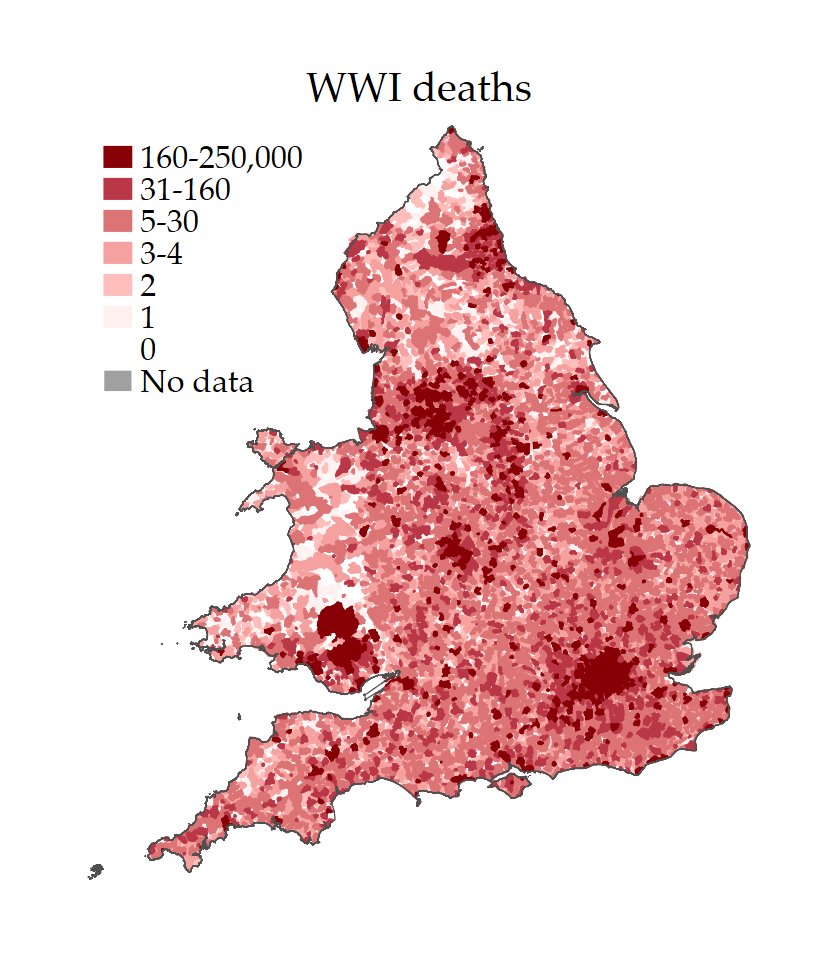
What are the effects of large human-capital shocks on innovation?
In a new paper, we study how WWI military deaths across British communities affected local invention over the next decades.
We find that places that lost more young men became persistently less innovative.
(🧵1/11)
Thinking about a PhD in Economics? The Department of Economics @UniBergamo offers 4-year scholarship, coursework + state-of-the-art research training in a young, dynamic research environment.
Expression of interest now open: https://t.co/Egdyza7v2y
Deadline: March 20, 2026
@cepr_org@UniBergamo In a RDD setting we show that early adoption of compulsory schooling in 1877 Italy had a significant impact on innovation and industrialization through an increase in human capital. Policy implication: earlier adoption and enforcement of CSL can affect economic growth patterns.
New CEPR Discussion Paper - DP20519
From Chalkboards to Steam Engines: Early Adoption of Compulsory Schooling, Innovation, and Industrialization
@fcinnio, Elona Harka @UniBergamo
https://t.co/Em2SvNhMhR
#CEPR_EH#EconTwitter
Our paper with @fcinnio@HornungErik “Flow of ideas: Economic societies and the rise of useful knowledge” is out in print @EJ_RES🚨
In this paper we investigate the importance of knowledge sharing societies from the 18th century on long-run innovation. Read on for more -->
Still 12 days to apply to the PhD program in Economics at the University of Bergamo. Join a young and dynamic faculty with different areas of expertise in a beautiful historical city in the Milan area.
Deadline June 16. Submit your application here: https://t.co/UIEVLDHDrf
🚨 PhD applications are now open:
🎓 PhD in Economics
📍 University of Bergamo
🕒 Deadline: 16 June 2025
Join a vibrant research community, apply now 👉 [https://t.co/KY5p7S1BUB]
#PhD#EconPhD#Economics#EconTwitter#PhDOpportunity#UniBg
Expression of interest is now open for our PhD program in Economics. Join a dynamic research environment and engage in cutting-edge research! All the details are in the following link: https://t.co/fd95nQM8FF…Know someone who might be interested? Pass it along!
Domani, io e @amingardi duelleremo sul nostro ultimo libro "Libertà contro libertà" (@edizionimulino) all'Università di Bergamo, per il ciclo di seminari "Leggere il contemporaneo". Modera Francesco Cinnirella, @fcinnio
@Noahpinion Institutions are important, no doubt. But there is nothing random between what became West and East Germany:
https://t.co/C3aCb1EANr
@essobecker
@Woessmann
@LukasMergele
My take on that: as for the Great Recession we learned a lot from the Great Depression, for a deeper understanding of the current fertility decline we should learn more from research on the historical demographic transition.
Fantastic article about how economic and cultural factors shape (together) fertility:
"If the goal is to increase fertility, neither cultural nor economic solutions are likely to work in isolation" @stephmurrayyyy@TheAtlantic
A million times yes!
https://t.co/HzwbYl8jor