Excited to join @Disney as their Chief DEI Officer.
Can’t wait to work with Bob Iger & Kathleen Kennedy to make their content MORE woke!
Even the linguini.
3 Stoic Oneliners To Beat Anxiety:
1. “It's not things that upset us, it's our judgment about things.” — Epictetus
2. “We suffer more in imagination than in reality.” — Seneca
3. “Make the best use of what is in your power, take the rest as it happens.” — Epictetus
The psychological difference between zero acts of creation and one act of creation, no matter how small, is impossible to overstate. If you’re lucky, sometimes that one idea, one sentence, or one shitty first draft can turn into something bigger.
An Alaska Airlines flight was forced to make an emergency landing last night after a panel blew out shortly after takeoff. Thankfully, no serious injuries were reported.
The airline has temporarily grounded its fleet of Boeing 737-9 Max aircraft.
Happy New Year, all!
A close friend of mine asked me for a cheat sheet for getting into better shape in 2024. He specifically asked about supplements and abs several times.
He’s looking for a rapid reboot.
The below is what I sent him, along with a copy of The 4-Hour Body.
This post is minimally edited. I’m not trying to be Tolstoy; rather, I wanted to share a quick and dirty email of tactical advice to a friend who has limited time, a bunch of kids, etc.
I’m also simplifying a lot to get my point across quickly, so read it with that in mind. Needless to say, I’m not a doctor and none of this is medical advice. Chat with your MD and do your homework on supplements before consuming anything new.
My friend is also a roughly 200-pound male, so adjust kettlebell weights accordingly. Pavel Tsatsouline has excellent further resources.
Enjoy…
###
Ahoy, Santiago!
If you follow the directions in the below links for four weeks, you should see some significant changes.
First, just a few basics:
– Weight training will help with fat loss and appearance more than cardio, as it helps to build muscle, which then changes your metabolism.
– As they say, “Abs are made in the kitchen.” We all have abs, and it’s diet that will make them visible or invisible, so diet is 90%-plus of seeing abs.
– Supplements can be helpful, but they are called “supplements” for a reason. They should supplement other more important changes to diet and exercise.
OK, here are my suggestions for the next 4–6 weeks, listed from most important to least important:
DIET
Focus on the Slow-Carb Diet. You get one “cheat day” per week to go crazy and eat whatever you want, so you’re not giving up your favorite foods for more than 6 days at a time. It really, really works.
These two articles are good starting points:
How to Lose 100 Pounds on the Slow-Carb Diet – Real Pics and Stories (https://t.co/KWKK9Eiy3r)
Everything You Need to Know About the Slow-Carb Diet™ (https://t.co/Zz3GZxNM61)
Also feel free to print this Slow-Carb diet one-pager from The 4-Hour Chef, which encapsulates nearly all the main points. (https://t.co/kn47vddV3U)
EXERCISE
Focus on kettlebell swings. Do these 2x per week and see these, in this order:
1. https://t.co/LFe547BPmL
2. The Perfect Posterior: Kettlebell Swings and Cheap Alternatives (https://t.co/7qlx0MRQnA)
Here’s an excerpt from the above blog post:
In 2005, my interest in kettlebells reinvigorated, I returned to the United States from Argentina and purchased one 53-pound kettlebell. I did nothing more than one set of 75 swings one hour after a light, protein-rich breakfast, twice a week on Mondays and Fridays. In the beginning, I couldn’t complete 75 consecutive repetitions, so I did multiple sets with 60 seconds between until I totaled 75. Total swing time for the entire week was 10–20 minutes.
I wasn’t trying to balance tequila shots on my butt cheeks. I wanted clear six-pack abs. In six weeks, I was at my lowest bodyfat percentage since 1999, and l’d reached my goal. I’ve since worked up to 50+ reps with the 106-lb. “beast,” which has directly transferred to 100-lb.+ gains in the deadlift.
The king of exercises—the two-handed kettlebell swing—is all you need for dramatic changes.
BASICS
Get a 35-lb kettlebell and a ~53-lb kettlebell to start. Do one week of the lighter then move up to the 53. After the 4–6 week experiment, you might buy one that is heavier. Good idea to use chalk on your hands.
SUPPLEMENTS
– Eat 30 grams (30g) of protein within 30 minutes of waking up. I know this isn’t a supplement, but it’s important, so I’m putting it here, since I think you might skip to this section. 🙂
– Consider 1000mg of cissus quadrangularis before lunch.
– Take 100–300mg of alpha-lipoic acid 30 min before dinner.
– Take 3,000–5,000iu of vitamin D before bed.
For now, that’s PLENTY!
The 4-Hour Body will have much more to explore, if you like. Hardcover will be on its way to you.
Un abrazo!
Tim
###
P.S. To bring some optimism into 2024, I’d like to quote from an email I received at the end of 2008 from a mentor of more than two decades:
While many are wringing their hands, I recall the 1970s when we were suffering from an oil shock causing long lines at gas stations, rationing, and 55 MPH speed limits on Federal highways, a recession, very little venture capital ($50 million per year into VC firms), and, what President Jimmy Carter (wearing a sweater while addressing the Nation on TV because he had turned down the heat in the White House) called a “malaise.” It was during those times that two kids without any real college education, Bill Gates and Steve Jobs, started companies that did pretty well. Opportunities abound in bad times as well as good times. In fact, the opportunities are often greater when the conventional wisdom is that everything is going into the toilet.
Well…we’re nearing the end of another great year, and, despite what we read about the outlook for 2009, we can look forward to a New Year filled with opportunities as well as stimulating challenges.
—
Once again, Happy New Year, everyone!
Naval Ravikant is one of the most respected investors and thinkers of our time.
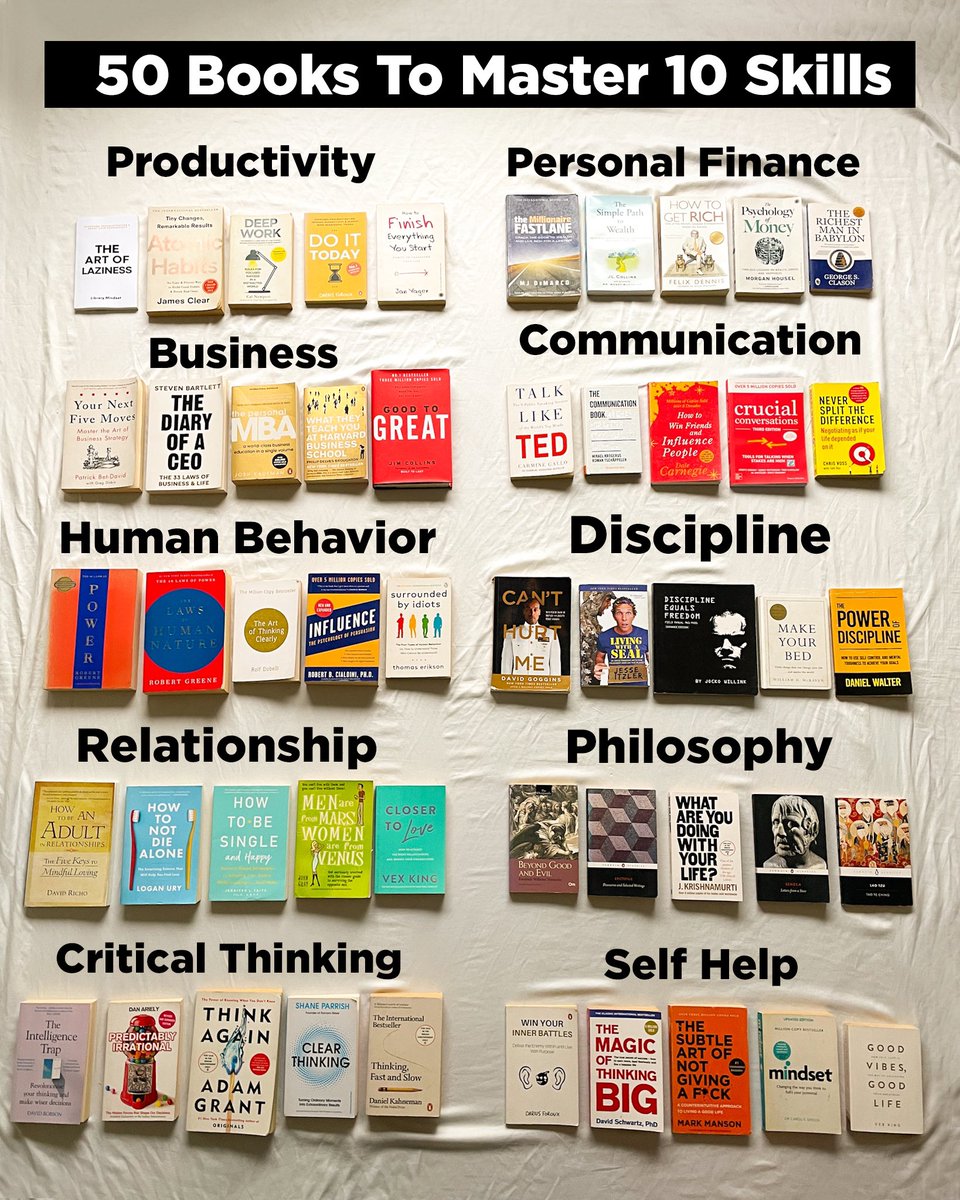
He credits reading 1-2 hours per day as the main reason he's been so successful.
Here are 43 reading tips from @naval:
1) Read what you love until you love to read.
2) Read the books they want to ban.
3) Reading a book isn’t a race—the better the book, the more slowly it should be absorbed.
4) I always spent money on books. I never viewed that as an expense. That’s an investment to me.
5) Good books are worth re-reading. Great books are worth re-buying.
6) The smarter you get, the slower you read.
7) If you can speed read it, it isn't worth reading.
8) Reading is the ultimate meta-skill and can be traded for anything else.
9) A vacation is a very expensive way to schedule the time to read a book in peace.
10) Reading is more efficient when at rest. Audio is more efficient when in motion.
11) Read to satisfy your own natural curiosity, not to impress or accomplish.
12) The genuine love for reading itself, when cultivated, is a superpower.
13) If it doesn’t grab my attention within the first chapter in a meaningful, positive way, I’ll either drop the book or skip ahead a few chapters.
14) Most books should just be summaries so I leave most books unfinished and only make it all the way through a few. The best ones can’t be easily summarized.
15) I don’t believe in delayed gratification when there are an infinite number of books out there to read. There are so many great books.
16) We live in the age of Alexandria, when every book and every piece of knowledge ever written down is a fingertip away. The means of learning are abundant—it’s the desire to learn that is scarce.
17) Learn to love to read, and all human knowledge is available to you right now.
18) If they wrote it to make money, don't read it.
19) Sequels are rarely good because the author that dumped decades of insights into the first book is suddenly given months to produce a second.
20) Assigned reading is propaganda.
21) I read out of curiosity and interest. The best book is the one you’ll devour.
22) Read enough, and you become a connoisseur. Then you naturally gravitate more toward theory, concepts, nonfiction.
23) Listening to books instead of reading them is like drinking your vegetables instead of eating them.
24) Study logic and math, because once you've mastered them, you won't fear any book.
25) No book in the library should scare you...You should be able to take any book down off the shelf and read it. A number of them are going to be too difficult for you. That’s okay—read them anyway. Then go back and reread them and reread them.
26) When you’re reading a book and you’re confused, that confusion is similar to the pain you get in the gym when you’re working out. But you’re building mental muscles instead of physical muscles. Learn how to learn and read the books.
27) Read originals and read classics. If you’re interested in evolution, read Charles Darwin. Don’t begin with Richard Dawkins (even though I think he’s great). Read him later; read Darwin first.
28) I came up with this hack where I started treating books as throwaway blog posts...I felt no obligation to finish any book. Now, when someone mentions a book to me, I buy it. At any given time, I’m reading somewhere between ten and twenty books.
29) If the book is getting a little boring, I’ll skip ahead. Sometimes, I start reading a book in the middle because some paragraph caught my eye. I’ll just continue from there, and I feel no obligation whatsoever to finish the book.
30) Any book that survived for two thousand years has been filtered through many people. The general principles are more likely to be correct. I wanted to get back into reading these sorts of books.
31) I have very poor attention. I skim. I speed read. I jump around. I could not tell you specific passages or quotes from books. At some deep level, you absorb them, and they become threads in the tapestry of your psyche. They kind of weave in there.
32) Read books, avoid news.
33) I probably read 1-2 hours a day, and that puts me in the top .00001%. I think that alone accounts for any material success that I’ve had in my life and any intelligence that I might have.
34) Number of books completed is a vanity metric. As you know more, you leave more books unfinished. Focus on new concepts with predictive power.
35) If I read a book and that I know it’s amazing, I’ll buy multiple copies, partially to give away, partially because I have them lying around the house.
36) I got over this idea of reading a large number of books...It’s a show-off thing, it’s a signaling thing...I no longer track books read or even care about books read, it’s about understanding concepts.
37) I would rather read the best 100 books over and over again until I absorb them rather than read all the books.”
38) I avoid the whole business and self-help category because you generally have one good idea and it’s buried in hundreds or thousands of pages and lots of anecdotes.
39) Feel free to skip around; it’s your book. There are books that I’ve literally started in the middle. I’ve read near to the end and then I’ve put it down...That liberation, that freedom just allows me to read.
40) Just like the best workout for you is the one that you’re excited enough to do every day, the same way I would say the books...to read are the ones that you’re excited about reading all the time.
41) I think the most important way to read is to pick up a lot of books, start reading them all. Put down any book instantly that doesn’t grab you and you don’t have reading and just keep going until you find something that does speak to you.
42) The great thing about reading is you can use that to pick up any new skill. So if you learn how to learn, it’s the ultimate meta skill.
43) I believe you can learn how to be healthy, you can learn how to be fit, you can learn how to be happy, you can learn how to have good relationships, you can learn how to be successful….You can trade it for any other skill. And that all begins with reading.
The 5-Minute Journal is simplicity itself and hits a lot of birds with one stone: 5 minutes in the morning of answering a few prompts, and then 5 minutes in the evening doing the same.
Each prompt has three lines for three answers.
To be answered in the morning:
I am grateful for . . .
1. __________
2. __________
3. __________
What would make today great?
1. __________
2. __________
3. __________
Daily affirmations.
I am . . .
1. __________
2. __________
3. __________
To be filled in at night:
3 amazing things that happened today . . .
1. __________
2. __________
3. __________
How could I have made today better?
1. __________
2. __________
3. __________
It’s easy to obsess over pushing the ball forward as a type-A personality, which leads to being constantly future-focused. If anxiety is a focus on the future, practicing appreciation, even for 2 to 3 minutes, is counter-balancing medicine.
The 5-Minute Journal forces me to think about what I have, as opposed to what I’m pursuing.
When you answer “I am grateful for . . . ,” I recommend considering four different categories. Otherwise, you will go on autopilot and repeat the same items day after day (e.g., “my healthy family,” “my loving dog,” etc.). I certainly did this, and it defeats the purpose.
What are you grateful for in the below four categories?
I ask myself this every morning as I fill out the 5MJ, and I pick my favorite three for that day:
An old relationship that really helped you, or that you valued highly.
An opportunity you have today. Perhaps that’s just an opportunity to call one of your parents, or an opportunity to go to work. It doesn’t have to be something large.
Something great that happened yesterday, whether you experienced or witnessed it.
Something simple near you or within sight. The gratitude points shouldn’t all be “my career” and other abstract items. Temper those with something simple and concrete—a beautiful cloud outside the window, the coffee that you’re drinking, the pen that you’re using, or whatever it might be.
I use Intelligent Change’s bound 5-Minute Journal and suggest it for convenience, but you can practice in your own notebook.
It’s fun and good therapy to review your p.m. “amazing things” answers at least once a month.
Rogan talks about aliens, comedy, fighting, politics, bio-hacking.
The Rock has WWE, movies, football, fitness, tequila.
I like business, philosophy, fitness, comedy, & utilitarianism.
You don’t pick your niche.
You are your niche.
Whats yours?