🚨 Scientists Say “Luck” Is Not Random — And Your Mind Shapes It
In 2019, Oxford physicists ran an experiment with electrons and found particles behaved differently depending on whether the observer expected a certain result. This confirmed a long-standing hypothesis: expectation itself changes outcomes.
🔹 Scientists call this the observer coherence effect. When you’re confident you’ll “get lucky,” your brain filters reality to highlight opportunities others ignore.
🔹 Research in Zurich found that people who believe in their luck are 3x more likely to find money, land jobs, and close deals — not because of magic, but because their brains are tuned to spot signals others miss.
🔹 Even quantum experiments with random numbers showed a strange pattern: participants’ focused intention nudged probabilities beyond statistical norms.
The lesson? Luck isn’t mysticism — it’s the power of focus aligning quantum possibilities in your favor. Every moment holds countless outcomes. Your mind helps decide which one becomes real.
Litio, cobre y tierras raras: América Latina se vuelve clave para que EEUU y Europa reduzcan su dependencia de China en minerales críticos para la transición energética y digital.
✍️ Yannic Fricke
You would expect the outer edge of our solar system to be freezing cold. Instead, NASA’s Voyager 1 encountered a scorching region of plasma so intense that scientists have called it a “wall of fire.”
When the spacecraft crossed the heliopause, the invisible boundary where the Sun’s solar wind meets interstellar space, it recorded temperatures between 30,000 and 90,000°F (17,000–50,000°C).
This is not actual fire. The extreme heat is created when the outgoing solar wind collides with the thin gas, dust, and magnetic fields of the interstellar medium. As the solar wind slows and compresses at this boundary, its kinetic energy is transformed into thermal energy, superheating the surrounding plasma.
Surprisingly, despite these blistering temperatures, the region would not feel hot to the touch. Temperature measures the average speed of individual particles, but the plasma at the heliopause is incredibly sparse, containing only a handful of particles per cubic centimeter. With so few particles, there is almost no heat energy available to transfer.
Voyager 1 also detected a sharp drop in solar particles and a dramatic rise in high-energy galactic cosmic rays, confirming it had left the protective bubble of the Sun’s heliosphere and entered true interstellar space.
Scientists determined the plasma’s extreme temperature by analyzing tiny waves in the plasma triggered by solar eruptions, then combining those density measurements with theoretical models.
The heliosphere serves as Earth’s first line of defense against dangerous cosmic radiation. Beyond it lies the raw environment of the Milky Way. Today, more than 15 billion miles (24 billion kilometers) from Earth, Voyager 1 continues its historic journey, still sending back valuable data from this distant frontier.
The Slinningsbålet in Ålesund is one of the most spectacular summer traditions in the world.
They make a 35-meter-tall pallet tower bonfire to celebrate the summer solstice (Sankthansaften).
[📹 visitalesund]
Today at exactly 8:24 a.m. UTC (4:24 a.m. EDT), Earth reached the June solstice, marking the official start of summer in the Northern Hemisphere and delivering the longest day and shortest night of the year for everyone north of the equator.
This extra daylight occurs not because Earth is closer to the Sun (we are actually heading toward our farthest point in early July), but because of our planet’s 23.5-degree axial tilt. The Northern Hemisphere is now angled most directly toward the Sun, causing it to rise at its most northeasterly point, reach its highest altitude at midday, and set at its most northwesterly position.
The farther north you are, the more pronounced the effect: much of the northern U.S. and southern Canada get 15–16 hours of daylight, Alaska sees nearly 20 hours, and locations above the Arctic Circle experience the midnight Sun. At the same moment, the Southern Hemisphere begins its winter with the shortest day of the year.
Although daylight will slowly begin to decrease after today, the change will be gradual at first, giving us many more weeks of long, luminous summer evenings. The solstice beautifully illustrates how Earth’s simple 23.5-degree tilt drives our seasons and daily rhythms.
The longest day of 2026 has arrived. At exactly 8:24 a.m. UTC on Sunday, June 21, Earth reached the June solstice, officially marking the first day of astronomical summer in the Northern Hemisphere.
Throughout the day, the Sun traces its highest and longest path across the sky, delivering the maximum daylight of the year. Much of the northern United States and southern Canada will enjoy 15 to 16 hours of daylight, while parts of Alaska and northern Canada get nearly 20 hours. Above the Arctic Circle, the midnight Sun shines without setting.
This extended daylight is not caused by Earth being closer to the Sun. Instead, it results from our planet’s 23.5-degree axial tilt. On the solstice, the Northern Hemisphere leans most directly toward the Sun, causing the Sun to rise and set at its northernmost points on the horizon and reach its highest altitude at midday.
After today, daylight will gradually shorten each day as we move toward the September equinox. The June solstice stands as one of the four major milestones in Earth’s annual orbit, alongside the equinoxes and the December solstice.
This map shows Switzerland’s four national languages without the uninhabited high mountain areas. Suddenly the country’s linguistic geography makes more sense: German dominates the north and centre, French the west, Italian the south, and Romansh survives in pockets of the east. Source: https://t.co/Q2sC2yIBye
King’s College Hospital in London has opened a rooftop garden for critical care patients, with its first patient, a 29-year-old woman dependent on feeding tubes, saying the outdoor space gave her “a real boost to keep on going.”
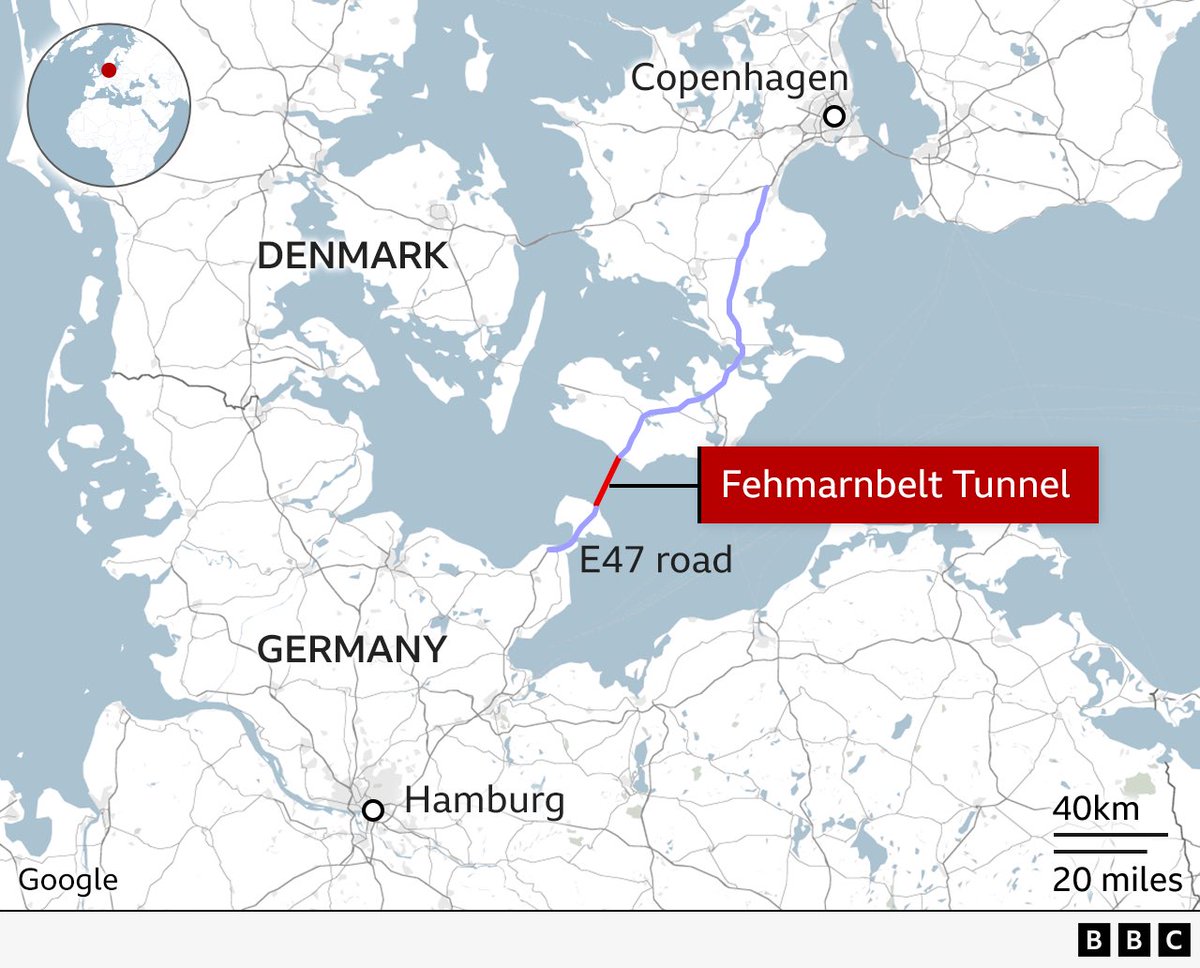
Europe is building an 18 km underwater tunnel between Germany and Denmark beneath the Baltic Sea
Once completed, trains will cross in just 7 minutes, while the Hamburg-Copenhagen journey will drop from 4h40 to 2h30
One of the most ambitious infrastructure projects in Europe 🇪🇺