Note for myself:
great and most plausible explanation of why the anti-capitalis left never attacks ultra rich artists and athletes, but just entrepreneurs.
This is because the anti-capitalist left is not actually against people being crazy rich. They're against certain types of people being crazy rich.
Artists and athletes make sense to them because they've played music and sports and because their success can be explained by "luck" and "talent". Messi's wealth is not offensive to them because they understand Messi is much better at football than they are.
But when it comes to business, the anti-capitalist leftist has no framework for understanding why Jeff Bezos might be super rich since 99% of them have never ever created a product, business or service that was of value to other people. They've never taken entrepreneurial risk. They've never employed people and felt the burden of responsibility that comes with that. They've never pick up a business and given it a play in the way they've picked up a ball or a guitar.
They *literally* don't understand wealth creation. They think there is a fixed amount of money and the only thing a business does is split it unfairly.
It's why they rage at Elon and other successful business leaders. Because they genuinely don't understand why they're wealthy.
Also, and this is just as important, athletes and artists are disproportionately young, attractive, "diverse", left wing etc. Business leaders are "evil" middle aged white men whose success offends the average anti-capitalist leftist because they don't understand a) what it is they do and b) that Elon Musk has the same talent advantage on them as Messi does, it's just harder to measure.
@ivanfioravanti Nah man, little gardens are precious and they need to be preserved with great care! And "we need to do this, we need to do that" is just empty words. I, on the other hand, can do something about myself and myself only.
If you've been wondering how to disable the recently introduced Claude Code timeout, for when it asks you a question, here's the workaround (ask Claude to put it in your global settings)
@jun_song It has some great use cases, for example gemini 2.5 flash is incredibly effective at speech to text (very fast and hi quality results, even in Italian, my native language) and it's very cheap.
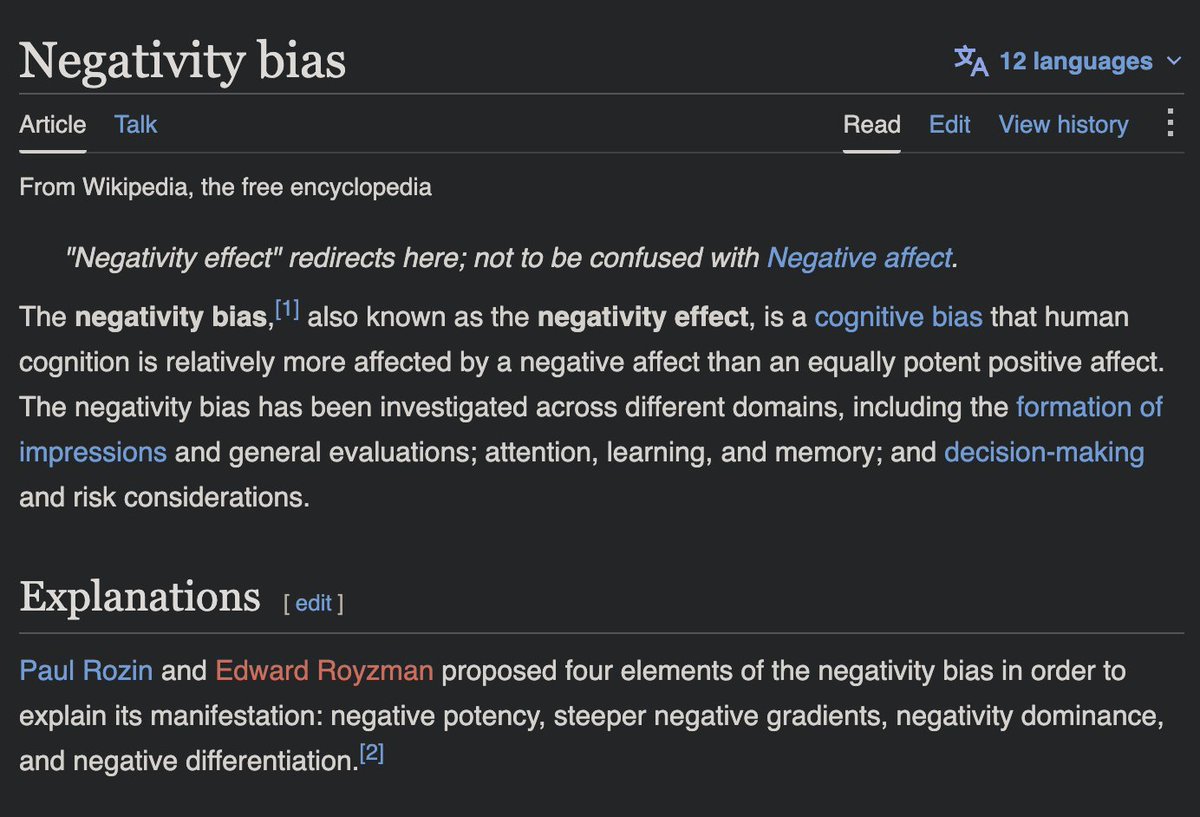
We pay more attention to negative than positive stimuli.
Not a suspect, but a well known bias probably due to evolutionary pressure:
bad things = death VS good things = life
What people suspect is indeed true
Negative content performs much better
About 1.5x better than positive content
But curious content (like hacky projects) comes in second, which is great news for me!
https://t.co/nh9MgjWcOf
I asked Grok to compile a thorough list of all the Sci-Fi books mentioned in the comments of this post.
Some are classics, some are more recent, great Sci-Fi starter pack overall:
- A Deepness in the Sky by Vernor Vinge (Zones of Thought series)
- A Fire Upon the Deep by Vernor Vinge (Zones of Thought series; referenced alongside the above)
- Ancillary Justice by Ann Leckie (Imperial Radch trilogy / series)
- Annihilation by Jeff VanderMeer (Southern Reach trilogy)
- Axiomatic by Greg Egan (short story collection)
- Blame! by Tsutomu Nihei (manga series)
- Blindsight by Peter Watts
- Blood Music by Greg Bear
- Bobiverse series (starting with We Are Legion (We Are Bob)) by Dennis E. Taylor
- Brave New World by Aldous Huxley
- Children of Strife (Children of Time #4) by Adrian Tchaikovsky
- Children of Time series (including Children of Ruin, Children of Memory, and Children of Strife) by Adrian Tchaikovsky
- Contact by Carl Sagan
- Cryptonomicon by Neal Stephenson
- Delta-v (Delta-v series) by Daniel Suarez
- Diaspora by Greg Egan
- Do Androids Dream of Electric Sheep? by Philip K. Dick
- Dune series by Frank Herbert
- East of West by Jonathan Hickman (graphic novel series, art by Nick Dragotta)
- Ender’s Game by Orson Scott Card (Ender’s Game / Ender series)
- Eon by Greg Bear
- Excession by Iain M. Banks (Culture series)
- Exhalation by Ted Chiang (short story collection; “everything by Ted Chiang” also referenced, including other collections like Stories of Your Life and Others)
- Foundation series by Isaac Asimov
- Honor Harrington series by David Weber
- Hyperion by Dan Simmons (Hyperion Cantos series)
- Imperial Radch trilogy by Ann Leckie (starting with Ancillary Justice)
- Limbo by Bernard Wolfe
- Neuromancer by William Gibson (Sprawl trilogy)
- Permutation City by Greg Egan
- Player of Games by Iain M. Banks (Culture series; “Culture books” also referenced)
- Player Piano by Kurt Vonnegut
- Project Hail Mary by Andy Weir
- Ra by qntm (Sam Hughes)
- Recursion by Blake Crouch
- Red Rising series by Pierce Brown
- Rendezvous with Rama by Arthur C. Clarke (Rama series)
- Ringworld by Larry Niven (Ringworld series)
- Saga by Brian K. Vaughan (graphic novel series, illustrated by Fiona Staples)
- Seveneves by Neal Stephenson
- Silo series (starting with Wool) by Hugh Howey
- Skyward series by Brandon Sanderson
- Slaughterhouse-Five by Kurt Vonnegut
- Snow Crash by Neal Stephenson
- Solaris by Stanisław Lem
- Spin by Robert Charles Wilson
- Stand on Zanzibar by John Brunner
- Stranger in a Strange Land by Robert A. Heinlein
- The Dark Forest by Liu Cixin (Remembrance of Earth’s Past / Three-Body Problem trilogy, book 2)
- The Diamond Age by Neal Stephenson
- The Expanse series by James S.A. Corey
- The Futurological Congress by Stanisław Lem
- The Hitchhiker’s Guide to the Galaxy series by Douglas Adams
- The Last Question by Isaac Asimov (short story)
- The Machine Stops by E. M. Forster (novella/short story)
- The Martian by Andy Weir
- The Moon Is a Harsh Mistress by Robert A. Heinlein
- The Road by Cormac McCarthy
- The Three Stigmata of Palmer Eldritch by Philip K. Dick
- The Three-Body Problem (Remembrance of Earth’s Past / Three-Body Problem trilogy) by Liu Cixin (“Three Body Problem trilogy” and “anything by Cixin Liu” also referenced)
- The Will of the Many by James Islington (Hierarchy series)
- Theft of Fire by Devon Eriksen
- There Is No Antimemetics Division by qntm (Sam Hughes)
- Ubik by Philip K. Dick
- Vurt by Jeff Noon
- Watchmen by Alan Moore and Dave Gibbons (graphic novel)
@thekitze What about books instead of screens?
And from time to time you make her a new cassette tape playlist for the coolest device a kid could ever own.
@ptremblay And better speed. From my early tests GLM 5.2 is a very good model, but 2-3 times slower than Opus/Sonnet (at least served from https://t.co/S5iyzyDw5g Anthropic compatible endpoints)
I disagree Pieter (@levelsio quoting because I can’t reply) I’ve been building an AI coaching platform since 2024 and the main traits for perceived realism for me (and our users) are still natural sounding inflections and fillers.
I'm just as surprised nobody in AI voice tech has realized a voice needs background and environmental noise to sound realistic
Even @ElevenLabs the leader in voice AI can not produce voice with background noise, or environment reverb sound
AI voices are always going to sound non-passable as human if they don't have that
And it's only me and this other guy even talking about it