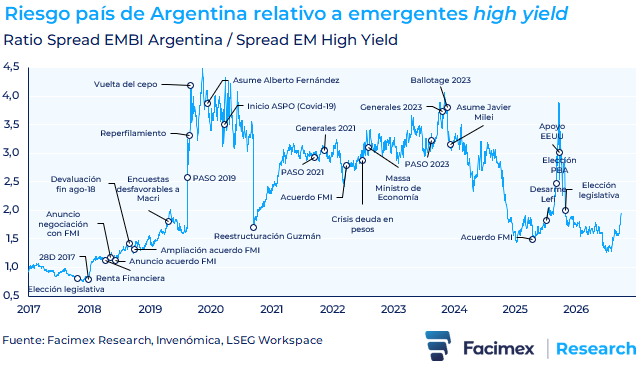
Nuestra medida preferida de riesgo país, que ajusta por el apetito global por créditos de alto riesgo, ya está en niveles similares al estrés de la pascua de 2019. En ese momento salió una muy reconocida encuestadora con números que mostraban a Macri perdiendo en un ballotage y el mercado se asustó. El nivel actual tiene una probabilidad implícita mayor al 40% para un escenario de reversión de políticas, algo que parece exagerado cuando todavía falta más de un año para la elección.
[No es recomendación de compra / venta de nada, estamos en medio de un sell off global de renta fija]
I mapped 25 public companies across 5 sectors of the Space economy: rockets, satellites, earth observation, lunar exploration and defense.
SpaceX IPOs in weeks at $1.75 TRILLION and most people have zero exposure to the sector it's about to reprice.
🧵 Full breakdown below:
🛰️ LAUNCH & ACCESS
The foundation layer. Nothing happens in space without getting there first.
$RKLB : Rocket Lab
The one I watch most closely in this sector. Q1 2026 hit a record $200M+ in revenue with a backlog over $2.2B. Electron is one of the most reliable small launch vehicles ever built (87 launches, 83 successes). But the real catalyst is Neutron, their medium lift rocket targeting megaconstellation deployment. First launch planned late 2026. Designed to compete with Falcon 9. Peter Beck has quietly built a vertically integrated space platform: rockets, satellite buses (Photon), spacecraft components, and now aiming for human spaceflight class capability. This isn't just a launch company anymore.
$FLY : Firefly Aerospace
IPO'd August 2025. Growing 40% quarter over quarter. Designs and manufactures launch vehicles, satellites, and lunar cargo spacecraft for Artemis missions. Very early in its public life, not profitable yet, but the growth rate is hard to ignore and the government contract pipeline gives long term visibility.
SpaceX (expected $SPCX)
Not yet public but about to be. Filed S1 on May 20, 2026. Expected to list on Nasdaq around June 12. Targeting $1.75T to $2T valuation. $18.7B in 2025 revenue with Starlink alone doing $11.4B. This is not just a rocket company. It's a global internet infrastructure monopoly being built from orbit. The IPO raise could hit $40B to $80B, shattering Saudi Aramco's record. When this lists, it re rates every single company on this map.
Blue Origin (private, often paired with $BA)
Jeff Bezos' rocket company. Still private. Developing New Glenn (medium to heavy lift) and Blue Moon lunar lander for NASA's Artemis program. Now launching AST SpaceMobile's BlueBird satellites, which tells you they're becoming a serious commercial launch provider. Watch for a potential public listing down the road.
$LDOS : Leidos
The quiet giant. One of the largest US defense and IT services contractors with deep space integration capabilities. Mission systems, satellite ground infrastructure, cybersecurity for space assets. Not a pure space play but they touch nearly every government space program. The kind of name nobody talks about that keeps showing up in every contract announcement.
📡 SATELLITE COMMS
This is where revenue is scaling fastest. Connecting the planet from orbit. And personally I think this subsector is the most investable part of space right now because the business models most resemble traditional recurring revenue.
$ASTS : AST SpaceMobile
The most ambitious play on this entire map. Building the first space based cellular broadband network that connects directly to unmodified smartphones. No dish. No special hardware. Your regular phone picks up signal from satellites. Partners include AT&T, Verizon, Vodafone, Rakuten, and Google. FCC just authorized commercial SpaceMobile service in the US. BlueBird 6, the largest commercial comms array ever deployed in LEO, successfully launched. Sitting on ~$3.5B cash and over $1.2B in contracted revenue commitments. This is either a generational infrastructure buildout or the most expensive bet in telecom history. The partner list tells me it's the former.
$VSAT : Viasat. Legacy satellite broadband
Airlines, military, maritime, enterprise. Facing Starlink competitive pressure but the defense angle is the real floor here. Government contracts provide stability that pure commercial satellite plays don't have. Not the sexiest name on this list but the kind of stock that holds up when the speculative ones get cut in half.
$IRDM : Iridium Communications
Operates the only satellite constellation providing truly global voice and data coverage, including the poles. 66 cross linked LEO satellites. Critical for maritime, aviation, government, and IoT. Extremely sticky revenue, high margins, constellation fully refreshed with Iridium NEXT. One of the most underappreciated cash flow machines in the space sector. Not flashy. Just prints. If I had to own one space stock for a decade and not touch it, this would be near the top of the list.
$GSAT : Globalstar
Became a much bigger story after Apple selected them to power the iPhone Emergency SOS via satellite feature. Apple invested heavily and Globalstar is building next gen satellites to expand the partnership. The Apple relationship alone makes this a completely different risk profile than most small cap space names. Effectively a satellite infrastructure play with the most valuable company on Earth as your anchor customer.
$SATS : EchoStar / Inmarsat
Operates one of the broadest geostationary satellite fleets globally. Maritime, aviation, government, enterprise connectivity. Large legacy business generating real cash flow while positioning for next gen services. The kind of mature operator that the market ignores during hype cycles and then remembers when it wants quality.
🌍 EARTH OBS & DATA
The intelligence layer. Imaging the planet daily and turning raw pixels into actionable decisions.
$PL : Planet Labs
The largest fleet of Earth observation satellites ever deployed. Daily imaging of the entire planet's landmass. Feeds agriculture, forestry, defense, insurance, and climate monitoring. Planet is the "data layer" of the space economy. If you believe Earth observation becomes as essential as GPS (and I do), Planet is the company best positioned to own that layer at scale.
$BKSY : BlackSky Technology
Real time geospatial intelligence. The play here is AI powered analytics layered on satellite imagery. Where Planet goes wide (image everything daily), BlackSky goes deep (real time intelligence for specific targets). Heavy defense and intel community customer base. Smaller but differentiated.
$SPIR : Spire Global
Satellite powered data analytics via a constellation of nanosatellites collecting weather, maritime, and aviation data. Business model is data as a service: they sell the analytics, not the hardware. Weather forecasting, ship tracking, supply chain intelligence. Interesting because unit economics improve with every satellite added to the constellation.
$TRMB : Trimble
Positioning, modeling, and data analytics across construction, agriculture, transportation, and geospatial workflows. Not a pure space company but deeply dependent on satellite positioning systems and increasingly integrating space based data into precision applications. Massive installed base. Real earnings. The boring but profitable way to play the space data theme.
$GILT : Gilat Satellite Networks
Ground segment technology: VSATs, amplifiers, modems, and managed network services. Israeli company with deep defense relationships. Every satellite constellation needs ground infrastructure to function. Gilat builds that infrastructure. Under the radar but essential.
🌙 EXPLORATION & ON ORBIT
The frontier. Lunar missions, space manufacturing, orbital services, asteroid mining. The highest risk and highest potential upside tier on this map.
$LUNR : Intuitive Machines
This one has been on a tear. Revenue nearly tripled year over year in Q1 2026 after closing the $800M Lanteris acquisition in January. Now expanding into satellite comms, orbital data processing, and deep space networking. Participating in the Space Force Andromeda program with a $6.2B ceiling. Also acquiring Goonhilly Earth Station. Went from "cool lunar lander startup" to vertically integrated space infrastructure company in about 12 months. The acquisition strategy is aggressive but so far the revenue is backing it up.
$RDW : Redwire
Space infrastructure and on orbit manufacturing. Revenue growing nearly 60% YoY with a record backlog approaching half a billion. Makes solar arrays, structures, sensors, and is pioneering manufacturing in microgravity. If the thesis that zero gravity unlocks materials impossible to create on Earth proves out, Redwire is the picks and shovels company for that entire category.
$KTOS : Kratos Defense & Security Solutions
Unmanned systems, satellite communications ground systems, cybersecurity, and hypersonic drone development. Their space division builds command and control infrastructure for satellite operations. The intersection of space and autonomous defense systems is exactly where government budgets are accelerating fastest.
$BWXT : BWX Technologies
Nuclear technology for defense and space. Provides nuclear propulsion and power systems for NASA and DoD. Nuclear thermal propulsion is considered essential for deep space missions to Mars and beyond. If humanity goes to Mars, BWXT technology is very likely on that spacecraft. Long term thesis but anchored by near term defense nuclear revenue that makes the wait very comfortable.
$ATRO : AstroForge
The asteroid mining company. Pre revenue. High risk, true moonshot category. The thesis: asteroids contain platinum group metals worth trillions. AstroForge is building spacecraft to go extract them. Most people will dismiss this as science fiction. Fair enough. But every transformative sector had a moment where it sounded like science fiction, and the people who mapped it early were the ones who captured the asymmetry.
🛡️ DEFENSE PRIMES
The trillion dollar backbone. When governments write space checks, these are the companies cashing them. Real revenue. Real earnings. Real dividends. The stability layer of the space economy.
$LMT : Lockheed Martin
Largest defense contractor on Earth. Space division builds GPS satellites, missile defense systems, Orion spacecraft (Artemis), hypersonic systems. Won the next gen missile warning satellite program. When the US government needs something in orbit, Lockheed is usually the first call.
$NOC : Northrop Grumman
Built the James Webb Space Telescope. Makes solid rocket boosters for nearly every US launch vehicle. Operates Cygnus cargo spacecraft for ISS resupply. Deep, long duration government contracts with decades of visibility.
$RTX : RTX (formerly Raytheon Technologies)
Missile defense, radar, satellite payloads, communications systems. Pratt & Whitney builds rocket engines. Collins Aerospace provides spacecraft avionics. The merger created a space/defense conglomerate that touches virtually every program in existence.
$LHX : L3Harris Technologies
Space and airborne systems. Satellite payloads, ground terminals, electro optical sensors, communication systems for classified programs. Key contractor on the Space Development Agency's proliferated LEO constellation for missile tracking. Growing rapidly as "space as a warfighting domain" becomes official Pentagon doctrine.
$GD : General Dynamics
Submarines, combat vehicles, IT services, and space. GDIT division provides mission critical IT infrastructure for space operations, ground segment systems, and satellite data processing. Not the flashiest space exposure but deeply embedded in the classified programs that quietly fund this entire sector.
📊 THE ETF PLAY
$NASA : Tema Space Innovators ETF
Launched March 31, 2026. Actively managed, 20 to 40 holdings. And the real differentiator: direct pre IPO exposure to SpaceX through an SPV, something retail investors literally cannot access anywhere else. If you want one click space economy exposure with SpaceX embedded, this is it.
🧠 FINAL THOUGHTS
Five sectors. 25 companies. The full stack of the space economy.
SpaceX targeting $1.75T+ at IPO. When it lists, it becomes the gravitational center of this entire map. Every supplier, every competitor, every adjacent company gets re rated. The Arm IPO repriced chip IP in 2023. The SpaceX IPO reprices space.
What stands out to me looking at this map:
The pure plays (Rocket Lab, AST SpaceMobile, Intuitive Machines, Redwire) are where the growth is. Revenue doubling and tripling year over year. But these carry higher risk and most are still unprofitable.
The defense primes (Lockheed, Northrop, RTX, L3Harris, General Dynamics) are where the stability is. Real earnings, dividends, and space as a growing share of revenue. Lower upside but much lower downside.
The satellite comms layer (Iridium, Globalstar, AST SpaceMobile) is where the business models are proving out fastest. Recurring subscription revenue from connectivity. This part of space most resembles a traditional business.
I'm not saying buy everything on this list. I'm saying map it. Understand the layers. Know which companies have real revenue versus aspirational roadmaps. Know where the government contracts are versus the commercial bets.
This sector is where AI stocks were before ChatGPT made everyone a believer. The difference is the space crowd hasn't had its catalyst moment yet. The SpaceX IPO might be exactly that. The people who already mapped the landscape will move first.
En unos días cumplo mi primer década trabajando dentro del sistema bursátil (lo que comúnmente se llama "la bolsa"). Si tuviera que decirle 3 verdades incómodas que las personas que se dedican a esto no quieren admitir serían:
“Preocupa el préstamo de títulos de los clientes. Ante una crisis de la #Alyc, si el título está en la cuenta del comitente, su patrimonio está a salvo. Pero si se prestó, lo que tiene es un crédito contra el agente que deberá hacer valer en un concurso. Por eso, ademas de los regimenes de información, por ejemplo en exposición ante derivados, ahora vamos a establecer ratios para fijar un límite de levarge”, dijo el titular de @CNVArgentina Roberto Silva en @IAEF_oficial. Y puso a los casos de Guardati/Torti y Casanvoas como ejemplo del nuevos criterio de sanción
Nubank $NU alcanza los 112 millones de clientes, supera a Bradesco $BBD y se convierte en el 2º mayor banco de Brasil
➡️El Banco Central de Brasil publicó el ranking de reclamos y la cantidad de clientes de diferentes bancos de ese país.
➡️Nubank alcanzó 112M de clientes, convirtiéndose en el segundo banco más grande del país, solo por detrás de Caixa que tiene 158.1M.
➡️Superó a bancos tradicionales como Itaú $ITUB y Banco do Brasil. Desde 2022, Nubank viene creciendo de forma exponencial, manteniéndose entre los cinco primeros puestos del ranking.
➡️Su ADR hoy sube casi 4% y quedó a un 5% de suba para alcanzar máximos históricos.
La Secretaría de Finanzas anuncia una nueva licitación con suscripción en especie para el jueves 22 de enero:
✅ Dólar Linked
🔁 30/01/26 (D30E6) por 27/02/26 (D27F6).
🔁 30/01/26 (D30E6) por 30/04/26 (D30A6).
🔁 30/01/26 (D30E6) por 30/06/26 (TZV26).
Siguiendo con lo realizado en la licitación del 7 de enero, el objetivo de esta nueva licitación es continuar brindando herramientas para facilitar el roll over de los instrumentos de cobertura Dólar Liniked minimizando los desarbitrajes del fixing del TC A3500.
Más información 👇
https://t.co/Z86ubdzdOt
Resultado de la Licitación del Tesoro Nacional:
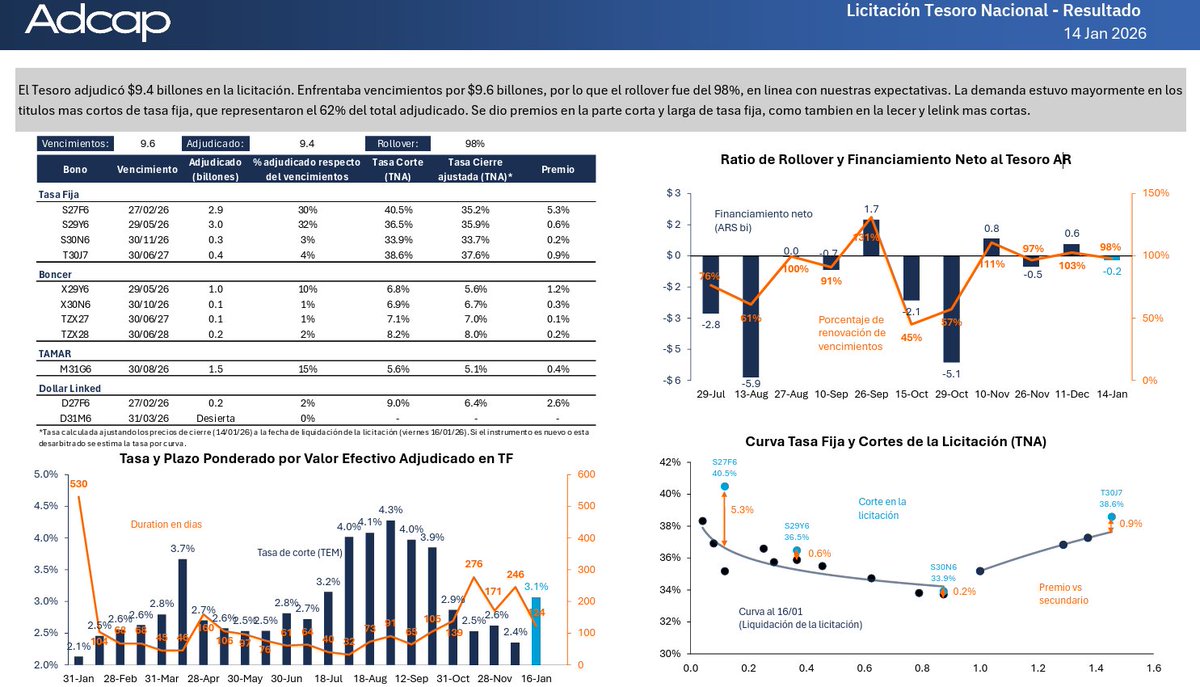
El Tesoro adjudicó $9.4 billones en la licitación. Enfrentaba vencimientos por $9.6 billones, por lo que el rollover fue del 98%, en linea con nuestras expectativas. La demanda estuvo mayormente en los titulos mas cortos de tasa fija, que representaron el 62% del total adjudicado. Se dio premios en la parte corta y larga de tasa fija, como tambien en la lecer y lelink mas cortas.
Excelente el post este para entender y derribar mitos.
La caída en el precio de los crudos no empezó ahora.
Hay sobre producción para una demanda que cada vez se revisa a la baja.
Cada USD que caen los diferentes crudos hay jugadores que dejan de ser rentables y si no ven una recuperación dejan lentamente de invertir.
Hablo de los crudos porque es literal así, WTI, Brent, Medanito, etc. todos tienen diferente precio porque son productos diferentes.
VM es extremadamente competitivo: en costos y en la calidad de su crudo.
EL punto clave no es la continuidad de VM sino:
1. No vale lo mismo $VIST $YPF o $PAMP con un precio de USD75 a un precio de USD 55. Sigue habiendo rentabilidad pero obviamente el valor es otro. Eso es lo que re-pricea el mercado todos los días.
Clave laburar en costos, hay todavía trabajo por hacer y se va a hacer. Pero aún rentabilizando más las operaciones el valor de cada compañía es otro.
2. A nivel agregado para Argentina cambia la magnitud del superávit de balanza energética. Pero sigue siendo positivo.
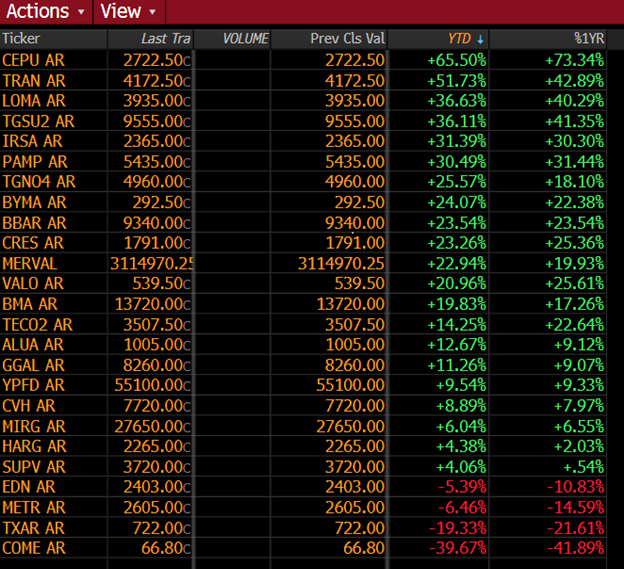
Llegando a fin de año, se podría decir, con satisfacción para quienes hacen análisis fundamental, que el desempeño relativo de los activos durante 2025 siguió de manera bastante fiel a los resultados de las empresas. Con escasas excepciones, los papeles que mejor anduvieron son los que tuvieron mejoras en sus resultados, en tanto que los que anduvieron peor que el Merval fueron los que vieron sus resultados caer vs. 2024. Después de los vaivenes locos del año, los fundamentals parecen haber hecho su trabajo.