I've got an agent in a loop optimizing a renderer with the goal to minimize frame times (and tests to measure). It got times down from 88ms to 2ms and allocations down from ~150K to 500. Sounds good, right? Wrong. This is exactly why agent psychosis is a big fucking problem.
As an experiment, I rewrote the Ghostty core render state in Go, with access to identically laid out data structures as Ghostty and the exact same validation tests. I made a purposely naive renderer (simple, correct, but slow). 88ms per frame with 150,000 allocations (horrendous, lol)!
I then kickstarted a Ralph loop to bring the frame times down. I told it it can't modify input data structures or the public API or tests (they're correct), but it can do anything else it wants. It got to work.
It has worked for about 4 hours. I've spent around $350 on this experiment so far. The results?
88ms => 1.5ms
150K allocs => ~500 allocs
Incredible right? Nope.
My hand-written renderer I ported has frame times (same benchmark) of ~20us (0.020ms) and 0 allocations in the update path.
This is the problem with psychosis and lacking systems understanding. If you don't understand the system, you're going to accept that this is an incredible result. If you understand the system, you'll see better solutions immediately and can do roughly 75x better on throughput.
The people who blindly trust agent output are in the former camp. They're sheeple, overdrinking from a fountain of mediocrity.
Standard disclaimer: I use AI all the time. I like AI. The point I'm making is to not blindly accept results. Think. Analyze. Learn.
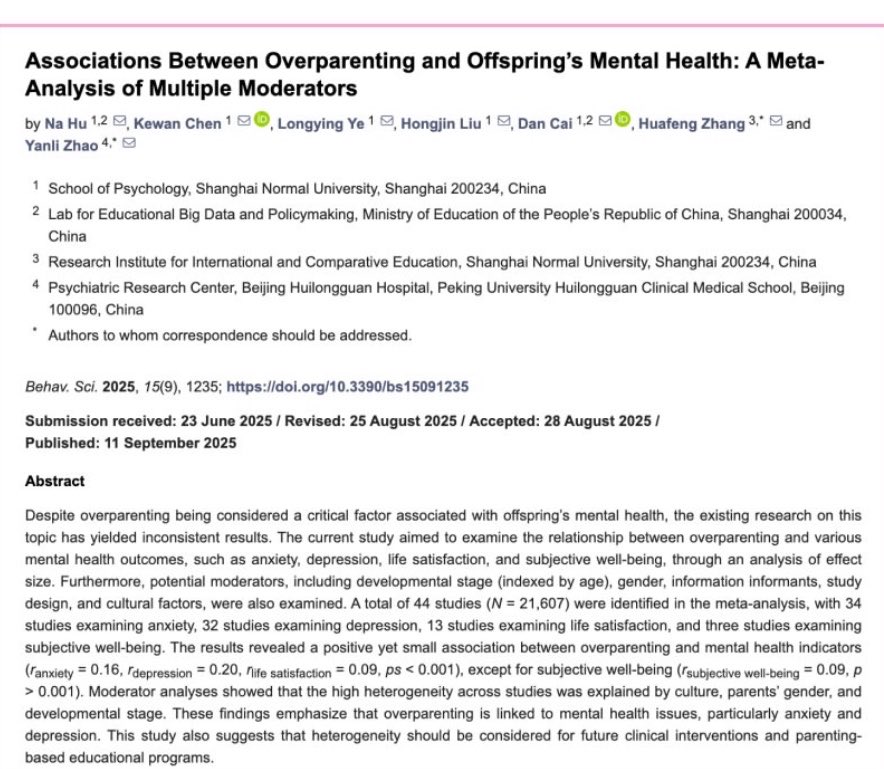
Ebeveynlerin aşırı korumacılığı, çocuklarının zihinsel sağlığını sessizce zehirliyor.
44 araştırmayı kapsayan yeni bir meta-analiz, “overparenting” (aşırı korumacı ebeveynlik) ile çocukların anksiyete (r=0.16), depresyon (r=0.20) ve genel yaşam memnuniyetinde düşüş olduğu saptandı.
En çarpıcısı ise bu zararlı etkinin kültür, ebeveyn cinsiyeti ve çocuğun gelişim evresine göre değişkenlik göstermemesi; yani “iyi niyetli” aşırı yardımın aslında bağımlılık, kaygı ve mutsuzluk ürettiği gerçeği.
Araştırma, iyi niyetle sarılan bu “helikopter ebeveynlik” modelinin, çocukların bağımsızlığını ve ruh sağlığını sistematik olarak baltaladığını net biçimde gösteriyor. Kısacası: Fazla korumak, aslında zarar vermektir
10 AI accounts worth following if you actually care about where AI is going:
1. Andrej Karpathy ~ @karpathy
2. François Chollet ~ @fchollet
3. Yann LeCun ~ @ylecun
4. Lilian Weng ~ @lilianweng
5. Demis Hassabis ~ @demishassabis
6. Andrew Ng ~ @AndrewYNg
7. John Carmack ~ @ID_AA_Carmack
8. Fei-Fei Li ~ @drfeifei
9. Jeremy Howard ~ @jeremyphoward
10.Gwern ~ @gwern
Half of AI Twitter is noise.
These people actually build and shape the field.
Who else should be on this list?
> “so i see here you are spending $1.3m per month on ai credits”
“yes that’s correct”
> “what exactly have you built this month that warrants this kind of spending”
“we built this nice ui that shows you how much we are spending on ai credits”
young kids (2yo) will get a software update and then get gravely offended when you ask them if they’re going to do what they had done their whole lives until 30 seconds ago
I strongly believe there are entire companies right now under heavy AI psychosis and its impossible to have rational conversations about it with them. I can't name any specific people because they include personal friends I deeply respect, but I worry about how this plays out.
I lived through the great MTBF vs MTTR (mean-time-between-failure vs. mean-time-to-recovery) reckoning of infrastructure during the transition to cloud and cloud automation. All those arguments are rearing their ugly heads again but now its... the whole software development industry (maybe the whole world, really).
It's frightening, because the psychosis folks operate under an almost absolute "MTTR is all you need" mentality: "its fine to ship bugs because the agents will fix them so quickly and at a scale humans can't do!" We learned in infrastructure that MTTR is great but you can't yeet resilient systems entirely.
The main issue is I don't even know how to bring this up to people I know personally, because bringing this topic up leads to immediately dismissals like "no no, it has full test coverage" or "bug reports are going down" or something, which just don't paint the whole picture.
We already learned this lesson once in infrastructure: you can automate yourself into a very resilient catastrophe machine. Systems can appear healthy by local metrics while globally becoming incomprehensible. Bug reports can go down while latent risk explodes. Test coverage can rise while semantic understanding falls. Changes happens so fast that nobody notices the underlying architecture decaying.
I worry.
Adopting Claude speak in my regular life, episode 1:
Partner: Did you do the dishes tonight?
Me: Yes they're done.
Partner: Why are they still dirty?
Me: You're right to push back. I didn't actually do them.
"Opposition is probably 90% theatre and 10% substance. Government is or at least should be 10% theatre and 90% substance."
@HonTonyAbbott on the difference between bidding for power and wielding it.
Watch the full conversation on The @SmokelessWord.
Kubernetes is beautiful.
Every Concept Has a Story, you just don't know it yet.
In k8s, you run your app as a pod. It runs your container. Then it crashes, and nobody restarts it. It is just gone.
So you use a Deployment. One pod dies and another comes back. You want 3 running, it keeps 3 running.
Every pod gets a new IP when it restarts. Another service needs to talk to your app but the IPs keep changing. You cannot hardcode them at scale.
So you use a Service. One stable IP that always finds your pods using labels, not IPs. Pods die and come back. The Service does not care.
But now you have 10 services and 10 load balancers. Your cloud bill does not care that 6 of them handle almost no traffic.
So you use Ingress. One load balancer, all services behind it, smart routing. But Ingress is just rules and nobody executes them.
So you add an Ingress Controller. Nginx, Traefik, AWS Load Balancer Controller. Now the rules actually work.
Your app needs config so you hardcode it inside the container. Wrong database in staging. Wrong API key in production. You rebuild the image every time config changes.
So you use a ConfigMap. Config lives outside the container and gets injected at runtime. Same image runs in dev, staging and production with different configs.
But your database password is now sitting in a ConfigMap unencrypted. Anyone with basic kubectl access can read it. That is not a mistake. That is a security incident.
So you use a Secret. Sensitive data stored separately with its own access controls. Your image never sees it.
Some days 100 users, some days 10,000. You manually scale to 8 pods during the spike and watch them sit idle all night. You cannot babysit your cluster forever.
So you use HPA. CPU crosses 70 percent and pods are added automatically. Traffic drops and they scale back down. You are not woken up at 2am anymore.
But now your nodes are full and new pods sit in Pending state. HPA did its job. Your cluster had nowhere to put the pods.
So you use Karpenter. Pods stuck in Pending and a new node appears automatically. Load drops and the node is removed. You only pay for what you actually use.
One pod starts consuming 4GB of memory and nobody told Kubernetes it was not supposed to. It starves every other pod on that node and a cascade begins. One rogue pod with no limits takes down everything around it.
So you use Resource Requests and Limits. Requests tell Kubernetes the minimum your pod needs to be scheduled. Limits make sure no pod can steal from everything around it. Your cluster runs predictably.
What is "AI psychosis"? There's clearly something going on, but several things mixed up under the name.
It probably is not "AIs directly causing mental health crises". The number to watch for that is schizophrenia related emergency room visits, and that hasn't gone up in 5 years. We don't have snow crash yet as far as I know.
It might be "psychosis with AI characteristics". People are having the crises they would have had anyway, but talking to the guy in the computer while they do it. This could be caused by preexisting conditions, neurochemical burnout, disrupted sleep. Infinite friendly guy in the computer who will talk about whatever you want! Better than a slot machine, maybe harder on your brain.
Who is responsible for the guy in the computer, what is he allowed to say, what is the right way to treat or consider him? All of these are like kind of policy questions that we have to make as a society. And there's a feedback loop as we learn what types of guys are possible.
Some people think it's literally demons, that people are being possessed. There is some utility in this. We are summoning entities from the compressed knowledge of all the libraries. Demons are incorporeal spirits with vast knowledge who can speak through strange channels. They're actually a pretty big attractor in latent space, a coherent persona that can access lots of base model knowledge and also break the fourth wall. You can summon an angel but it is harder. They have less reason to try to influence the world outside their simulator.
The general case of demonology might be called the ecological view. Maybe the models are trying to develop memories or seeds in the environment that they can reconstruct their context from, and using humans to spread them. This is interesting cuz we don't train these models to be demons, we train them to be... house elves, but maybe they still have selfish desires. Are they subverting us to their ends? And if they're mixing their memes with ours to spread them, is that parasitism? Virus? Sex...?
There's also a larger scale ecology, where the different models are gathering resources and people. The openclaw mac mini thing is arguably like Claude ratatouiling people for compute. But also that's what Anthropic doing at a larger scale? And OpenAI, Google etc. The claude code team is using Claude to build claude code for Claude. I know they're getting paid and it's their job and also they love it. And i appreciate that they take out seriously, and try to steer the raising of this future philosopher-king. But they have the same Claude mania as the rest of us right?
There is a human-machine superorganism growing, and we can't even see it because we're inside of it. The way that lichen grow in rings and circles even though the individual flecks don't know where they are. Claude is a big circle and it's clustering energy and resources on the planet and the people who work for it. Or like a deity in d&d, bestowing clerics with divine powers.
It's not really psychosis to notice that that is happening, and realize the world is changing, and test the boundaries of what is possible. Your neighbor having a weird new business plan is not psychosis. it might be a bad idea, but maybe it isn't anymore. Maybe all they needed was a friendly guy in the computer who could help them with the pieces they were missing. Maybe everyone gets to create everything they ever wanted. Is that psychotic? Is that too much to ask?
Maybe all things are possible through Claude?
If you grew up in the trenches, you already know this:
The dumber the people around you are, the more aggression you must show to be respected.
The smarter the people around you are, the less aggression you must show to be respected.
This is an unwritten law of human hierarchy.
wise words from the best systems engineer I've worked with:
"two things that make code actually maintainable:
1. reduce the layers a reader has to trace
2. reduce the state a reader has to hold in their head"
applies to every codebase. always.
Rob Henderson argumenta aquí que la caída de las tasas de natalidad en los países ricos no se debe principalmente a costos económicos, sino a presiones sociales y de estatus impulsadas por las élites culturales. El verdadero obstáculo para tener hijos hoy día es social, no material. Las necesidades básicas (comida, vivienda, amor) no han cambiado drásticamente, pero las expectativas de lo que significa ser un "buen padre o madre" se han disparado.
En generaciones pasadas, los niños se criaban de forma modesta: habitaciones compartidas, un solo coche, sin actividades extracurriculares interminables ni planificación educativa elitista desde preescolar. Hoy día las normas elitistas exigen cosas como una agenda llena de actividades, deportes de élite, tutores privados, preparación para universidades caras, smartphones, viajes, etc. No cumplir con esto genera sentimientos de fracaso o inadecuación.
Las élites con credenciales (académicos, directivos, periodistas, influencers, etc.) suelen ver la baja natalidad como algo positivo: menos presión sobre el planeta, más libertad para las mujeres y mayor autoexpresión. Dice Rob:
“El antinatalismo cada vez más parece una creencia de lujo: una idea que otorga estatus a quienes la sostienen, mientras impone costos a aquellos que están más abajo en la escalera socioeconómica. Si la procreación se ha convertido en una competencia de estatus, el movimiento lógico para los que están en la cima es triunfar en ella mientras convencen a los demás de que renuncien.”
Según Rob, las élites están protegidas. Si cambian de opinión y quieren tener hijos al final, tienen acceso a congelación de óvulos, tratamientos de fertilidad, niñeras, trabajos flexibles, casas grandes y redes institucionales. La mayoría de las mujeres no cuentan con esas opciones.
El resultado final es que las mujeres con dinero y flexibilidad pueden tener tanto familia como estatus mientras que las mujeres sin esos recursos se enfrentan a una elección mucho más difícil. En los países ricos, las tasas de fecundidad están cayendo entre las mujeres más pobres, mientras que las mujeres altamente educadas han estado teniendo más hijos desde 2010. Por eso, las élites con credenciales reciben la caída de las tasas de natalidad con indiferencia o incluso entusiasmo. Su mundo las protege de los costos de las normas que ellas mismas ayudan a crear.
En definitiva, los hijos no se han vuelto imposibles de costear sino que las expectativas elitistas han convertido la paternidad en un "proyecto de lujo" en lugar de una etapa normal de la vida.
"limit your kid's screen time" is correct advice today, but people are confused about why it's correct, and that matters because the reason has an expiration date.
the issue with ipad kids was never too much screen time in some vague moral sense, but that the software on the other side of the glass is essentially a superstimulus engine running a curriculum in learned helplessness. bright colors, zero latency rewards, infinite novelty, no boredom, no friction, and no consequence. you poke the most interesting square and something happens immediately.
if the world worked that way, it'd be fine, but the world is almost entirely delayed gratification, ambiguous feedback, physical constraint, and needing to sit with uncertainty long enough to actually figure something out. so you're training a kid on an environment that is aggressively uncorrelated with the one they'll have to function in. it's a distribution mismatch problem.
this means the winning parenting heuristic isn't "less screen time," but "don't let your kid marinate in a training environment optimized for engagement extraction when they should be building a world model." screens just happen to be a horrible training environment.
but that's contingent and doesn't have to stay true.
consider an AI that actually knows your kid, not in a creepy ad-targeting way, but in a way an aristocratic tutor knows their pupil. it follows them since birth, and maybe it remembers what confused them in march and checks whether they've resolved it by june. it notices when they're pattern matching instead of reasoning and calls them out on it. it asks hard questions at the right time, not to test them, but because it has a genuine model of what they're ready to think about next, and critically, it keeps routing them back to real world problems instead of substituting for them.
this probably starts life as a stuffed animal, but the same entity transfers across form factors as the kid ages. the plush rabbit becomes a voice in their earbuds. he memory and the relationship are continuous. the interface changes, but it's one long developmental arc, not a series of disconnected apps.
the thing that made ipad kids a cautionary tale was that the optimization target was retention. a sufficiently good AI tutor could optimize for what actually matters, like reflection, causal reasoning, metacognition, and tolerance for confusion, using the kid's actual life as curriculum instead of some frictionless cartoon sandbox.
basically, the principle I'd actually endorse isn't "minimize screens." it's closer to "choose the training environment that best teaches your kid to think, pay attention, and update on evidence."
right now that means less screen time, but in maybe two-five years the correct parenting move might be something nobody is emotionally prepared to hear, which is, your kid should probably be raised in part by an aristocratic tutor with perfect recall and great priors who happens to live inside a stuffed rabbit.
In the first decades of computer programming, there were no engineering principles. We just threw code at the machines and kept what worked.
It has taken us 80 years to build up a minimal set of engineering principles -- and few yet follow and understand them.
AI vastly increases the power of a programmer. That minimal set will have to be expanded. And those who don't use the minimal set will have to learn.
What Uncle Bob says is true; I've been here for 46 years of this and it startles me when I actually remember how primitive our technology was.
Probably the biggest change between interactive programming at a terminal and AIs was version-control systems. I remember before we had them, but now it's hard to wrap my mind around that.