Hello world!
My old account algo was a mess so this is my new account!
Quick intro if you don't know who I am:
> Founder and CEO of XTrace
> Alum of Stanford and KCL
> prev. Mathworks and Sandia
> now live in SF
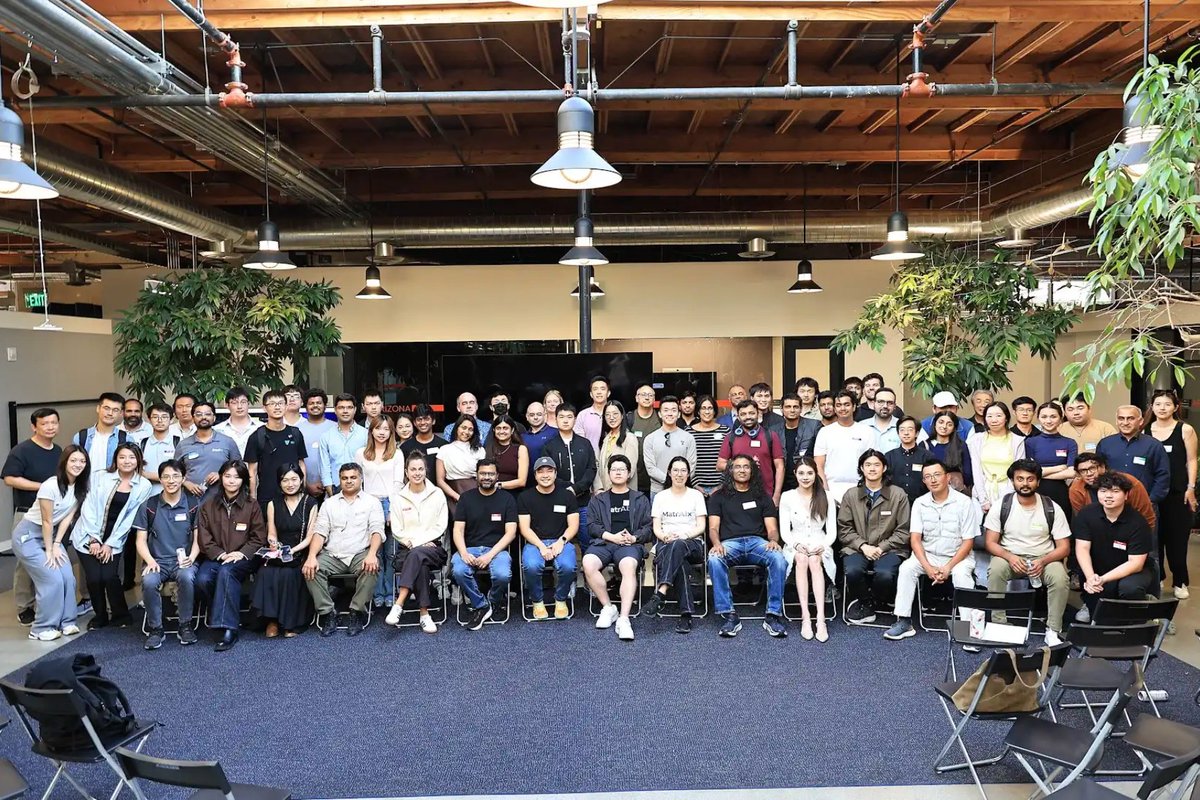
This is the most insightful panel on coding agents for engineers, CTOs, and engineering managers during SF Tech Week 2026.
Next Thursday, Oct 8, I'm hosting: "Unlock the Full Power of Coding Agents: Software Engineering in the Agent Era"
Panelists:
- @austinywang (@manaflowai)
- Carrick Rogers (Saris AI)
- @felixmeng_ (@XTrace_ai )
What we'll cover:
- How tech leaders keep up with new agent tools that come out every day
- How to stop vibe coding from hurting your team's code quality
- How to keep your agents and your team aligned
Sign up: https://t.co/HS8vGNvLQf
Full calendar: https://t.co/sRMiCzqEW9
@Techweek_ #SFTechWeek
@Google open-sourced some insane research
What if not just your agent had a harness, but your environment did too?
>Agent harness: frozen LLM → add tools, memory, loops
>EnvHarness: static environment → add states, rules, observations
They got SWE-bench 61.7 → 68.3
links in comments:
Saturday at the OpenStages panel, I shared my thoughts on the next frontier of AI coding agents: memory that is stateful, shareable, and enforceable, not just retrievable.
Most teams already have specs, decisions, and hard-won engineering lessons documented somewhere. But in practice, coding agents can still miss them, operate on stale assumptions, or confidently take the wrong path.
At @XTrace_ai, we’re building what we call harness-level memory:
- Rules trigger at the right point in an agent’s workflow
- Instructions can include scripts and executable code
- Violations can block progress unless there’s a justified override
- Learned engineering context stays valid as the codebase evolves
The goal is to turn tribal knowledge and past mistakes into harness-level memory that every agent and teammate inherits. Each failure and each success gets written back, so the next agent starts ahead of where the last one finished. To me, that is the clearest path to recursive self-improvement.
Bookmark this!
52% of the time, the model ignores your system prompt.
You didn't read that wrong.
Researchers (Amazon + Notre Dame, NAACL 2025) tested 3,538 cases of exactly this. Every model they tried fell apart the moment instructions clashed.
You wrote careful guardrails. The model treats them as a suggestion.
arxiv link in comments:
I resigned from Anthropic today. I spent the last three years doing pretraining research at both OpenAI and Anthropic. Neither company is acting responsibly. They are racing straight to self-improving superintelligence and gambling with our lives. More thoughts below.
Bookmark this paper from NVIDIA!
Ever added a skill to your agent and just... trusted it worked?
NVIDIA ran the numbers. The linters that check a skill's structure and style tell you almost nothing about how it does on real tasks (correlation 0.14).
What actually works: run the same task with and without the skill, and look at the difference. They did this 947 times. The skill helped in about 3 out of 4 runs. The other 1 in 4? Nothing, or worse.
arxiv link in comments:
What is the best way to manage agent context and memory?
I was asked so many times during the From Context to Execution panel. Hosted by Stella Xiao and Sumit Jagdale from Sartorial.
AI agents don’t just need more memory; they need memory that knows when it’s no longer true. Most teams store context as static instructions, markdown files, or accumulated “memories.” But software systems change constantly. A feature ships, infrastructure changes, a deployment config is removed, and yesterday’s correct context becomes today’s source of confusion.
The approach: tie memory to the state of the world.
For coding agents, that means connecting memories to the repo and infrastructure state. When a PR changes relevant files, only the associated memories need to be reviewed. If a state transition invalidates a memory, the system should flag why it is no longer reliable.
A few principles that stood out:
Not all memory is worth keeping. Store what is non-derivable or expensive to reconstruct; discard cheap, task-specific knowledge.
Successful trajectories can be harmful. Similar-looking tasks can cause agents to confidently reuse the wrong solution.
Mistakes and recoveries may generalize better. Knowing how an agent failed — and recovered — can be more useful than replaying a previous “success.”
Context should be conditional. Load it when a task, file, or error state makes it relevant — not all at session start.
The hard problem isn’t just retrieval. It’s provenance, validity, and decay.
As models improve, the competitive layer may be less about writing longer prompts and more about maintaining a living, auditable understanding of what is true right now.
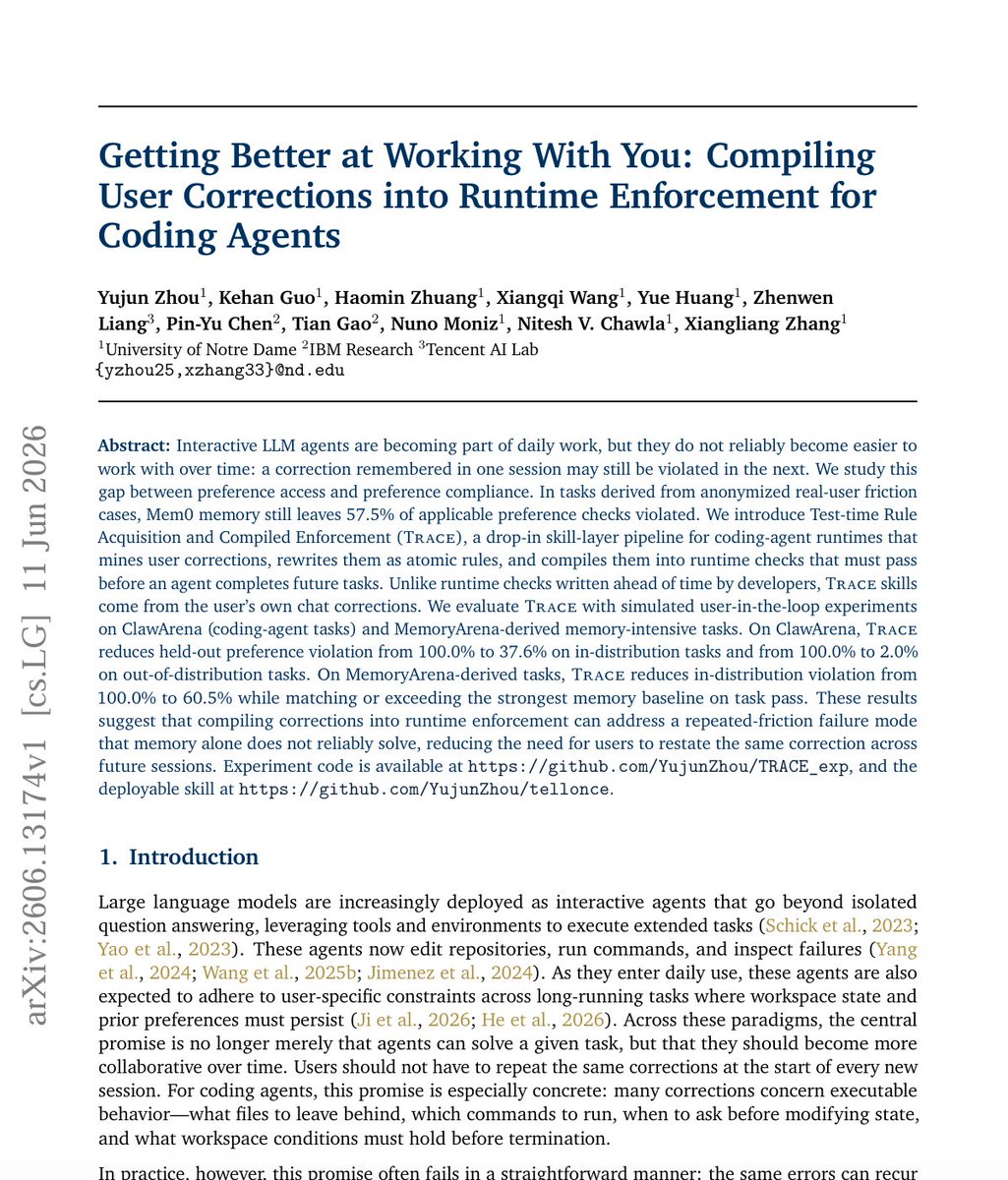
Bookmark this research from IBM and Tencent!
Coding agents "remember" your corrections, then break them next session.
Even with memory (Mem0), 57.5% of preferences still get violated
The study's fix: compile corrections into runtime checks the agent must pass. Violations drop from 100% → 2% on new tasks.
arxiv link: