Big day today at @Ginkgo: we're pulling back the curtain on our proprietary biological foundation models and launching a model API!
Our API will support private and open models, and we're pricing it competitively to enable others to build on top of it.
Details in 🧵👇
@bsenser@svpino From the article:
"There are a number of very good open-source libraries if you want to start your journey in TDA."
scikit-tda: https://t.co/HnxLnbTRCM
giotto-tda: https://t.co/a2W804GoXI
Mapper: https://t.co/huKWNWeBMX
... All available on GitHub. Not open source enough?
What if we used prompt engineering on Chemical Language Models to help us discover new molecules?
In our paper, we developed a novel SMILES-based prompt engineering strategy that was able to identify structurally distinct functional analogues of small molecules.
🧵(1/11)
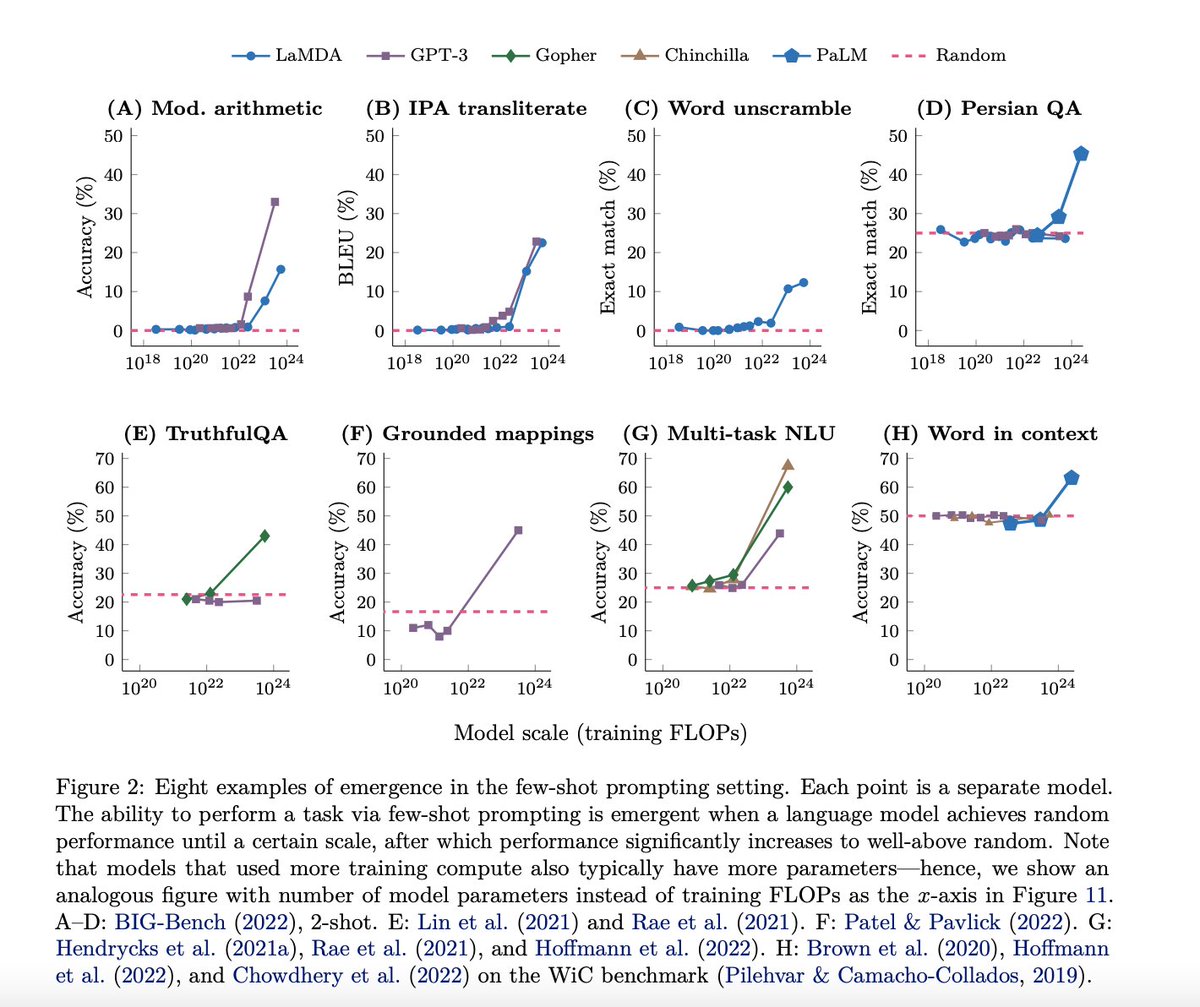
Considering examples of "emergence" in abilities of LLMs as model size is increased
In the early days of BEC I remember someone remarking "turns out the thermodynamic limit is just a few hundred atoms". Not so in LLMs!
I described some of the most beautiful and famous mathematical theorems to Midjourney.
Here is how it imagined them:
1. "The set of real numbers is uncountably infinite."
@jivarahasya Hello! Are you taking on PhD candidates? I am a biochemist currently working in novel phage defense systems, exploring a newly identified small molecule interaction, and am building up my computational expertise.
#AlphaFold full code is now available… Anyone at @ASU and/or @ASUBiodesign working on getting this set up?
I’d love to help set up a submission protocol so any lab can submit without much coding knowledge.
Nature has published the latest iteration of AlphaFold, a computational approach employing machine learning for predicting full-chain protein structure with high accuracy. https://t.co/8AFXh96gIv