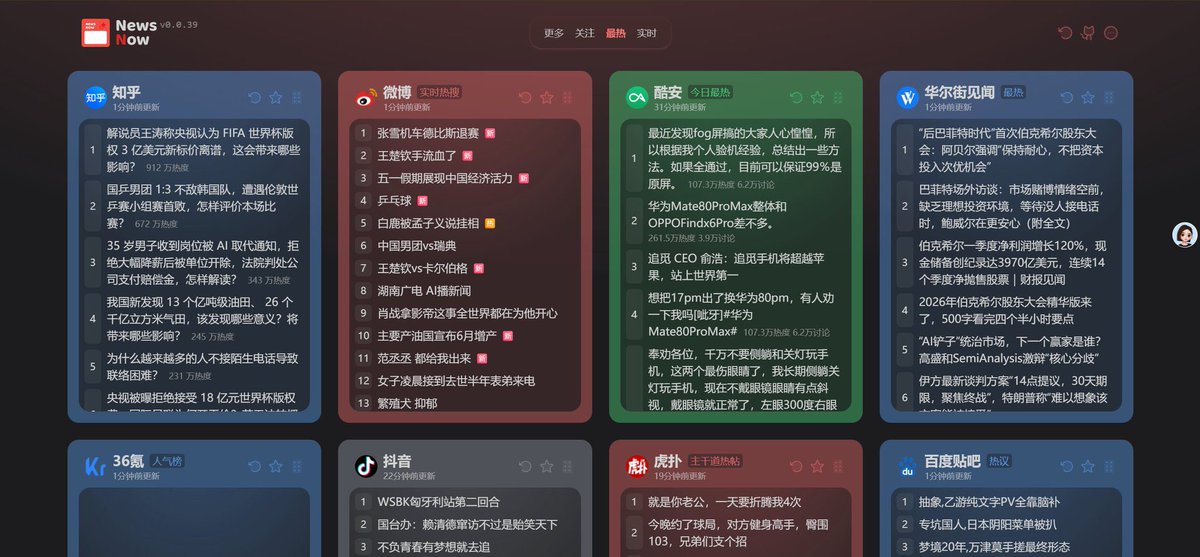
I’ve noticed a very real pain point in AI coding:
What am I supposed to do while waiting for the AI to come back?
When I code with an AI agent, I often enter a strange state.
I hand a task to the agent.
It starts reading code, editing files, running tests, fixing errors.
It looks like the AI is working for me.
But I don’t actually feel relaxed.
Because I’m still waiting for it.
And this is not ordinary waiting.
If it only takes a few seconds, that’s fine.
But many agent tasks take tens of seconds, minutes, or even longer.
During that time, I get stuck in an awkward state:
I can’t fully leave, because I’ll need to review what it changed, check whether it went off track, and decide what to do next.
But I also can’t really participate, because the execution is currently in the agent’s hands.
So I’m neither focused on work nor truly resting.
I’m just suspended.
This feels surprisingly oppressive.
In traditional software development, we also wait for builds, tests, and deployments.
But that kind of waiting is usually more predictable.
You roughly know what the system is doing.
You know what you’ll do when it finishes.
Waiting for an AI agent feels different.
The agent is thinking, searching files, changing code, generating solutions, and sometimes fixing its own mistakes.
But you don’t know whether it will drift, miss context, introduce bugs, or misunderstand the original intent.
So it’s hard to fully relax.
If I stare at it, I feel anxious.
If I don’t stare at it, I worry it might go wrong.
If I switch to something else, I may not come back easily.
This is a hidden problem in many AI coding products:
They improve execution efficiency,
but they also create a new kind of cognitive burden.
Especially when the waiting time becomes longer, people naturally open something else:
messages, feeds, group chats, another task, an article, another tab.
On the surface, this looks like “using fragmented time.”
But once you truly jump away, the context-switching cost becomes very high.
When you come back, you have to reload everything:
What did I ask the agent to do?
Where is it now?
Why did this diff appear?
Did it actually solve the core problem?
Should I let it continue, or should I take over?
So the AI agent may save execution time,
but if the waiting state is not designed well, part of that saved time gets eaten by attention switching and context recovery.
This made me wonder:
Can we design a better way to handle this waiting time?
Not by forcing people to stare at a progress bar.
Not by encouraging them to start another serious task.
Not by inserting a random feed that pulls them completely away.
But by creating a lightweight middle state:
You stay near the main task,
but you don’t have to stay tense.
You can loosen up a bit,
but you don’t fully derail.
I call this a “waiting capsule.”
It is not a heavy feature.
It is more like a low-friction cognitive buffer next to the AI agent workflow.
When the agent is working, the capsule can show lightweight content:
a related case,
a technical concept,
a piece of industry news,
a product insight,
an old note,
an unfinished question,
or even something light enough to let the brain breathe.
The point is not to “maximize every minute.”
I actually think this should not be too productivity-driven.
It is not about forcing learning into every gap.
It is not about squeezing more value out of waiting time.
Its real value is to help people stay in a more humane state while the AI is executing.
Because humans are not machines that can stay in high-alert monitoring mode forever.
Rigorous judgment does require focus.
But rigor should not depend on constant tension.
If someone stays too long in the state of:
“I must keep watching it.”
“It might go wrong at any second.”
“I may need to rescue it later.”
“I’m bored, but I also don’t want to lose the context.”
Their attention gets drained.
Their judgment narrows.
Their inspiration gets suppressed.
High alert is good for risk detection, inspection, and fallback.
But it is not good for long-term creativity.
It is not good for sustained complex judgment.
A more human work rhythm needs tension and release.
When it’s time to inspect, we should converge.
When it’s time to wait, we should be able to loosen up a little.
Not fully leaving the main thread.
But not staring at a progress bar like a guard either.
This is where the waiting capsule matters.
It is not about making vibe coders lazy.
It is not about distracting people.
It is about providing a low-load, returnable buffer while the AI is executing.
A place where people can briefly touch inspiration, knowledge, news, old notes, or lightweight content.
But unlike an infinite feed, it should not pull them completely away.
If done well, AI coding would feel less like a tense monitoring relationship.
It would feel more like a rhythmic collaboration:
The AI executes.
The human keeps judgment.
The AI pushes the task forward.
The human stays mentally alive.
The AI does not require the human to stare at it like a supervisor.
But the human also does not fully leave the work context.
And if this idea goes deeper, I don’t think the content should only come from the external web.
It should connect with your personal knowledge base.
Because different people need different things while waiting.
Some people want technical background.
Some want industry news.
Some want to review English expressions.
Some want product examples.
Some just want something light.
Some need the feeling of: “I’ve thought about something like this before.”
If the waiting capsule can connect to a personal knowledge base, it becomes more than random recommendation.
It can surface lightly related things from your old notes, saved articles, project retrospectives, reading highlights, question lists, and idea fragments.
It does not need to be as precise as search.
It does not need to feel as heavy as formal learning.
It is more like gently bringing back your past thoughts at the right moment:
“You thought about a similar problem before.”
“This task is related to a case you saved.”
“This connects to a long-term theme you care about.”
For many people, the biggest problem with a personal knowledge base is not the lack of content.
It is that the content is asleep.
Notes are written and forgotten.
Bookmarks keep accumulating.
Project retrospectives are rarely reopened.
AI agent waiting time creates a natural moment to reactivate them.
So the waiting capsule is not about filling empty time.
It is about helping people who code with AI maintain a low-load but connected mental state during the gap where they can’t participate, but also can’t fully leave.
They can come back.
They can still judge.
They can still have new ideas.
A good AI coding product should not make people stare at AI like supervisors.
It should let the AI execute while the human keeps a more natural rhythm:
not constantly tense,
not completely derailed,
not losing context,
and not suppressing inspiration.
A2UI v0.9 is the new standard for portable Generative UI, allowing your agents to natively "speak" UI directly to your existing frontends.
✨ React, Flutter, and Angular support
🐍 Python SDK via pip install
⚡ High-performance streaming
🛠️ Design system integration
Learn more via the blog: https://t.co/YOTjKGBDjm