@mohamed07473@_AfricanUnion Please explain your statement so that we can obtain a better understanding of your political perspective. What exactly do you mean by "imperialist AU" and the AU's "colonial masters"?
@WandileSihlobo I agree that the vision should be prosperity for all in the region, and nations will become more stable and happy when they reach self-sufficiency in their food production. We need to help each other to reach that point of successful food production for all.
This man stole a country from his own father and spent the next 18 years buying the West with gas money.
- He deposed his own dad in a palace coup and left him in exile for nearly a decade
- He founded the news network that aired Osama bin Laden's tapes
- He built America's largest military base in the Middle East and charges no rent for it
- He bought Harrods, the Shard, Canary Wharf, Paris Saint-Germain and 17% of Volkswagen
- He won the 2022 World Cup for a country with no football history
Sheikh Hamad bin Khalifa Al Thani died this morning at 74.
Here's how bought the world:
In June 1995, he waited for his father to leave the country, then took the throne. The coup was bloodless. His father spent nearly a decade in exile.
Qatar is about one third the size of Belgium, and its population was barely two million, most of them foreign workers.
But it was sitting on one of the LARGEST natural gas reserves on Earth.
He bet everything on liquefied natural gas. Qatar became the world's biggest LNG exporter and one of the richest countries alive per person.
Then he hit the problem every commodity business hits:
Gas is gas, anyone with a tanker can sell it, and a tiny country with no army and that much money is a snack for its neighbours.
So he bought two things nobody else in the Gulf thought to buy...
The first was the world's attention.
In 1996 he issued a decree and Al Jazeera was born. Within a few years it was the most influential news network in the Arab world.
He owned the loudest microphone in the region and never had to speak into it himself.
The second was the American military.
In 1996, Qatar spent over a billion dollars building an air base at Al Udeid, outside Doha. It got the longest runway in the Gulf and shelters for nearly a hundred aircraft.
Qatar's air force only had about a dozen fighter jets.
In 1999 he reportedly told US officials he wanted 10,000 American servicemen stationed there permanently.
Then 9/11 happened, and they came.
The genius part:
Al Udeid is now the forward headquarters of US Central Command and the largest American base in the Middle East, with roughly 10,000 troops.
Qatar charges no rent.
He built the asset before the customer existed, handed it over free, and bought the one thing cash cannot: The US military parked permanently between his gas and everyone who wanted it.
The network broadcasting bin Laden and the runway flying America's war sat in the same tiny country, paid for by the same man.
Then he went shopping...
He set up the Qatar Investment Authority in 2005:
- Harrods
- The Shard
- Canary Wharf, London's largest property owner, bought with Brookfield for 2.6 billion pounds
- 17% of Volkswagen
- Paris Saint-Germain
All his.
In 2017 the Telegraph ran the headline "Qataris own more of London than the Queen."
Then 2008 arrived. Barclays needed billions or the British government was going to own it. Qatar wrote the cheque and its stake climbed to 12.7%. Barclays was later charged over how it disclosed that Qatari money.
In 2010, FIFA handed the 2022 World Cup to a desert country with NO football history. Corruption allegations shadowed the bid for over a decade, and the treatment of the migrant workers who built it drew brutal criticism.
Yet he walked into the opening match in 2022 and the stadium gave him a standing ovation.
Every other Gulf state was selling the same molecule at the same price. Hamad spent his money on a newsroom, a runway, a football club and half of London.
A country of two million now brokers hostage deals and hosts American presidents.
He built all of it in 18 years, and he took the throne from his own father to start.
Truly an unmatched legacy.
After years of being banned from entering a stadium in my own country, for no crime other than being a woman, this is how I walked in.
This was the World Cup FIFA 2026 between England and Panama but for me, it was beyond that.
You have to be a woman from Iran or Afghanistan to truly understand this emotion.
For whom this simple act, walking into a stadium, moving with joy, showing my hair, sitting next to men, was not just forbidden. I was beaten for it. Imprisoned for it. Humiliated for it. Exiled for it. And even in exile, I became a target for multiple assassination plots.
And now people lecture me: "Don't politicize football."
I have a question: which part of my body hasn't already been politicized by the Islamic Republic? My hair? My voice? My seat in a stadium?
They turned our entire existence into a political battlefield. Every inch of a woman was a crime scene under their law.
And now I'm supposed to just sit back, eat a hot dog, and enjoy the game?
I did enjoy the game. England won. But walking through those gates, that was the real victory.
He is 84 years old. He just completed the world's most difficult ultramarathon (Comrades) in the world. And he did it within cutt-off time. 11h12. Johannes Mosehla.
Ages Of Human History
1. 🏹 Paleolithic Age (2.5M–10,000 BCE)
2. 🎣 Mesolithic Age (10,000–8000 BCE)
3. 🌾 Neolithic Age (8000–3000 BCE)
4. 🏺 Bronze Age (3300–1200 BCE)
5. ⚔️ Iron Age (1200–500 BCE)
6. 🏛️ Classical Age (500 BCE–500 CE)
7. 🏰 Medieval Age (500–1500 CE)
8. 🎨 Renaissance (14th–17th Century)
9. ⛵ Age of Discovery (15th–17th Century)
10. 🏭 Industrial Age (1760–1900 CE)
11. ☢️ Atomic Age (1945–Present)
12. 🚀 Space Age (1957–Present)
13. 💻 Information Age (1970–Present)
14. 🤖 Digital Age (2000–Present)
🚨 Colombia just elected a man who said the only peace process he believes in is one "imposed by the force of arms."
Do you understand what that means?
– Abelardo de la Espriella — a political newcomer, zero elected office, celebrity criminal lawyer — just won Colombia's first round with 43.7% of the vote
– He was trailing in polls. He outperformed every establishment right candidate. He did it anyway.
– His platform: 10 mega-prisons in the jungle. Military offensives. US-backed strikes on cartels. End all peace negotiations with armed groups.
– His exact words: "Any bandit who resists will be eliminated as appropriate. If he submits, he goes to a mega-prison to pay his debt to justice."
– That is not a campaign slogan. That is a GOVERNING DOCTRINE.
– He modeled himself directly after Nayib Bukele — the man who put 80,000 gang members in a single prison and dropped El Salvador's murder rate to near zero
– Outgoing President Gustavo Petro ran on total peace negotiations with cartels and guerrillas. His policy produced more kidnappings, more extortion, more violence.
– The Colombian electorate just looked at four years of that and said: enough.
– The runoff is June 21. His opponent: leftist Senator Iván Cepeda at 40.9%.
– Ecuador's President Noboa congratulated him within hours. The regional right is watching.
The Colombian people didn't elect a politician.
They elected a lawyer who spent 20 years watching cartels walk free — and decided to run for president to stop it himself.
The cartel era in Colombia just opened a door that CANNOT be closed.
And the jungle is watching.
I'll keep you updated. Turn on notifications. 🚨
DMITRI MENDELEEV: The Boy Whose Mother Crossed Siberia for Him In 1850, a dying widow dragged her 16-year-old son 4,000 miles across frozen Siberia — just to get him into university. She succeeded… then died weeks later.
Nineteen years after her death, that boy gave the world the Periodic Table.Dmitri Mendeleev was the youngest of at least 14 children in remote Tobolsk, Siberia. When he was 13, his father died and the family was left penniless. His extraordinary mother, Maria Dmitrievna, reopened their abandoned glass factory and ran it herself to keep food on the table and her youngest son in school.When the factory burned down, she made the ultimate decision. She would take Dmitri to St. Petersburg — no matter the cost.They traveled for weeks by sledge and boat through brutal cold and wilderness. Maria was already ill, but she refused to turn back. Moscow University rejected them because Dmitri was from Siberia. So she pushed on another 400 miles to St. Petersburg.The Main Pedagogical Institute finally accepted him. Maria had won.
A few weeks later, she died.Left alone at 16, grieving both parents, Dmitri honored her sacrifice by throwing himself into chemistry. In 1869, he created something revolutionary: a table that arranged the 63 known elements not just by weight, but by their properties and behavior.He boldly left empty spaces — and predicted the exact properties of elements that hadn’t been discovered yet.
Skeptics laughed.Then the discoveries came:
Gallium (1875), Scandium (1879), and Germanium (1886) — all exactly as Mendeleev had foreseen.The Periodic Table wasn’t just an organizer. It revealed the hidden rhythm of nature itself. Today it remains the foundation of modern chemistry and still predicts new elements.Dmitri never forgot his mother. He kept her photograph and credited her sacrifice for everything he achieved. Maria Dmitrievna never studied science — she was a Siberian widow who ran a factory and raised 14 children. Yet she saw genius in her son and gave her life so the world could one day see it too.The greatest scientific discovery of the 19th century didn’t begin in a laboratory.
It began with a mother who refused to let poverty, distance, or death stop her son’s destiny.
Imagine you are on your balcony and you notice a man running from the police. From your height you can see where the guy evaded the officer and is hiding.
You can clearly see the police needs pointed in the right direction but you choose to say nothing, even when the officer asks you. On another balcony, the man is yelling and pointing the guy is getting away. What would you have done? Protect the person in trouble or point out where they were?
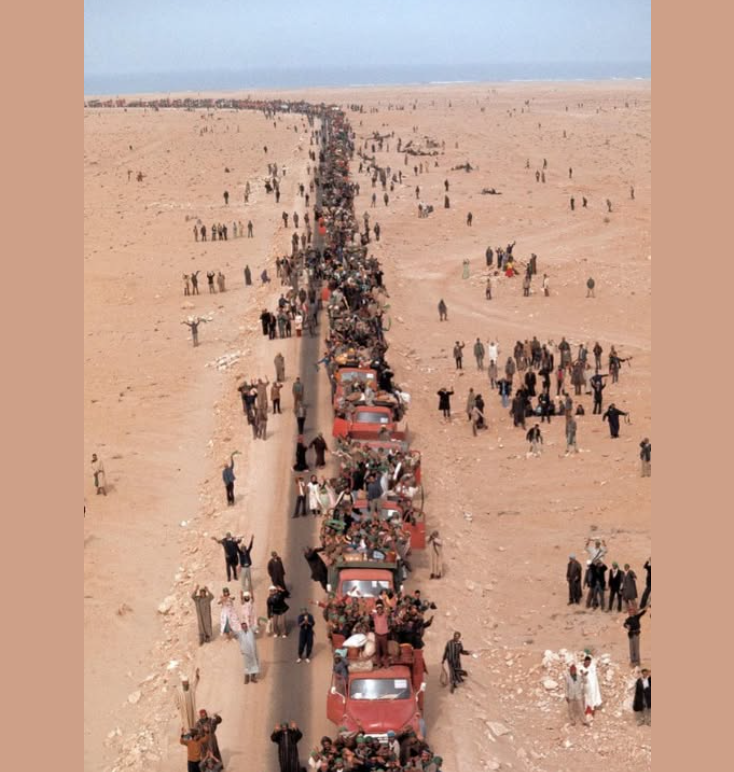
In 1975, more than 300,000 Moroccans took part in the historic “Green March,” a massive peaceful demonstration into Western Sahara aimed at ending Spanish control over the territory.
On November 6, around 350,000 unarmed Moroccan civilians, supported by roughly 20,000 troops, marched across the border carrying Moroccan flags, copies of the Quran, and portraits of King Hassan II. The carefully orchestrated event was designed to pressure Spain into handing over the territory without armed conflict.
The march occurred at a critical moment, just weeks before the death of Spanish dictator General Francisco Franco. On November 14, Spain, Morocco, and Mauritania signed the Madrid Accords, formally transferring administrative control and effectively bringing an end to nearly a century of Spanish colonial presence in the region.
The issue remains unresolved to this day. The Algeria-backed Polisario Front rejected the agreement and declared the Sahrawi Arab Democratic Republic in 1976. A UN-brokered ceasefire was signed in 1991, but Western Sahara continues to be one of the world’s longest-standing territorial disputes, with the promised referendum on self-determination still unheld due to disagreements over voter eligibility.