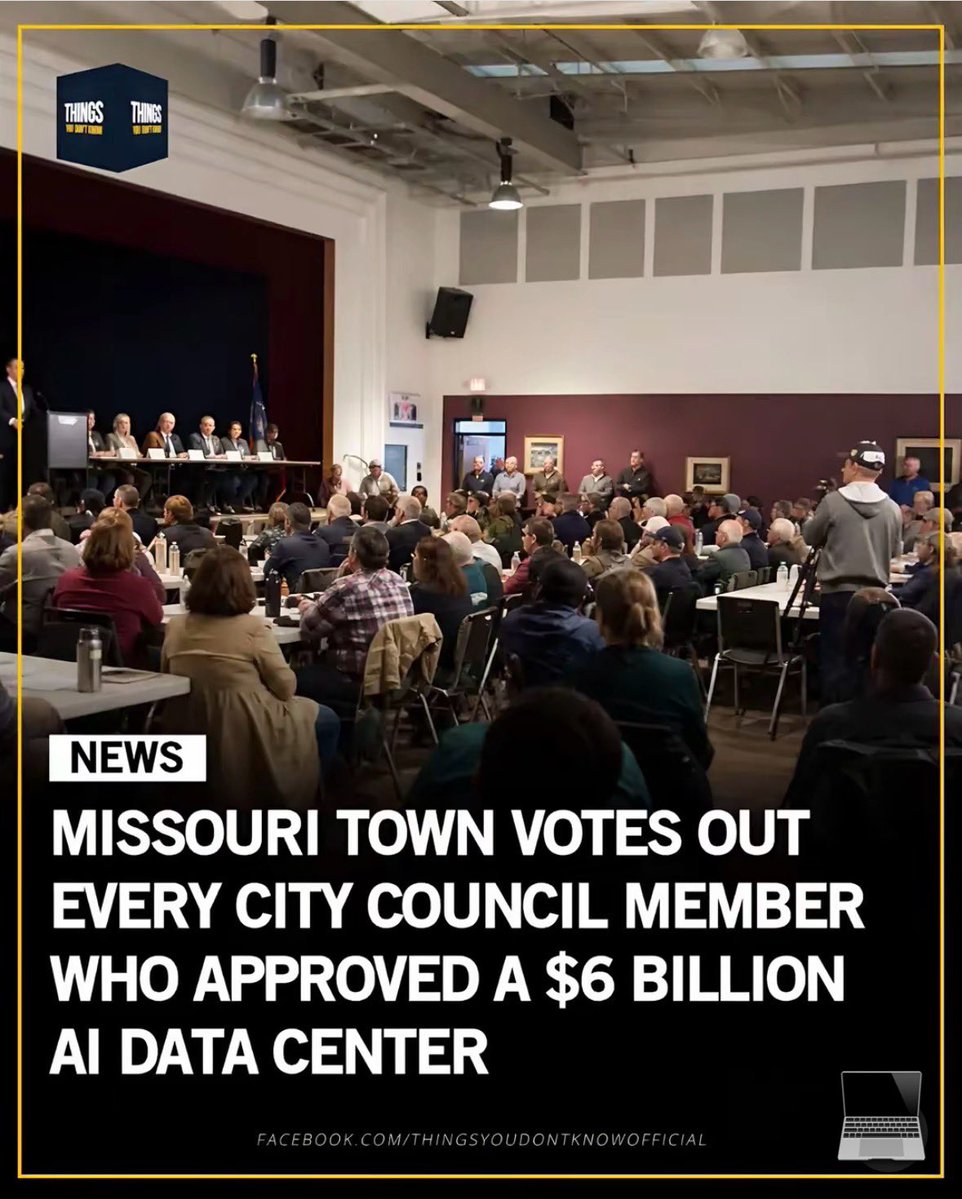
This is what local accountability looks like:
In Festus, Missouri, a town of about 14,000 people, the city council quietly approved a $6 billion Ai data center to be built on 360 acres just north of Highway 67.
Residents say they were never properly heard. Meetings were held in private. Documents were released too late. A week after the approval, the town held a regular election. Voter turnout jumped 129 percent.
Every single council member who had voted yes lost in a landslide. A 70-year-old first-time candidate beat an 8-year incumbent by 40 percentage points.
Now a recall petition is circulating to remove the mayor as well. The lawsuit against the city is already filed.
Has your local government ever been held accountable like this? 🔥
Yes, corruption exists everywhere, but this level of wickedness is something I’ve mostly seen in Africa. When a relative made it to the House of Representatives years ago, the first thing he did was buy what looked like a 20-acre farm. He fenced the entire land, built something inside that only your imagination can describe, and it takes a full five-minute drive from the gate to the final fence. He even constructed a brand-new road leading to his mansion, and stopped it the moment it passed the last fence. He was never there, no one was. His kids lived abroad, his wife lived in Abuja and he shuttled between Abuja and Lagos, yet he used money meant for the people to acquire this nonsense for himself.
He had Zero legacy. It was awful. Of course he only served one term.
To say our parliament is a joke an abject failure is the understatement of the decade.
It took 50 years for Kenya to accumulate KSH 2 trillion worth of national debt.
In 2014, the debt was KSH 2.3 trillion.
It was KSH 8.6 trillion when Ruto took over. It went up close to 300% under Uhuru Kenyatta. Reckless and irresponsible.
It is just under KSH 12 trillion today.
Almost KSH 4 trillion in three years. And, there is nothing to show for any of this debt.
Secondary capitation just got cut in half. SHA is garbage. Crumbling infrastructure and corruption on steroids.
And for every single shilling we earn today, 75% is going to debt service. As opposed, going to the "people service".
With all that in mind, take a look at the findings of the Office of Auditor General in the attached first picture.
This is from the 2023-2024 fiscal year.
And I will translate it for you.
The Auditor–General is saying that:
(1) The Public Debt Management Office (PDMO) – the unit that actually borrows on behalf of Kenya – has not been properly audited by the Internal Audit Directorate.
(2) The internal auditors at Treasury claim they have a 3-year strategy that includes PDMO, but they won't show it to the Auditor-General.
(3) They say they audited PDMO in 2020/21, but no audit report was provided. Last did it 2020/2021 - years before probably 6 trillion in new debt was borrowed.
No fresh audit, for close to 5 years, and they say they don't have a copy of that old audit. Can you believe this nonsense?
(4) There is no internal audit risk management policy, so they can’t even show how they decide what to audit. I don't have the words to describe just how dumb and crazy this particular situation is. And I have been trying to articulate it for an hour. It is perhaps closest to, running into a rally driver who is dressed up, has his fancy souped up Subaru Imprezza, but then you find out he does not have any idea where the race is starting, going, or ending.
The AG explicitly says this is contrary to Reg. 160(1)(b) and 162(2)(b)(c) of the Public Finance Management (National Government) Regulations, which require:
(a) internal auditors to give reasonable assurance on risk management, control and governance;
(b) organizational structures that guarantee independence, broad audit coverage and follow-up on recommendations.
In summary, the Treasury is not complying with the PFM framework on one of the most sensitive areas of government – public debt.
This is not a small procedural issue. In a country where we are spending 75% of every single shilling on debt service, and in a country where the president is out here asking for another KSH 4.5 trillion in debt today, this is bonkers.
What this all means is that, our borrowing as a country has effectively been “unchecked” internally.
If PDMO is not being properly audited, there is no independent internal check that:
(1) Borrowing is within legal limits and done in compliance with all laws;
(2) Terms are competitive, and prudent for the country;
(3) Proceeds are used as approved; and
(4) Risks (such as FX, interest, refinancing) are being managed properly and prudently.
In the AG’s own words, and I quote:
“the National Treasury did not benefit from the oversight role and advice from the Internal Audit Function on effective management of public debt”
Meaning that the internal control system around debt is effectively broken. It is the wild-west. We are in the jungle.
That’s exactly how:
(1) Odious, unnecessary or overpriced loans slip through;
(2) Shady Eurobond-type deals happen;
(3) Politically connected intermediaries and advisors eat; and
(4) Nobody inside the system raises a finger.
Going back to the macro situation, this helps explain why our debt situation is so bad.
>>Debt has jumped from ~KSh 8.6T to near KSh 12T in three years.
>>Over 70% of revenue is now going to debt service.
>>Domestic debt is about half the total but roughly 70% of the interest bill (very expensive, short-term, bank-heavy stuff).
Now add this AG finding, that:
All this borrowing has been happening without a functioning internal audit framework over the debt office.
In that kind of a situation:
(1) Debt decisions may not have been systematically tested for value for money, affordability, or consistency with policy.
(2) Errors, abuse, or outright theft in debt contracting can go undetected for years.
(3) The probability that some of this debt is irregular, unlawful, or clearly against the public interest goes up sharply.
Here is the important question.
Ruto has borrowed close to KSH 4 trillion since taking office. The debt is up 40% in three years.
Folks are asking, where is this money? What did it build?
Again, it took 50 years for us to rack up KSH 2 trillion in debt.
And it has taken this government three years to rack up KSH 4 trillion.
If internal audit isn’t auditing PDMO amidst all this borrowing, who, exactly, has been giving Parliament comfort that debt is well-managed?
The answer is, NO ONE.
Here is my summation.
(1) Budget and Finance Committees have been approving borrowing based largely on Treasury’s own numbers, not on independent internal audit work. Our parliament has failed miserably, once again.
(2) This finding gives citizens and litigants concrete evidence that Parliament’s oversight has been hollow – not just politically, but structurally, because the key assurance function inside Treasury wasn’t doing its job.
Here is what must be demanded by every Kenyan.
(1) A full, independent public debt audit;
(2) Legal reforms to ring-fence and publish internal audit work on debt; annually.
(3) Litigation demanding that ALL debt contracts be disclosed and, where irregular, challenged.
These are the minimums when it comes to this situation.
Contact your MPs and make these demands known. And let them know you are going to vote them out if they do not fight to bring accountability on this issue.
@Senate_KE@NAssemblyKE@MoGAbdi@Bright_Shitemi@MigunaMiguna@Mizani254@JohnMbadiN@EricLatiff
Today I would like to take a moment to educate Kenyans on the ongoing frenzy of ' Chinese Engineers are better ' and ' Kenyans engineers can't do this or that' and engineers who don't understand why you keep seeing Chinese in projects.
I will use a case study of Kiambu road