"When you wake up in the morning, think about the privilege of being alive: to breathe, to think, to enjoy, to love." Marcus Aurelius 😀
#Followback#FollowMe#SiguemeYTeSigo 💯
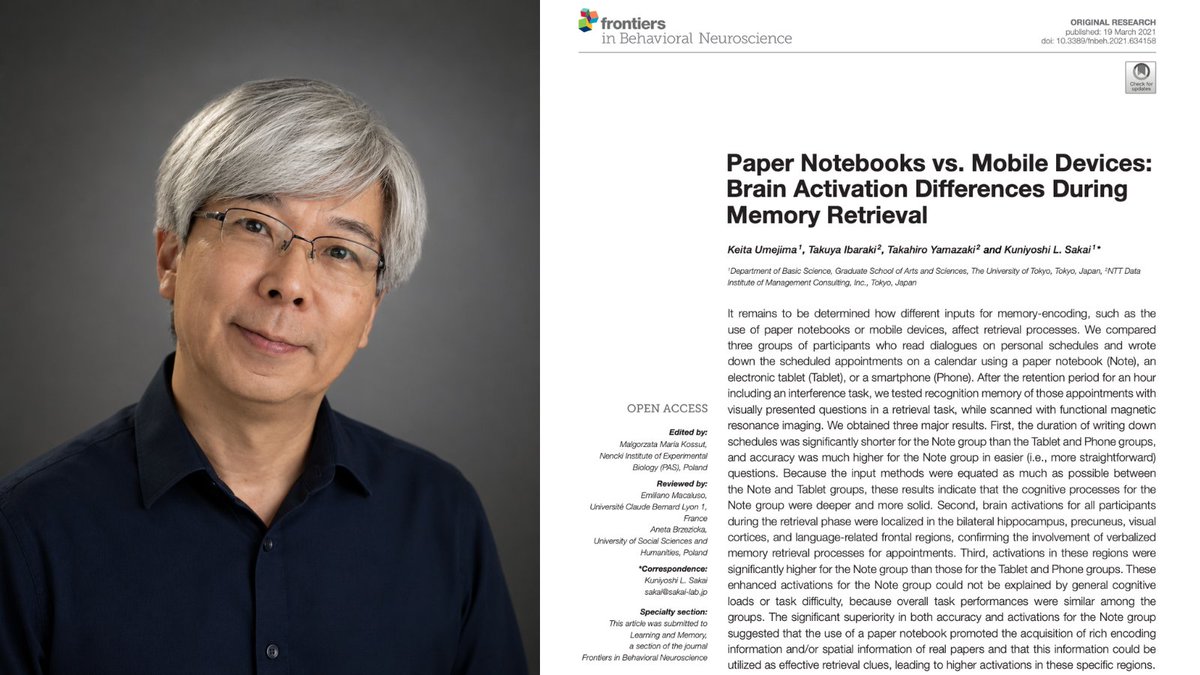
A Japanese neuroscientist put 48 people inside an MRI scanner and proved that writing your schedule on paper makes you remember it better than any calendar app on Earth, and the tech industry has spent the last 20 years hoping you would never read the paper.
His name is Keita Umejima.
He works inside the Sakai Lab in the Graduate School of Arts and Sciences at the University of Tokyo, and the paper was published in 2021 in a journal called Frontiers in Behavioral Neuroscience.
The finding is clean enough that it should have changed how every person on Earth writes down their schedule.
The experiment was so simple. His team recruited 48 university student volunteers between 18 and 29 and split them into three groups of 16 each.
Every participant was asked to read a set of dialogues about personal schedules and then record all the appointments into a calendar.
One group used a paper notebook and a pen. The second group used a stylus on an electronic tablet. The third group typed the appointments into a smartphone.
Then the researchers made them wait for a full hour, with a deliberate distraction task in the middle so no one could quietly rehearse the schedule in their head.
When the hour was up, every participant was slid into an fMRI machine and asked multiple choice questions about the appointments they had recorded, while the scanner watched the blood flow through their brains in real time.
The behavioral results came in first, and they were already brutal.
The paper notebook group finished recording their calendar in about 11 minutes. The tablet group took 14. The smartphone group took 16.
The paper group was roughly 25 percent faster than the phone group at the exact same task, and when the researchers checked whether people who preferred analog in daily life were skewing the numbers, they found the difference held either way.
The speed gap was not about familiarity with the tool. It was about how the brain was actually processing the information as it went in.
On the memory test that followed, the paper group answered the straightforward recall questions more accurately than either digital group.
They had encoded the schedule faster and remembered it more precisely, using a tool the tech industry has spent 20 years telling you was obsolete.
Then the fMRI data came in, and the picture got sharper.
When the paper notebook group tried to remember an appointment, the scanner showed strong activation across several regions of the brain at once.
The hippocampus, which is the part of the brain responsible for forming and retrieving memories, lit up far more than in either digital group. So did the precuneus, which is the region that handles spatial imagination and holds visual scenes in the mind's eye.
Language regions and visual imagery regions were also more active in the paper group than in the tablet or phone group.
The reason turned out to be something Umejima's senior author Kuniyoshi Sakai spelled out plainly in his interviews.
A page in a paper notebook is a physical location in space. The top left corner is not the same as the middle of the page. A Tuesday appointment written next to a coffee stain is not the same as a Tuesday appointment written under a doodle.
Every entry has a texture, a position, a slight variation in handwriting pressure, a physical relationship to everything else on the page.
Digital calendars strip all of that away. Every entry looks the same as every other entry. The font is identical. The spacing is uniform. Every scroll is the same motion. Every tap creates the same visual signature.
The tool that was designed to make appointments easier to record also made them almost impossible for the brain to anchor to any spatial cue.
The hippocampus, as it turns out, is not just a memory organ. It is a spatial memory organ. It evolved to help you remember which cave had the water and which grove had the fruit, and when you write something down by hand on a specific page in a specific spot, you are giving your hippocampus the same kind of hook it was designed to grab.
When you type the same thing into a phone, you give it almost nothing to grab at all.
Umejima's team is not the only lab pointing at this. A 2014 Princeton study by Pam Mueller and Daniel Oppenheimer tested 327 students on notes taken by laptop versus notes taken by hand, and the handwriting group won on every question that required real understanding.
A 2024 Norwegian study by Audrey van der Meer scanned the brains of students writing versus typing single words and found that handwriting fires up neural connectivity patterns that typing leaves completely dark.
After 3 studies, 3 countries, and 3 different methods.. the answer was the same every time.
The paper notebook is not old-fashioned. It is a memory upgrade the tech industry has spent the last 20 years quietly convincing you to give up.
Every appointment you have ever typed into a calendar app was recorded through a thinner pipe than a handwritten one. Every schedule you set on your phone this year is sitting in your brain with weaker anchors than it would have if you had written it on a page.
You do not forget your own appointments because your memory is broken. You forget them because the tool you used to record them stripped out every cue the brain needed to hold on.
The fix is the thing your grandmother already knew.
Buy a notebook. Write the thing down. The slower road is the faster one.
Excessive smartphone use harms brain development, intellect, and cognitive abilities in children and young people!
#Followback#FollowMe#SiguemeYTeSigo 💯
A German neuroscientist published a book in 2012 arguing that smartphones are quietly producing the first generation in human history whose brains will shrink before they turn 30, and the media spent the next decade trying to destroy him for saying it.
His name is Manfred Spitzer.
He runs the Psychiatric University Hospital in Ulm and directs Germany's largest transfer center for neuroscience and education.
The book is called Digitale Demenz, which translates as Digital Dementia, and it became one of the best-selling popular science books in German history almost the moment it was published.
The press hated him for it. He was called Germany's most controversial brain scientist, accused of being a Luddite, a moral panic merchant, and a fearmonger who hated children.
None of that stopped the book from being translated into more than a dozen languages, and almost none of it engaged with the actual neuroscience he was citing.
The phrase digital dementia did not even start with him.
It started with South Korean doctors in the late 2000s, who noticed something strange in their clinics. Patients in their twenties were arriving with memory complaints that had previously only shown up in much older adults. Forgetting numbers they used to know by heart. Losing the ability to recall directions in cities they had lived in for years. Struggling to remember conversations from earlier the same day.
The doctors connected it to the rise of smartphone use, which had hit South Korea harder and earlier than almost any other country on Earth. Spitzer picked up the phrase and built an entire book around the neuroscience that explained it.
The core thesis is brutally simple. The brain behaves like a muscle. It grows when you use it, and it atrophies when you do not. Every cognitive task you outsource to a device is a task your brain is no longer practicing, and the neural circuits responsible for that task are no longer being reinforced. Over time, they weaken in exactly the same way an unused muscle weakens.
Spitzer was not arguing that smartphones would give you Alzheimer's. He was arguing that decades of cognitive outsourcing would produce a measurable decline in the underlying machinery, long before any clinical diagnosis would catch it, and that the decline was already showing up in young adults.
The mechanism is what made him impossible to dismiss. By the early 2010s, there was already deep evidence that the brain physically remodels itself in response to use. London taxi drivers who had memorized the entire street map of the city had measurably larger hippocampi than the average person, which is the brain region responsible for spatial memory.
Musicians who practiced for thousands of hours had thicker auditory cortices. Spitzer's argument was just the dark side of the same finding. If the brain grows in response to use, then it must shrink in response to neglect. And if every cognitive task adults used to perform with their own memory, navigation, arithmetic, attention, and reading was now being handled by a glowing rectangle in their pocket, then the regions responsible for all of those tasks were quietly being underused for the first time in human evolutionary history.
Then the supporting data started landing.
A 2020 study at McGill University tracked 50 regular drivers and measured GPS use. The heavy users had weaker spatial memory than the rest, and when researchers retested a subset three years later, those users had declined the fastest. The same hippocampus London cabbies had built up by ignoring shortcuts was being slowly hollowed out in everyone else by accepting them.
A 2024 MIT study scanned the brains of people writing essays with and without ChatGPT. The AI group showed 55 percent weaker brain connectivity than the group writing on their own. 83 percent of the ChatGPT users could not recall a single line from essays they had written minutes earlier. The damage stayed even when the tool was taken away.
A 2024 paper out of Norway recorded EEG scans of students writing words by hand versus typing them. The handwriting condition lit up the entire learning network. The typing condition produced almost nothing.
Every one of these findings is exactly what Spitzer predicted in 2012.
The most uncomfortable line in his book is the one almost nobody in the German press wanted to print.
He pointed out that the people building these devices were not letting their own children use them. Steve Jobs did not let his kids near an iPad. Bill Gates capped his children's screen time at 30 minutes a day. The senior engineers at Google were sending their kids to Waldorf schools that banned screens entirely.
The people who knew the most about what these products were doing to the developing brain were the ones protecting their own families from them, and almost nobody on the outside was asking why.
The generation he was warning about is now in their twenties.
The first cognitive scans of what we did to them are starting to come back, and the pattern is exactly what he said it would be.
The brain you were born with is not the brain you will die with.
You are training it every day. The only question is which direction.