Are quantum proofs (solutions) stronger than classical proofs? I cover this in my latest blog- https://t.co/lylau4jguo
Thanks @somechinanigans, @JohnBostanci, Andrew Huang, John Wright, Fermi Ma & Anand Natarajan for the engaging chat! #quantum#theoreticalcomplexity
I’m excited about this line of work because it shows that if you pick the right abstractions, you can use clean theoretical reasoning to make surprising predictions about LLM behavior.
This is a very neat result: given a dataset and a target system prompt like “reply in Spanish,” they show you can select a subset of the data such that fine-tuning an LLM on that subset causes the model to behave *as if* it were given that system prompt!
In the new paper, this framework is used to model the system prompt and training examples as vectors in low-dim “behavior space”. To spoof the system prompt, they simply fine-tune on the examples w/ positive inner product with the system prompt vector!
This fall, I’ll be joining NYU as an assistant professor of computer science. The department is betting big on quantum computing, and I’m thrilled to be part of it. Come visit me in NYC!
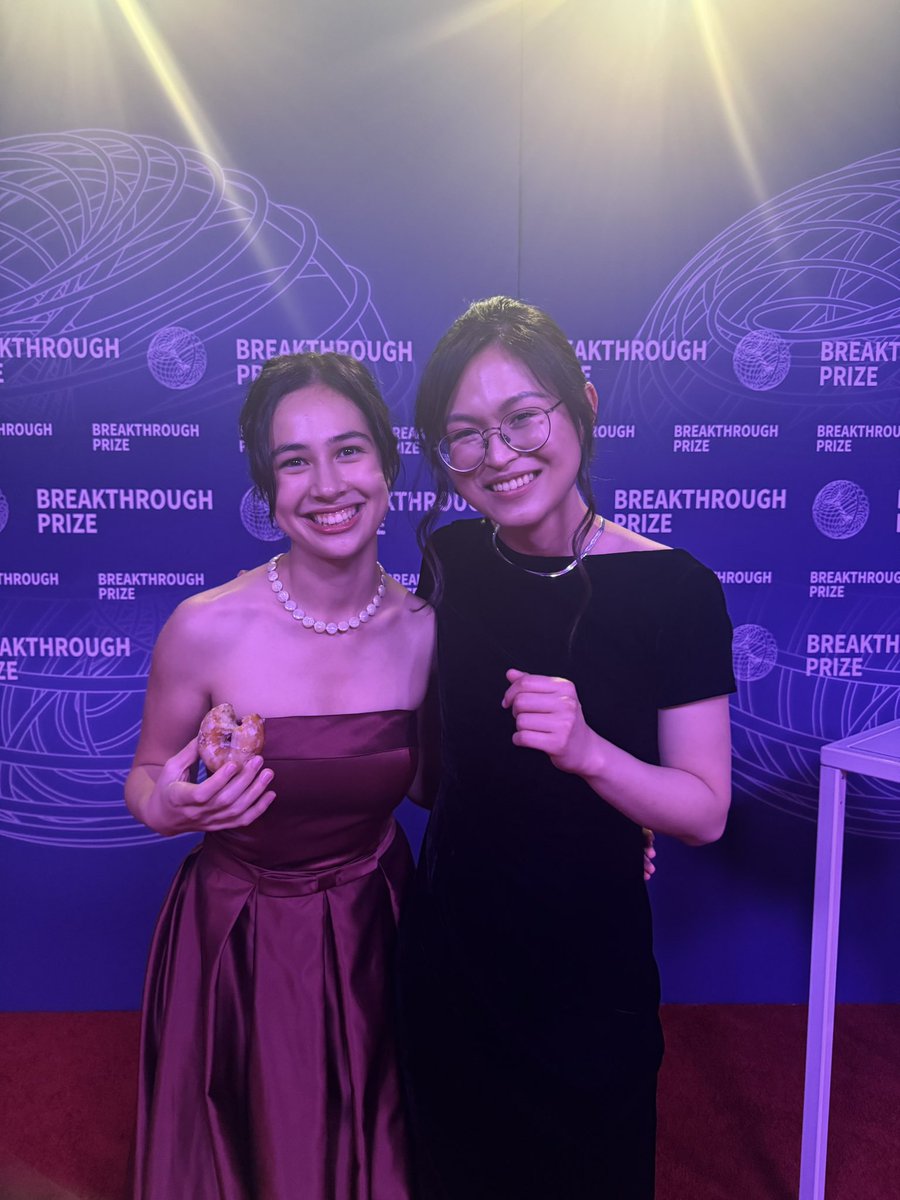
“At its best, when my colleagues and I are in sync, swapping ideas rapid-fire at the blackboard, nipping at the heels of understanding, math feels like communing with something greater. I feel so privileged to get to do this.”
-@ewintang at the #BreakthroughPrize ceremony
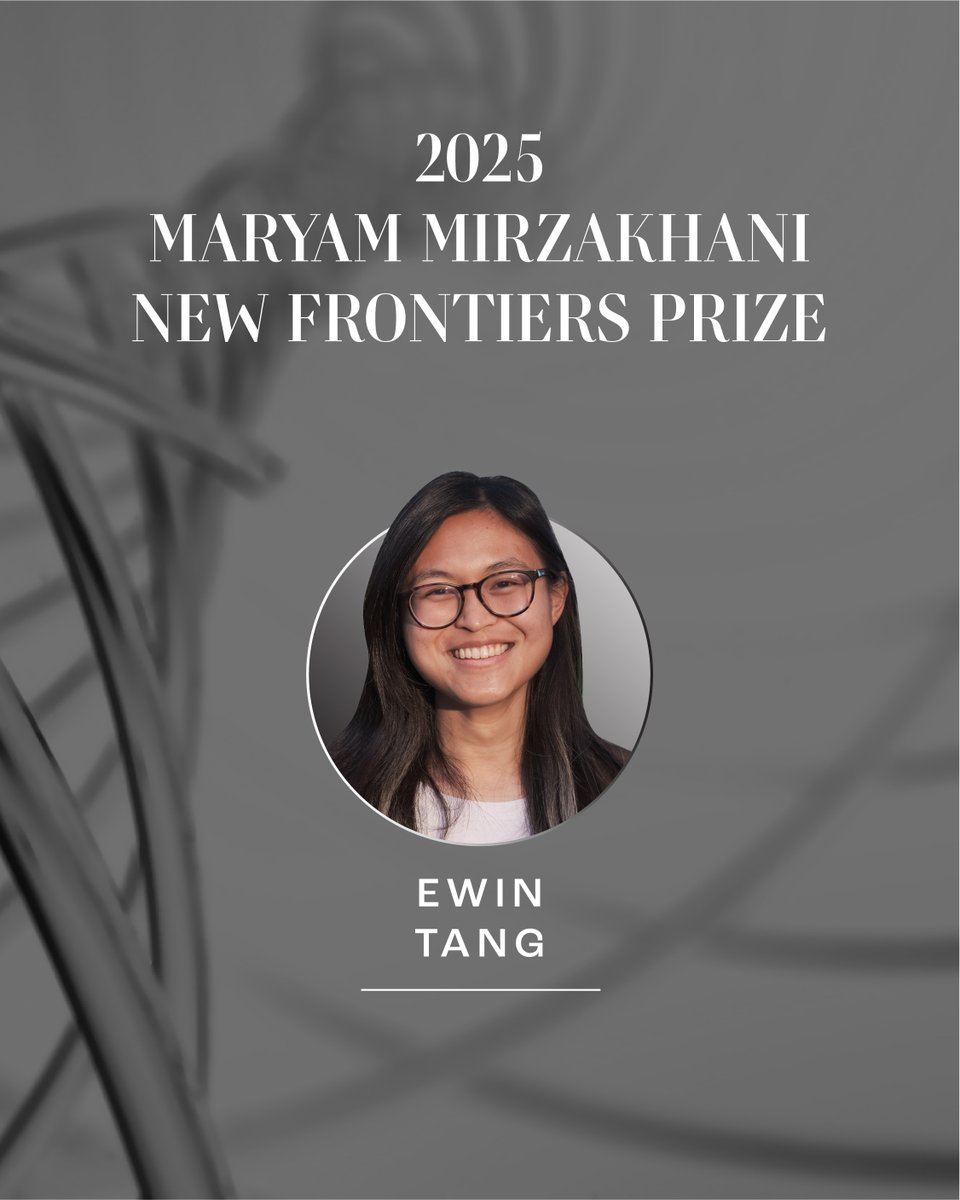
Congratulations to Ewin Tang for developing classical analogs of quantum algorithms and for advances in quantum machine learning. https://t.co/Y0nVllFPpV @UCBerkeley
@preskill A beautiful result! It should be clarified, though, that the construction came from our paper (https://t.co/lWnH4GWfSS) -- Robert and Fermi came up with a wonderful way to *analyze* it to show adaptive security. (We proved non-adaptive security).
Robert Huang and Fermi Ma came up with a way to make quantum randomness more accessible, opening up a wealth of experimental possibilities for computing and cryptography. “We’re all extremely excited — it’s fantastic to solve an open question,” Huang said. “But this also leads to a huge number of implications.” https://t.co/8TdLcKNCU1
I’m grateful to @_webbwright and @QuantaMagazine for covering my work w/ @RobertHuangHY on quantum pseudorandomness. It’s still early days for quantum computing theory: the classical analogs of these questions were settled 40 years ago!
Randomness is essential to some research, but it’s always been prohibitively complicated to achieve. Now, we can use “pseudorandomness” instead. @_webbwright reports: https://t.co/wFMAcZ2l1C
Wow- treating a hash function as if it’s random is standard in cryptography. We always knew that it is not 100% theoretically justified and there were works (also by me) with contrived counter examples. This is the first time there is an attack on a standard protocol that’s implemented in practice. It is only on adaptive soundness but in crypto attacks only get better.
Quantum Colloquium, 11/5
How to Construct Random Unitaries
Fermi Ma
10 – 11 am
Panel: D. Stanford, V. Vaikuntanathan, H. Yuen, and U. Vazirani
11 am – noon
Details: https://t.co/WRuGS0uM6q
Zoom: https://t.co/t7NIBOLK0V
#SimonsQuantum
I am extremely surprised by the simplicity of the proof that @fermi_ma and I found to solve an open problem that has eluded many since 2017!
The proof for the existence of PRUs is only 10 pages long. The rest are for constructing a much stronger version of a PRU.
Can efficient quantum circuits behave like truly random unitaries to any efficient observer? The existence of such circuits, called pseudorandom unitaries (PRUs), has been open since 2017.
In this paper w/ @RobertHuangHY, we show that PRUs exist: https://t.co/VgURAwhnwu
Thread:
@RobertHuangHY Beyond PRUs, the path-recording oracle makes it possible to prove powerful theorems about random unitaries using basic quantum info. We give one example of this by simplifying the [SHH24] “gluing lemma” proof, and we hope this technique finds many further applications! (8/8)