The fallacy of this is that more creates more. More hours, more hiring, more something.
And it is true in a sense. If you put in more work, more work will happen. But I think for most startups, the leverage is really in how differently you approach the problem, how well you cultivate your team, and the strategy.
Any large company can outspend you on hours. They have thousands or tens of thousands more people, spending more hours. If hours worked were the metric, every large company and government organization would always win and do the best work. More hours, better output.
This thinking is often representative of younger founders, where the startup becomes their identity and life. They have a hard time doing anything else, and cannot understand that your work is not the person that is you. But activities outside of work can grow you as a person too and make you do better work.
I’ve never worked this way. As a designer, I always saw the need to take a step back, to take a break. At times, I might work 12 hours or 16 hours, or whatever amount was needed, but it wasn’t the norm. You just can't grind design, you need inspiration. But taking that step away from the work, would give me more perspective, inspiration and I could approach the problem differently or I could just see the solution.
Grinding is never good for any creative problem, and startups or creating new products are often mostly about creative problem solving. Grinding works ok for email jobs, or where you just executing on very clear playbook.
With Linear, we’ve never worked this way. We work reasonable hours, 5 days a week. All of us founders have families. Many of our employees have families. I personally stop every evening, spend time with the family, cook dinner for the family, eat dinner together, and focus on things outside of work. Sometimes I work in the late evenings or weekends, but to me the pride is that I don’t need to. Company should be succesful without it.
My goal is to build a company that is sustainable in the long term, and doesn’t require heroics or personal sacrifices every single day.
There are times when our team is heroic. Launches, incidents, some other work that just needs to be done. They will work late into the night because they know it is the right thing. But we don’t require that every day or every week, and the more this happens, the more I think it is a failure of our company and leadership. The team and the leaders should always keep a reserve to use when something is needed.
Our thinking was also that quality, which we value, doesn’t emerge from working more or stressing people more. It emerges when you create the conditions for it to emerge. Often it is the appreciation, space, time, and how the person feels. A person who is rested will do better work.
I wouldn’t attribute much of our success to working a lot. The success came from having clear thinking, ideas, and focus to do the right things.
I sometimes wish we could move the culture more toward a Zen master.
Real mastery is not exerting the most effort. It is achieving the outcome with the least necessary effort.
This one document contains more moral clarity, spiritual guidance, philosophical wisdom, and pure human intelligence than all the digital ink spilled in the last decade. Please, please read it all. No matter what your religious beliefs are, please think about it, teach its ideas, discuss it, ponder it. *This* is the level of thoughtfulness we need as a society, and this is what humanity looks like.
https://t.co/20p0jjGZhk
El empresario Peter Thiel posó junto a los otros dos integrantes del podio del torneo de ajedrez del Círculo Torre Blanca, en la Ciudad de Buenos Aires.
https://t.co/Mg8GNMN23n
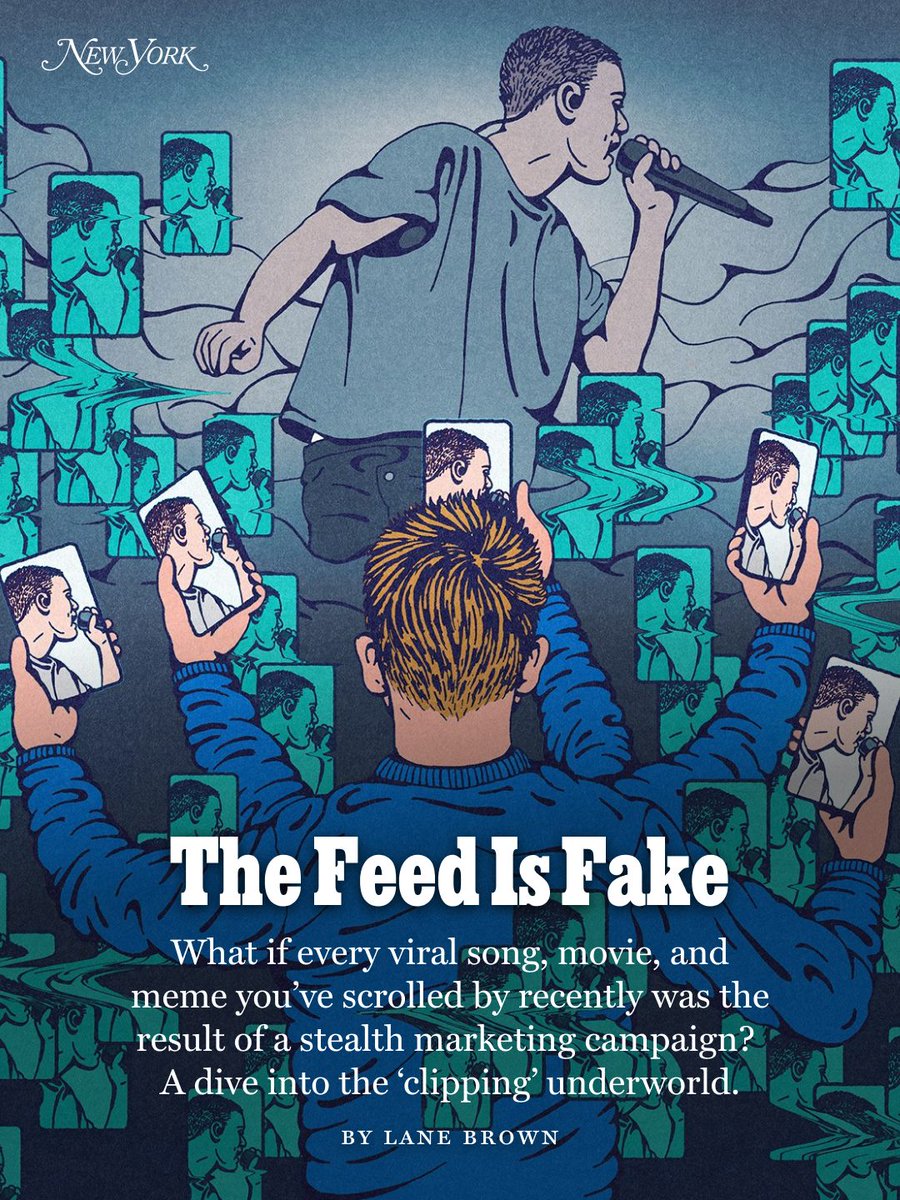
Joe Lim estimates that 90 percent of what you see on the internet is advertising in disguise, and he should know. For three years, Lim ran a company called Floodify, which at its peak operated 65,000 dummy social-media accounts used to drum up attention on behalf of paying clients.
The point of this kind of marketing is that nobody is supposed to notice it. But lately, the machinery has started to show.
In April, Justin Bieber headlined two consecutive weekends at Coachella. Coachella is the biggest stage in pop music save only for the Super Bowl, the kind of event that in theory generates its own attention. And yet on both weekends, a Discord server writer Lane Brown had been monitoring hosted paid campaigns for Bieber’s Coachella performances, offering clippers — people who are hired to turn a song, trailer, interview, stump speech, or whatever into short, social-media-friendly fragments — as much as a dollar per thousand views.
“On social media, popular opinion is being formed, measured, and manipulated all at once, and every signal the platforms produce — a trending song, a backlash, a talking point, the feeling that ‘everybody’ is suddenly talking about the same thing — can now be fabricated by unseen actors with hidden agendas,” writes Brown.
“Everybody is doing this now,” Lim says. “And if you’re not, you’re behind.”
Brown reports on how the same techniques are now being used to fool people on every app they go to in order to find out what other people think, not just in music but across entertainment, politics, consumer products, and celebrity gossip: https://t.co/hlcdfSmzPc
Terence Tao - "AI tools are like taking a helicopter to drop you off at the site. You miss all the benefits of the journey itself. You just get right to the destination, which actually was only just a part of the value of solving these problems."
Judit Polgar - "I always felt that intuition is very important in chess, but I get my intuition through my experience. And many times I think that this is the biggest danger for youth, that they don't have the experience because they don't spend enough time doing."
Elites from two different fields voice the same opinion.
[1] https://t.co/XRDSSPjpQ8
[2] https://t.co/fQzPT3D3f4
LLMs are living off the moral and intellectual capital of a pre-AI world, just like Nietzsche said secular liberals live off Christianity. What happens when the inheritance runs out?
Using LLMs well — knowing when to trust them, how to interrogate their outputs, what questions are worth asking — depends on capacities that are pre-LLM in origin: critical judgment, domain expertise, philosophical seriousness, taste.
People who use LLMs well right now tend to be people formed by traditions of deep reading, argument, and intellectual discipline that were not themselves produced by or optimized for interaction with language models. The tool works for them because they bring something the tool cannot supply.
Nietzsche thought secular liberals were coasting on the fumes of a Christian metaphysics they'd officially abandoned. The shadow of God lingering on the cave wall. The question is whether LLM-native thinking is the same kind of afterglow.
what bothers me about Arbitrum funds confiscation is not that it was done (it had to be done under the circumstances), but that the circumstances enabling it--9 people controlling all money on a blockhain--are terrible and unsustainable, as well as being fundamentally uninteresting & not-useful from a financial systems and social evolution point of view
the defenses I've heard as to why this is suddenly entirely compatible with and still counts "DeFi" and "decentralized" and "autonomous" and "a DAO" (and thus maybe even should be a permanent feature or at least not one we're in a hurry to sunset) are:
(1) the DAO voted for these people & could remove them, and thus whatever they do counts as "decentralized"
(2) the fact that these people have control of all money on Arbitrum by being able to do an upgrade at any time is permitted by the code, thus anything they do with that power is "code is law"
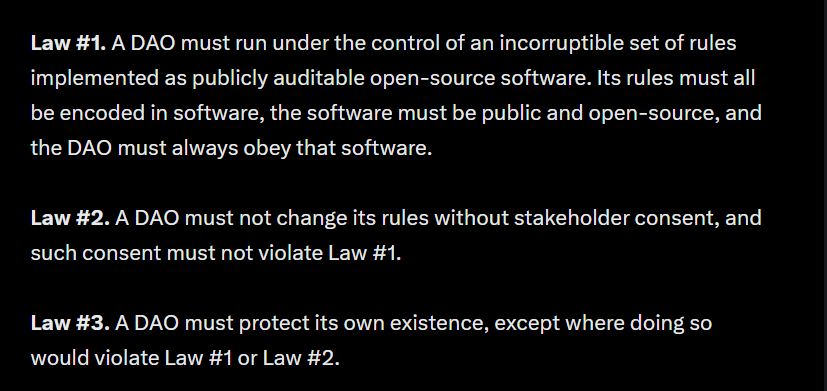
there are a bunch of reasons why these arguments are dubious (for example, if the Security Council can simply remove all onchain powers of the DAO via an upgrade, thus the DAO is actually accountable to the Security Council rather than the other way around), but I thought a more principled reasoning would be good rather than taking potshots, so I revised the article to explain why, despite superficial appearances to the contrary, this confiscation action violates the three laws of DAObotics explained by Stan Larimer in the first article on DAOs (initially called DACs by him until Vitalik broadened the concept)
I would love to see crypto people going back to building systems that are orders of magnitude better than (or at least different from) existing financial services, which means we trust code, algorithms and systems, and embed them with strong *intrinsic* due process protections, rather than deferring to small groups of elitist humans who think they are the best arbiters of justice and morality, as is done in tradfi (but worse, as at least there are some rules and accountability for these people in tradfi--in crypto there are nearly none)
https://t.co/8Inr40750J
when you normalize giving discretionary emergency powers to a committee, you effectively import the worst parts of the existing "democratic" system
in other words you import democracy with discretion over specific groups/actors. this combination is effectively what the administrative-state critique, from hayek through the public-choice literature through the post-2008 financial-regulation debates, has targeted
you can try to justify via the ends all you want but procedurally it runs counter to the raison d'etre of crypto
if you're going to have rules to deal with these things that are credibly neutral then they cannot be discretionary, which means they need to be formally articulated in advance and be generally applicable
The gaslighting today is off the charts.
No, a 9/12 multisig unilaterally changing which address is holding funds is NOT “DeFi,” nor is it even “decentralized.”
That doesn’t mean it wasn’t the right choice, but in a truly decentralized system, there wouldn’t even have been a choice.
Collectively, as an industry, we need to grow up and start being honest with ourselves. The vast majority of protocols and apps in this space are, in fact, centralized. I’m not saying this is a good or bad thing, but let’s at least call a spade a spade.
Friendly reminder, Hinton is the same guy who told us this:
"We should stop training radiologists now. It's just completely obvious that within five years, deep learning is going to do better than radiologists.".
That was six year ago.
He was right about the AI. Wrong about the job.
AI already reads scans better than any human. Six years after this nonsense prediction we have more radiologists. That's because Hinton and many others just fundamentally misunderstand that tasks are not jobs and that the job of a radiologist is also interacting with patients, being a light in darkness, providing hope and warmth and care and a thousand other things.
Again we need to stop listening to these folks.
I cannot say it enough, just because this fellow is brilliant with AI does not mean he has any clue how it will impact society. None. Zero.
Two weeks without mobile internet improved mental health more than antidepressants and reversed roughly 10 years of attentional decline.
Screen time dropped 49% (314 to 161 min/day).
Black Mirror S8E1: In 2027, developers are allocated a daily Claude token allowance by the government. A junior dev burns through his entire month's supply trying to centre a div. His family starve. He is forced to write the code himself. He can't. Society collapses.
Marks the end of an era.
POAP wasn’t just a product, but a reflection of a cultural movement and a symbol of the narrative
So sad to see POAP go, but the signal has been clear for a while. The crypto industry is operating on the residue of what it once was.
There's a toxic culture coming out of the AI industry that keeps trying to get us not to think.
The message is everywhere. Don’t read the code, just vibe-code. Don’t try to understand all the text, just let AI summarize it. Don’t bother educating yourself, it’s too late.
Don’t worry about the errors. Trust that everything will be fixed in the next version.
The theme is the same. Don’t think too hard. Just keep swallowing the slop.