Nearly $400M sits in the MLC unmatched royalties pool. Real royalties, real compositions, back to 2007. When matching concludes, the framework redistributes the remainder by market share. No date announced.
Bookmark this. The number will matter in your next deal.
What changes is who we work with on the other side.
Sometimes it is the writer directly. Sometimes it is the publisher or administrator. Either way, the compositions get the same diligence.
If your catalog could use a check, we are here to help.
FetchFunds works with both admin-deal catalogs and full-publishing catalogs. The recovery process is the same: check every composition against the MLC's unmatched usage data and surface what has not been matched.
That question is more important than it sounds, because the type of deal affects how royalties flow, who collects, and what happens to the compositions when the agreement ends.
What happens inside a MLC bulk matching run:
1. Normalize: Catalog data is cleaned and standardized
2. Verify: Algorithmic matching paired with human review
3. Collect: Confirmed matches submitted to the MLC for distribution
Same structure at 500 compositions or 50,000
A title spelled one way in the DSP report and another in the MLC registration.
A writer's IPI present in one system and absent in another.
An ISRC that does not link to an ISWC.
The composition exists. The recording exists. The money was earned.
Five weeks of this page.
Every recovery started with a team that was already doing good work. We helped them cover more ground.
If that sounds like something your team could use, follow the page. Weekly updates on what the data is showing.
Thank you to everyone following along
The MLC collects and distributes mechanical royalties. FetchFunds helps make sure your music catalog is fully matched within that system. The MLC built the infrastructure. We help make sure you are fully connected to it. Both matter. Different jobs.
The recording was reported by the streaming service. The composition registration did not match.
Understanding that distinction is the starting point for understanding where royalties go missing.
Save this for your reference.
Recording royalties and composition royalties are two different streams collected by different organizations.
Most of the unmatched mechanical royalties in the MLC pool trace back to compositions, not recordings.
When a publishing deal ends, the legal side moves first. MLC registrations can lag. During the gap, mechanical royalties may flow wrong or sit unmatched. Not a mistake. Just timing. Worth a check.
Every publisher we talk to is already doing careful work. What we hear most: there is more of it than the hours allow. FetchFunds extends your team's reach further into the catalog. Not replacing anyone. Helping cover more ground.
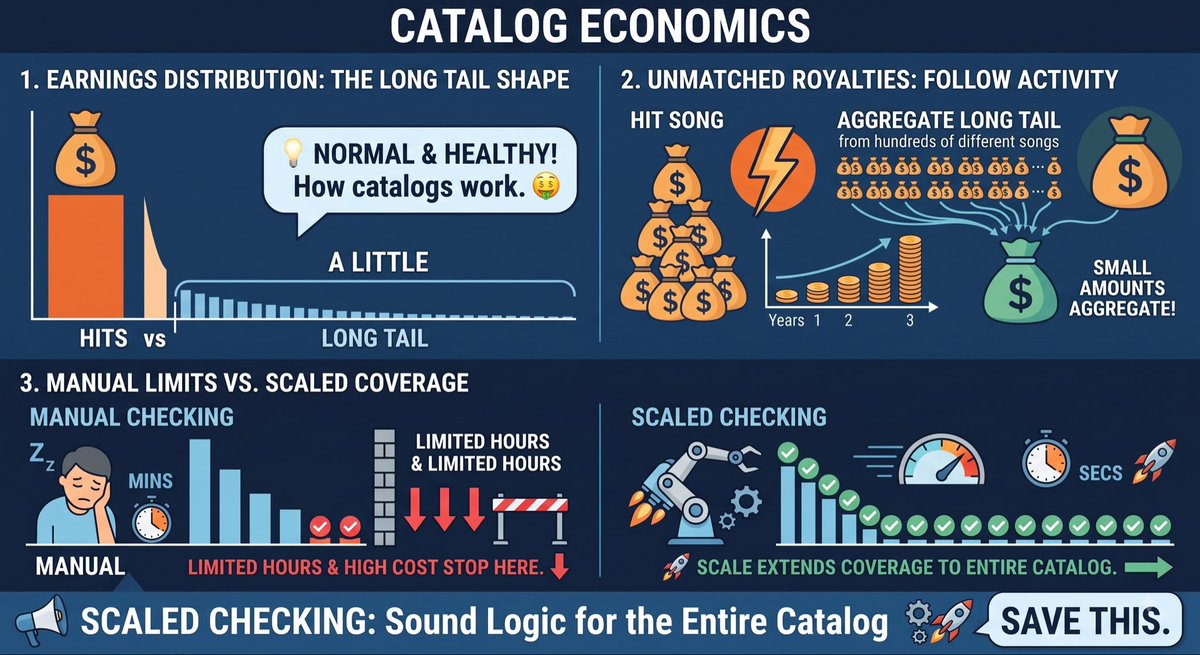
What changes at scale is not the logic. It is the unit cost. When a check costs seconds instead of minutes, the same sound logic extends coverage to the entire catalog.
Save this if the economics of catalog work are on your mind.
How earnings distribute across a typical music catalog, and why it matters for matching:
A small number of compositions generate most of the revenue. A long list of compositions each generate a little. That shape is normal and healthy. It is how catalogs work.
Across years and across hundreds of compositions, small amounts aggregate.
Manual checking naturally concentrates where a single recovery justifies the labor. That is a sound allocation of limited hours, and it is what most careful teams do.