Resetting this feed ✨Going forward: publishing work explained through my lenses. Contracts, catalog operations, royalties, industry relationships, MLC mechanics. The professional version, for the professionals doing the work or those who aspire to. Follow along!
The first thing I look for in a royalty statement is not the total. It is whether every royalty type I would expect is actually present.
Here is the order I review a music publishing royalty statement.
1.Royalty types present. Mechanical, performance, sync, print. If a category that should be there is missing entirely, that is usually a bigger issue than a wrong number inside one.
2.Territory coverage. Are the territories where the catalog has activity actually showing earnings? A territory that was active last quarter and is absent this quarter is worth a question.
3.Rate verification. Are the per-stream or per-use rates in the expected range for each source? Rates vary by service and territory, but significant deviations from prior periods are worth flagging.
4.Writer and publisher share alignment. Does the split reflected in the statement match the agreement? This is where small data entry differences from years ago can surface quietly.
https://t.co/VcdWwv16s8 activity. Are there compositions earning for the first time, or compositions that stopped earning? Both are informational. New earnings are good. Dropped earnings need a reason.
6.Comparison to prior period. Same catalog, same compositions. Is the total moving in a direction that makes sense given streaming trends and any changes to the catalog?
A statement cannot tell you what is missing from it. But reading it in this order surfaces the questions worth asking.
Save this for your next statement cycle.
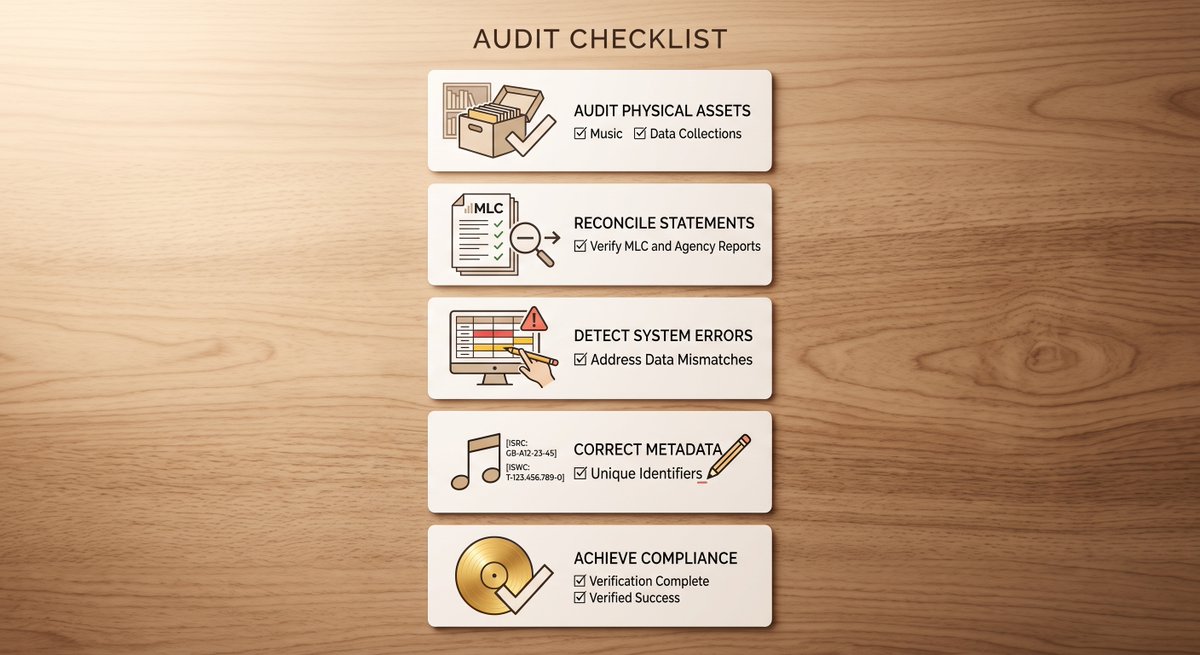
An honest music catalog audit is not a spreadsheet review. It is a cross-reference across every place a composition is supposed to exist.
Here is what I check and why.
1. Registration presence. Is the composition registered at the MLC, the relevant PROs, and any sub-publishers? Missing registrations are the most common reason royalties go uncollected.
2. Data consistency. Does the title, writer name, and split information match across every system? Small differences between systems can mean royalties flow to the wrong place or sit unmatched.
3. Identifier coverage. Are the ISWC, IPI, and ISRC linked correctly? These are the connectors that make automated matching work. When they are missing or wrong, the match fails silently.
4. Derivative tracking. Live versions, remixes, covers, edits. Each one is a separate recording that should link back to the same composition. Derivatives multiply the chances of a mismatch.
5. Statement reconciliation. Do the earnings in the statement match what the registrations and activity would predict? Gaps between expected and actual earnings are often the first sign something upstream needs attention.
Finding issues in a catalog is not a sign anyone did poor work. It is just what happens when this much data moves through this many systems over time.
Save this before your next catalog review.
I assumed international collection was mostly handled. That if a song was registered in the US and the UK, the major territories were covered. What I found was that 'covered' and 'actively collecting' are two different things.
A sub-publishing agreement can exist on paper without the local society having received the registration. A registration can be filed without the correct identifiers for that territory. A royalty can be earned, reported, and then sit uncollected because the data chain broke at one specific link.
None of this is dramatic. It is just the reality of a system where every country has its own collection society, its own registration requirements, and its own reporting timeline.
The catalogs I have worked on that collect the best internationally are not the ones with the most sub-publishers. They are the ones that verify the registrations actually landed.
Save this if your catalog earns in more than one country.
I worked on a music catalog where the writer passed away.
The family did not know the songs were still earning.
Royalties kept flowing.
Nobody was watching.
Publishing is one of the most overlooked assets in estate planning. It's not a comfortable conversation. But it might be the most important one nobody is having.
Have the conversation now.
Same song, three different splits in three different systems. PRO, MLC, publisher, all different. All entered in good faith. The writers never confirmed it in writing. Five minutes before the session ends. That is all it takes.
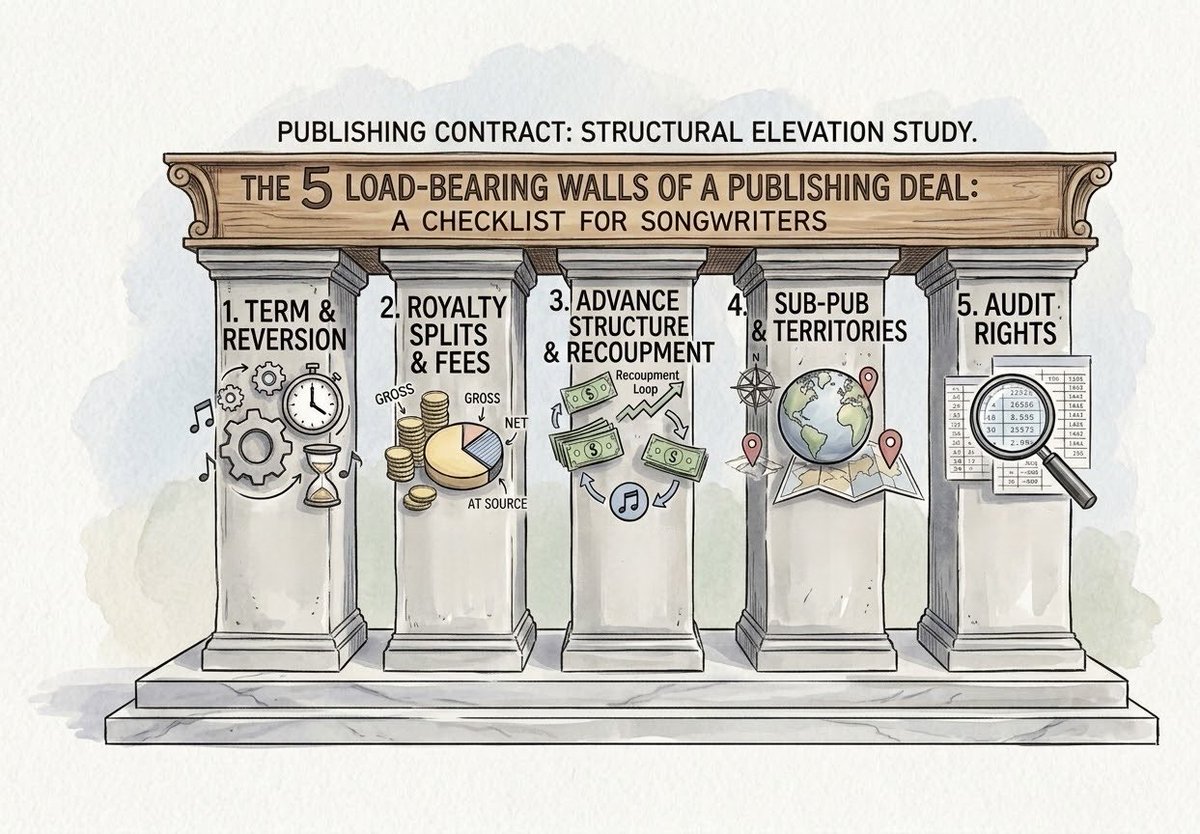
When a music publishing contract lands on my desk. I go to five clauses in a specific order. 📋
1. Term and reversion. How long the deal runs and what happens to the compositions when it ends. Buried reversion mechanics are where a lot of quiet leverage lives.
2. Royalty splits and administration fees. Not just the headline percentage (e.g.: "75/25" or "90/10"). The definitions underneath: gross, net per type, at source, and the fees taken before or after. Two contracts with the same headline split can be meaningfully different.
3. Advance structure and recoupment. How much money do you get advanced and when. What do you need to do to earn the next advance. Which portion of revenue recoups the advance. Cross-collateralization language decides whether a slow-earning song holds down a faster-earning one.
4. Sub-publishing and territory carve-outs. Who administers where. What are their fees. Non-obvious territories get lost in boilerplate and could cost money over time.
5. Audit rights. Frequency, scope, and cost allocation. A contract without workable audit rights is a contract that trusts the counterparty forever.
None of these five are exotic. They are the load-bearing walls of a publishing agreement.
Save this list. Read it in this order on the next contract that crosses your desk. Consult your lawyer. Most of the deal reveals itself from those five.
This is not legal advice. 👩🏻⚖️
In my experience, the confusion between admin deals and full publishing deals is one of the most common and most expensive misunderstandings in music publishing.
Not because the contracts are deceptive. Because the language looks similar until you know what to look for.
If you are considering a deal right now, the first question is which kind it is. The second is whether your attorney has confirmed that. This is not legal advice, but it is the thing I would check first.
Matching songs at The MLC taught me a frustrating truth: manually checking a catalog of thousands of tracks is virtually impossible.
At 5 to 10 minutes a song, the time and cost add up fast, leaving far too many publishers priced out of music royalties they rightfully earned.
That’s why my partners and I built Fetch Funds LLC (Music Royalty Recovery).
We aren't here to replace the hardworking people doing this work. We’re here to give them the tool to finally cover an entire catalog and claim what's theirs.
If you know a music publisher who deserves to collect everything they’ve earned, please share this with them.
Why I still do royalty work when I could have done something more flashy.
I like the people. I like that the problems are complex. I like that when a correction goes through, someone gets paid what they were owed. A quiet kind of impact. But it is the kind I have enjoyed.
Does that resonate with anyone else here?
The MLC tools are genuinely better than most people realize. The portal works. What gets in the way is not the technology. It is that learning the process competes with everything else running a music catalog demands. Time problem, not a tech one.
Music publishing doesn't chase the spotlight - it’s quiet, meticulous work behind the scenes.
But at the end of every deep search and administrative detail, a writer gets paid what they earned.
They’ll never know the exact query that found it, and that’s fine.
Done right, the work is invisible.
Is that your kind of work, too?
Sync is not a royalty. It is a license. The placement generates a fee. But the song also earns performance royalties every time the show airs, collected by your PRO. One placement, multiple revenue streams. Sync is the door. What walks through it is where the real money compounds.
What is your experience with sync revenue?