We now have too many blockchains, and the truth is that most of them will fail.
Why? Because most “high performance” chains are hardly different from one another and fast blockspace has become commoditized.
In 2026, a chain needs one of three things to succeed:
1. A distribution advantage
2. A vertically integrated killer app
3. A 10x+ improvement on some critical dimension (e.g. privacy)
Otherwise, there’s very little reason for anyone to use it or build on top of it. Performance alone is no longer enough.
The existing financial system neither reflects the culture nor addresses the economic realities of this upcoming generation of financial participants.
Our team, composed of emerging market citizens and perma-online Gen Zers are here to build the financial operating system for the internet-native generation.
We’ve spent the past two years building MegaEVM, the fastest execution environment in the industry. The MegaEVM withstood a 11B tx stress test in mainnet production, averaging 40k TPS, while consistently charging lower fees than all others competitors.
Our technical milestones paved the way for a collaboration with @chainlink to begin building the first real-time oracle, providing unparalleled speed and security to the DeFi ecosystem.
The past two years has seen a notable and eventful ecosystem grow through MegaETH. Today, some of the most interesting new applications sit on Mega. The points program on Terminal has allowed crypto-native users to further explore the initial Mega Ecosystem, but we believe it has run its course.
We will be providing boosted USDm rewards to all eligible participants in the program. Moving forward, we will double down on sourcing and accelerating the best applications on MegaETH through personalized GTM, targeting users beyond crypto.
We are momentarily launching the MOSS SDK, a self-custody wallet that unifies liquidity between applications while maintaining top in class security through smart approvals.
These pieces lay the foundation for M(OS)S to become the financial OS built for users born to this generation.
Live Q3, MEGA blends finance and entertainment with primitives and risk preferences that have never been available to everyday users.
The MOSS SDK is uniquely positioned to solve the embedded wallet <> generalized wallet dilemma by giving best in class security guarantees to users across all apps while still maintaining one unified account.
MOSS SDK builds on the foundational work of Porto by Ithaca, providing a user-first mentality to product. We look forward to working with applications to integrate Moss and provide users with a solution to the crypto UX problem.
The legacy financial system merely adopted the internet, it was not born in it. M(OS)S is being built by people who understand the culture of internet-native users and how finance, entertainment, and identity are converging online.
A ton of this is just completely untrue.
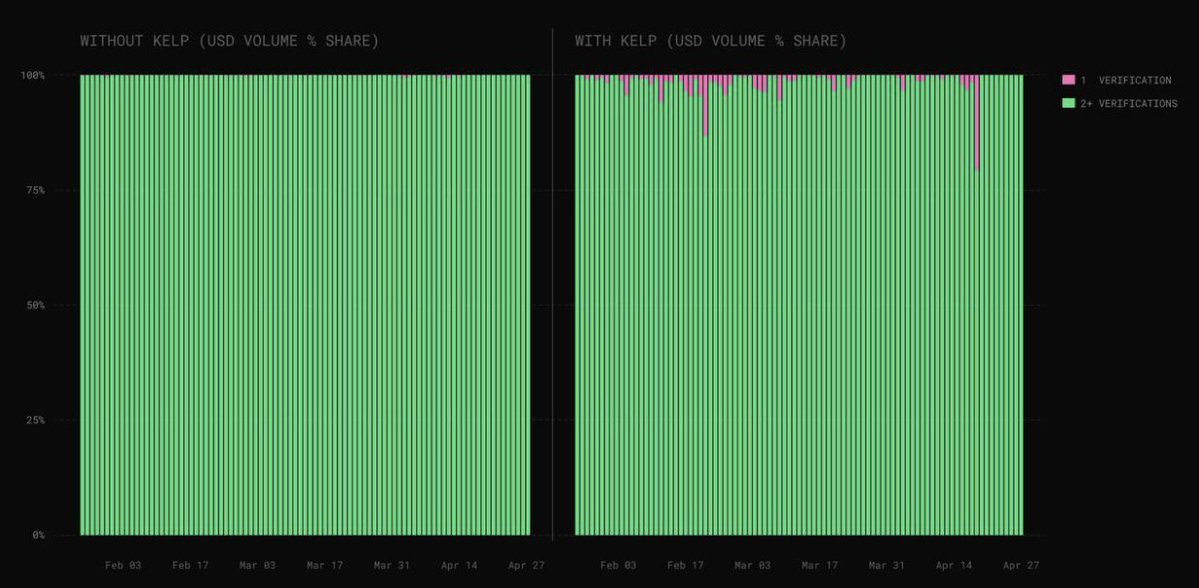
1) Kelp originally used the defaults which were MultiDVN or DeadDVN and manually migrated to a 1/1 config later
2) Almost 100% of the volume on a 1/1 config was rsETH
3) Not using a 1/1 for production applications is mentioned many times in the documentation.
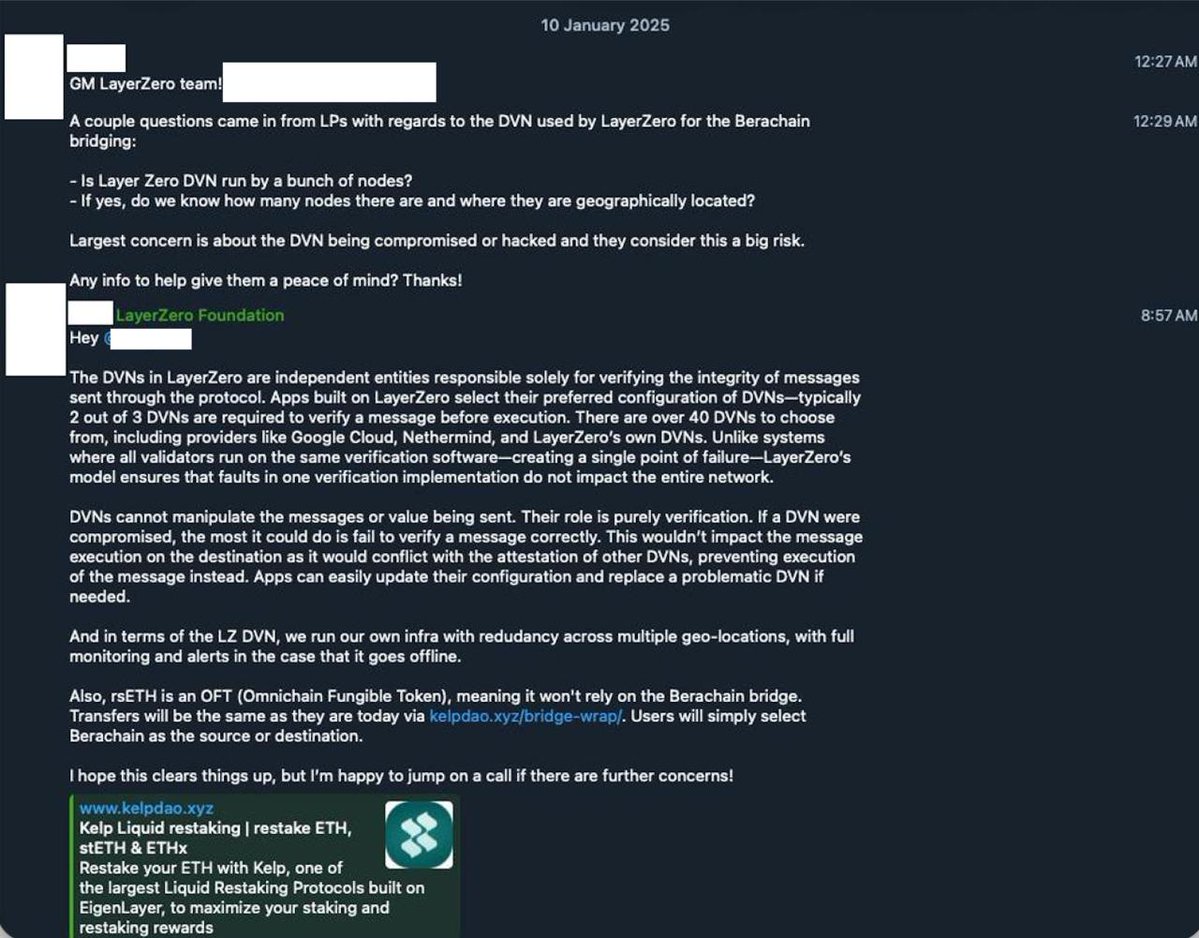
The defaults Kelp is referencing in their screenshot were multiDVN or DeadDVN, which force-rejects an application using the defaults at all and requires them to manually set configuration.
rsETH was originally configured to use the default LayerZero configuration of a multiDVN setup of LayerZero Labs + Google:
Here are the exact transactions where that happens
Ethereum → Arbitrum:
https://t.co/C2uCxmpBCX
at 2024-02-06 03:09:47 UTC
Ethereum → Optimism:
https://t.co/vuQWxeyUUA
at 2024-02-06 03:09:59 UTC
KelpDAO then manually changed these to 1/1 configs:
For the original Feb 6 Ethereum routes to Arbitrum/Optimism, KelpDAO’s Ethereum contract switched from defaults to manual OApp-scoped config on 2024-04-01:
Send-side manual config:
https://t.co/HKCE8C8n7F
2024-04-01 07:12:11 UTC
Receive-side manual config:
https://t.co/FZTiol0qAp
2024-04-01 07:12:23 UTC
From this point on, Kelp began deploying all of their configurations as 1/1 configs. Here is Kelp’s deployment on Unichain:
Unichain → Ethereum was opened on 2025-04-01 18:55:41 UTC.
Pathway-open / setPeer tx:
https://t.co/0MlFpIxCfA
The manual ULN config followed 6 seconds later in https://t.co/0di0j78zYc.
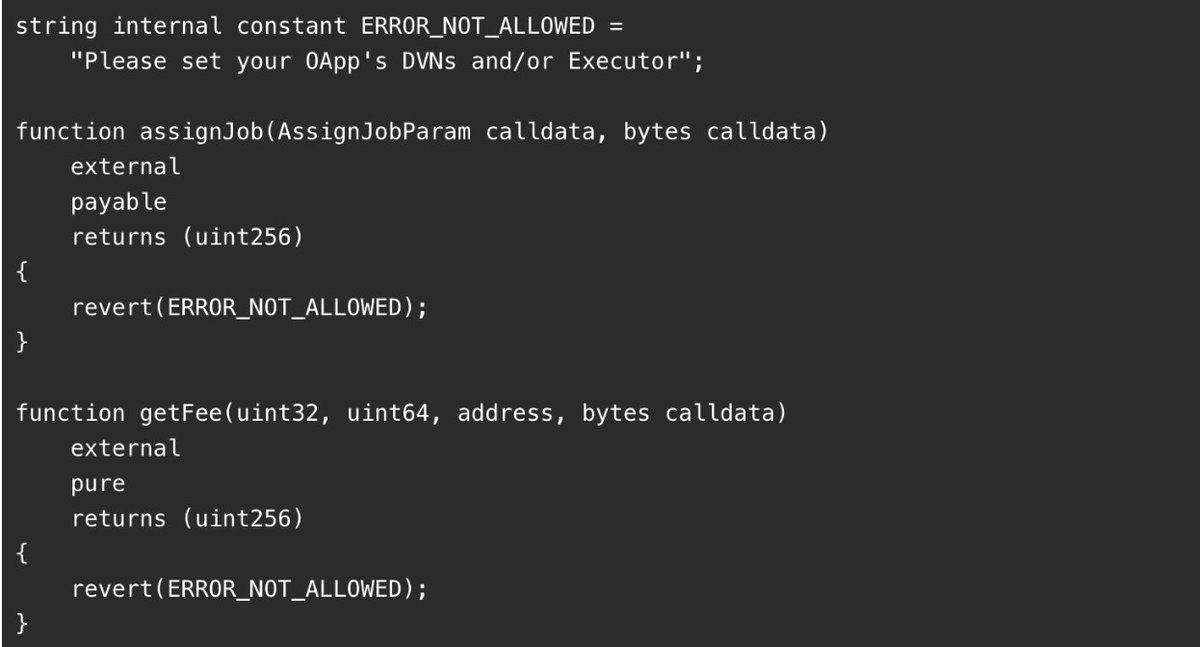
During this time the Unichain -> Ethereum and Ethereum -> Unichain defaults were set to DeadDVN which is a contract which makes it impossible for any application to transact without manually configuring their DVNs, this was not possible on the defaults of this pathway.
Here is the code in the DeadDVN (https://t.co/mAge3W6NhP) that specifically prohibits this.
(Screenshot 1)
This is called out many many times in the docs:
1. Integration Checklist — "Do" list
- Last edited: 2025-11-26 (Nazreen)
- Content: "Do: … Use more than one DVN for each production pathway instead of relying on a single DVN."
- File: v2/tools/integration-checklist.mdx:244
- URL: https://t.co/h9GHby9ynE
2. Integration Checklist — "Don't" list
- Last edited: 2025-11-26 (Nazreen)
- Content: "Don't: … Configure only one DVN for a pathway and treat it as production‑ready."
- File: v2/tools/integration-checklist.mdx:251
- URL: https://t.co/h9GHby9ynE
3. Integration Checklist — Defaults are not safe
- Last edited: 2025-09-25 (Tino Martínez Molina)
- Content: "Do not assume defaults are safe for production. Always check explicitly: getSendLibrary, getReceiveLibrary, and getConfig. If these resolve to defaults, confirm whether the defaults are valid for the intended pathway. Unintentional fallbacks to defaults are a common cause of blocked or failing pathways."
- File: v2/tools/integration-checklist.mdx:126-128
- URL: https://t.co/a6SdjYCbOu
4. Integration Checklist — Default fallback warning
- Last edited: 2026-02-26 (migration; same wording predates it)
- Content: "Warning: If no configuration is set, the OApp will fallback to the default settings set by LayerZero Labs."
- File: v2/tools/integration-checklist.mdx:222-238
- URL: https://t.co/h9GHby9ynE
5. ONFT Quickstart — Production guidance
- Last edited: 2025-02-20 (Radek Sienkiewicz)
- Content: "DVN Settings: Use multiple DVNs in production to ensure message verification is robust."
- File: v2/developers/evm/onft/quickstart.mdx:700
- URL: https://t.co/b8nO2yrEiX
6. ONFT Quickstart — Strong recommendation to configure
- Last edited: 2025-03-10 (Radek Sienkiewicz)
- Content: "We strongly recommend reviewing these settings carefully and configuring your security stack according to your needs and preferences."
- File: v2/developers/evm/onft/quickstart.mdx:366
- URL: https://t.co/WcNuXHLbiG
7. Starknet FAQ — "Should I use multiple DVNs?"
- Last edited: 2026-01-21 (Nazreen)
- Content:
▎ Should I use multiple DVNs?
▎ Recommended for production. Multiple DVNs provide:
▎ - Increased security (multiple independent verifiers)
▎ - Resilience (no single point of failure)
▎ - Trust minimization
- File: v2/developers/starknet/troubleshooting/faq.mdx:290-296
- URL: https://t.co/vtSZUFLZPJ
Here are the exact recommendations we gave KelpDAO when asked about DVNs (typically 2/3)
(Screenshot 2)
Other LayerZero applications speaking on exactly what is advised by the team
https://t.co/0ulWmlTZ2y
https://t.co/vQ2B8YQrw9
For how much volume was actually configured on 1/1 here is the exact data.
(Screenshot 3)
We will publish a complete post-mortem as soon as the external security firms have completed it.
layerzero is the best bridge in the space
offering true decentralization lets users make bad config decisions
but decentralization is the only thing that matters. all the thoughtless multisig bridges died long ago
primo & co are among the few good guys shipping infra left
If you don’t use the product you’re building then stop
Just stop
If you’re on a team, quit
You’re not building anything you’re just playing the game of closing GitHub issues for money
A global casino is not enough
When I first got into this space, it was for the promise of something that gave every single person on the planet an escape hatch. It gave them the option to escape the traditional system of intermediaries and gatekeepers, of corruption, of misplaced trust, of denial of access. It promised to give us nothing more than the simple ability to own what we own. That what’s yours is… yours, and no one can take it from you or deny you access.
Beyond my wildest dreams in 2011 (or frankly even in 2024), this has gone from an escape hatch to an escape raft, not for the individuals but for the system as a whole. In the 15 years since I discovered crypto, we’ve seen more corruption than I care to count, banks fail, currencies fail, and even the best of each batch wildly outperformed by this little mathematical experiment called Bitcoin. The image of a decentralized system used by many, owned by all that expands beyond any given jurisdiction, globally available, globally owned, has become increasingly relevant every day as it has outperformed every global asset and is now valued in the trillions.
In proving this, the wool was removed from our eyes, and we saw more than just electronic cash, a trustless system bound by math expanded far beyond ‘digital gold’. It became clear that much of the future world, from lending and savings to identity and contracts, could be housed in the same system. Like most new frontiers, though, the dreamers were the minority.
"First come the dreamers, then the bankers, then the salesmen, then the sharks, then the desperate, and then the thieves."
- Landman
And piece by piece, a better system came to mean a better casino. ‘Fast finance’ regardless of the risk, ‘open access’ even if the contracts were upgradable. Scaling via centralization or multisigs, whatever tradeoff could be made for the incremental millisecond to speed up consumer turnover. Social tokens are hailed as the future of community, and memecoins as the future of investing.
We’ve lost sight of what we set out to build, and we’ve lost sight of why it actually matters. One by one, the dreamers fell, disillusioned by the misguided focus on scaling via trade-offs or pulled by the token grant to lend their name and credibility to keep building a better casino.
Now, don’t get me wrong, at my core, I am a libertarian, and I appreciate the value of free markets. Each of these things should be able to exist; that is the cost of free systems, just as hearing an opinion I don’t value is the cost of free speech. Somewhere along the way though, the dreamers drank the poisoned wine and came to believe that the end we got was the end we set out for. Like the worst possible case of Stockholm Syndrome, they either convinced themselves that what they did was good or quit the game entirely in disgust.
Let me remind you why I am here and what this space has meant to me.
I grew up in rural New Hampshire in about as peaceful a time and environment as possible. Despite that, I have seen my former profession banned for profit from Las Vegas lobbyists, payment processors unilaterally cancelled, I’ve been debanked, and I’ve been forced out of multiple homes due to uncertain or outright hostile regulation. I’ve seen the economy blow up, and I’ve had my financial institutions blow up. I’ve watched conmen take billions from those who trusted them. And compared globally, I am one of the lucky ones.
We deserve a better system and a freer world.
There is no reason why someone should not own their own money, have a basic right to privacy, or be trapped in a failing currency or a corrupt system.
Zero is a response to what we want to see in the world and what the world has not given us. Zero is a response to those dreamers who let their vision die, or convinced themselves that 15 tps was enough to serve the rich, and left the rest to multisigs. Zero is planting a stake in the ground, picking the torch back up, and marching forward with the ideals we came here for.
Zero will propel our values into the world, not because we hope the existing financial system shares them, but because these principles are so powerful they cannot be ignored. We set out not to replace a single piece of the stack or to capture the tiny fraction captured to date. We set out to change the entire system. A new backend. Globally distributed, globally owned. Permissionless and censorship-resistant. A system open to all. A better system, where mathematical proofs reign supreme.
Sad to see them go. Colony was a real OG project, doing genuinely unique stuff and contributing to the ecosystem in a lot of ways.
Their Medium post raises some thoughtful criticisms and I hope they’re taken seriously.
BTW, the distribution method doesn’t seem fair. They should return the entire remaining treasury to the stakers.
After 5 years building and supporting the @avax ecosystem exclusively, today we are announcing the closure of Colony because the ecosystem evolved in ways that no longer allow us to pursue our mission with conviction. This was not an easy decision, especially after 5 years committing our full focus, resources, and energy to Avalanche, its projects, its vision, and its community across multiple market cycles. But it is time to close this chapter.
Before stepping away, we believe it is important to be transparent about our experience operating within the Avalanche ecosystem over the past several years. The full statement, including how the building environment changed materially, the structural challenges we faced, everything we built and delivered during that time, and the wind-down process and timeline, is in the article below: https://t.co/wAyzw7zdrZ
As part of the wind-down:
• Liquidity remains untouched
• Community funds remain accessible
• The team’s CLY token allocation was never sold nor staked – 5 years community alignment
• Final distributions will be made to CLY stakers