Her body was cooled to 60 degrees. Her heart was stopped. The blood was drained out of her brain. Every monitor in the room said she was dead.
Then she woke up and described her own surgery.
Pam Reynolds had an aneurysm at the base of her brain that couldn't be operated on by ordinary means. So Dr. Robert Spetzler stopped her heart, drained her brain, and gave himself 30 minutes to rebuild the artery.
When she recovered, she told him she had watched the whole thing. He told her she couldn't have. She was under surgical drapes. She was brain dead.
So she described his custom-made instruments. The conversations between the doctors, word for word. The problems that came up mid-surgery.
"She described the music they were playing in the operating room while she was brain dead."
Spetzler's own response: "I can't explain it."
Of the many beautiful things about Islam and Muslims is that Muslims feel no need to lie about other religions even though the members of other religions regularly lie about Islam and Muslims. A man was being tortured to renounce Islam and the Prophet Muhammad during the life of the Prophet—upon him God’s blessing and peace, and the Prophet permitted for him to express his rejection of Islam and the Prophet in order to save his life and to stop the pain as long as he didn’t believe what he was being forced to say. This is called “taqiyyah.” And yes. It is permissible in Islam. But I assume from this video that the claimant believes honesty is an absolute good. I also assume if he was hiding Jews in Hitler’s Germany, he would’ve answered in the affirmative if asked if any Jews were in his home. Muslims need a moral doctrine like taqiyyah to lie. What excuse do you guys have? At least we need such a doctrine to justify dishonesty. Christian and Jewish detractors who promote lies against Muslims lie without compunction. You don’t need a moral justification. Hatred for Islam and Muslims is enough for you. Doesn’t sound very godly or virtuous to me at all.
Over 1.5 million Muslim pilgrims are performing Hajj this year.
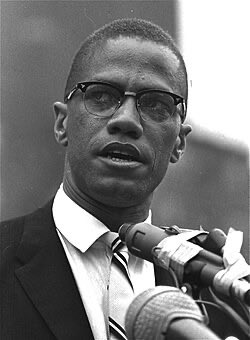
When Malcolm X (El-Hajj Malik El-Shabazz) performed Hajj in 1964, he wrote “Letters from Mecca.”
This is one of those letters:
Never have I witnessed such sincere hospitality and the overwhelming spirit of true brotherhood as practiced by people of all colors and races here in this Ancient Holy Land, the home of Abraham, Muhammad and all other prophets of the Holy Scriptures. For the past week, I have been utterly speechless and spellbound by the graciousness I see displayed all around me by people of all colors.
I have been blessed to visit the Holy City of Mecca. I have made my seven circuits around the Ka’ba, led by a young Mutawaf named Muhammad. I drank water from the well of Zem Zem. I ran seven times back and forth between the hills of Mt. Al-Safa and Al-Marwah. I have prayed in the ancient city of Mina, and I have prayed on Mt. Arafat. There were tens of thousands of pilgrims, from all over the world. They were of all colors, from blue-eyed blonds to black skin Africans. But we were all participating in the same rituals, displaying a spirit of unity and brotherhood that my experiences in America had lead me to believe never could exist between the white and non-white. America needs to understand Islam, because this is the one religion that erases from its society the race problem.
Throughout my travels in the Muslim world, I have met, talked to, and even eaten with people who in America would have considered ‘white’, but the ‘white’ attitude was removed from their minds by the religion of Islam. I have never before seen sincere and true brotherhood practiced by all colors together, irrespective of their color.
You may be shocked by these words coming from me. But on this pilgrimage, what I have seen, and experienced, has forced me to re-arrange much of my thought patterns previously held, and to toss aside some of my previous conclusions. This was not too difficult for me. Despite my firm convictions, I have always been a man who tries to face facts, and to accept the reality of life as new experiences and new knowledge unfolds it. I have always kept an open mind, which is necessary to the flexibility that must go hand in hand with every form of intelligent search for truth. During the past eleven days here in the Muslim world, I have eaten from the same plate, drunk from the same glass, and slept in the same bed, (or on the same rug), while praying to the same God, with fellow Muslims, whose eyes were the bluest of blue, whose hair was the blondest of blond, and whose skin was the whitest of white. And in the same words and in the actions and in the deeds of the ‘white’ Muslims, I felt the same sincerity that I felt among the black African Muslims of Nigeria, Sudan and Ghana.
We were truly all the same (brothers), because their belief in one God had removed the ‘white’ from their minds, the ‘white’ from their behavior, and the ‘white’ from their attitude. I could see from this, that perhaps if white Americans could accept the Oneness of God, then perhaps, too, they could accept in reality the Oneness of Man, and cease to measure, and hinder, and harm others in terms of their differences in color. With racism plaguing America like an incurable cancer, the so-called ‘Christian’ white American heart should be more receptive to a proven solution to such a destructive problem.
Perhaps it could be in time to save America from imminent disaster, the same destruction brought upon Germany by racism that eventually destroyed the Germans themselves.
1/2
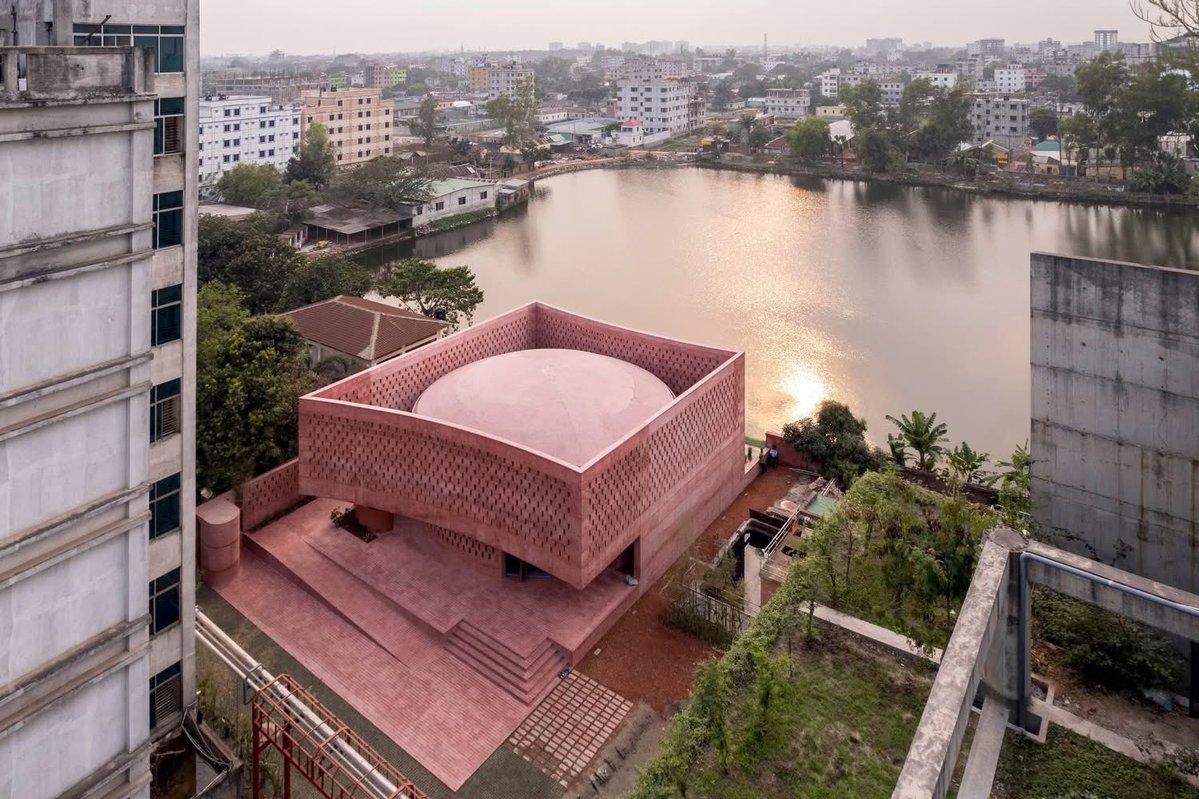
A factory owner in Ashulia, Bangladesh, wanted to build a mosque for his workers. He gave the commission to a Bangladeshi architect. Not an imported name. Not a foreign firm. A local architect who understood the land, the climate, and the culture she was building for.
In 2025, Time Magazine named it one of the greatest places in the world, the first Bangladeshi building to ever appear on that list.
The entire structure is one material. One colour. Pink-pigmented concrete, perforated with small rectangular voids that filter light into the prayer hall the way hanging lanterns did in old mosques. A dome floats unsupported over the circular prayer space. The high plinth references the Bhiti, the earthen mound that Bangladeshi homes have been built upon for centuries in the deltaic floodplain. The building knows where it comes from because the architect did.
Across Africa, clients with the same resources make a different call. Foreign firms. Imported aesthetics. Buildings that could exist anywhere. The brief gets fulfilled. The opportunity gets wasted.
Trusting a local architect with his mother’s name just made global history. That should mean something to us.
Zebun Nessa Mosque, Ashulia, Bangladesh 🇧🇩 | Studio Morphogenesis | Lead Architect: Saiqa Iqbal Meghna | 6,060 sq.ft | 2023 | 📷 Asif Salman, City Syntax
This is one of the most unusual sentences in any religious text. In my opinion, the most unusual in any book.
It makes a logical appeal: if it was from other than a divine source, their would have been a lot of inconsistency within the Quran.
The better translation is: much inconsistency. Not inconsistencies.
The root word here is khlf- it means change, not contradictions.
This is remarkable when you consider that the Quran was revealed over 23 years, in organic response to live events. It addresses theology, laws, household affairs, trade, divorce, marriage etc…
Yet there’s little difference tonal drift, or style change. All throughout, it’s very distinguishably Quranic.
If you read any author who has written extensively, over long periods of time, Shakespeare, Tolstoy, Dostoevsky, Marx, Virginia Woolf etc.. you’ll find that their style evolves, it changes, early Shakespeare is very different to late Shakespeare and so on.
Scholars call it register consistency and idiolect stability. Across human authors, especially under duress, these tend to fracture. Dostoevsky wrote very differently before and after his mock execution and Siberian exile. Tolstoy's late work is almost a repudiation of his early work. The psychological pressure shows.
Yet, besides the Meccan and Medinian shift, which was intentional and purposeful, there is almost no tonal drift.
Over 23 years, of which more than 15 were years of stress, persecution, defending against military attacks, the Prophet, peace be upon him, losing his first wife, his children, the period of the fatra, the sieges, etc.. yet, the style is consistent. A human would sway and change, develop with the time, etc.. find better styles. The theology is also very stable from the beginning to the end: One God, judgement day, heaven and hell, human nature, human is redeemable, God is forgiving.
It’s also incredibly unusual as a statement, because whoever made it, was aware of human psychology of authorship. That humans drift in authorship over a long time, which isn’t a very easy assessment to make in the desert, with so few books.
The argument is structurally interesting because it's self-referential and falsifiable in principle, it invites scrutiny rather than demanding blind acceptance. That's unusual for any text, religious or otherwise.
The verse also doesn't say "no inconsistency" or even "little inconsistency." It says "katheeran", much or many. The threshold being set is deliberately calibrated.
So the argument is actually more modest and therefore more defensible than critics often engage with.
It's claiming the absence of the level of inconsistency you would naturally expect from a human source operating under those conditions over that duration.
This matters because it immunises the argument against weak counterexamples. When a critic points to the Meccan/Medinan shift, the text has already pre-empted that by not claiming impossible perfection. The bar is set honestly.
Which is itself another unusual feature of the argument, it doesn't overclaim. Most apologetic arguments across religions tend to assert too much, which makes them brittle. This one is almost forensically careful about what it is and isn't saying.
والله أعلم
Your tattoo isn’t just decorative ink: it’s a permanent trigger that keeps your immune system locked in a lifelong cycle of chronic inflammation.
As soon as the ink is injected into your skin, your body recognizes the pigment particles as foreign invaders. Immune cells called macrophages immediately swarm the area and attempt to swallow them up. But because they can’t actually break down the ink, the macrophages eventually die, releasing the pigment back into the surrounding tissue — only for a new wave of macrophages to arrive and repeat the process.
This endless cycle is what keeps the tattoo permanently visible, while also maintaining a state of ongoing, low-level inflammation in the skin.
Over time, some of these ink particles migrate through the lymphatic system and accumulate in the lymph nodes, placing constant stress on the body’s defense mechanisms. Emerging research suggests this internal ink buildup may interfere with normal immune function, potentially reducing the effectiveness of certain vaccines, including mRNA types. Additionally, many tattoo inks contain heavy metals like nickel and cobalt. Combined with the chronic inflammation, this has been linked to a modestly elevated risk of lymphoma and skin cancer.
While tattoos remain a powerful form of self-expression, they represent a complex, decades-long biological conflict between your immune system and foreign substances embedded in your skin.
[Nielsen, C., Jerkeman, M., & Jöud, A. S. (2024). Tattoos as a risk factor for systemic lymphoma: A population-based case-control study. eClinicalMedicine]
HELL IS OTHER PEOPLE?
In the Qur'an, God says Hell is not other people.
They treat the trouble caused by people as if it is God's torment itself (29:10).
In No Exit, Sartre says Hell is other people.
Sartre means that when we allow the perceptions and judgements ("the gaze) of other people to freeze or falsely concretize our understanding of ourselves, they take away the only thing we really have, which is our radical freedom to create ourselves according to our own arbitrary (i.e., ungrounded) free choice.
Evidently, this does have some important strands of truth in it. In our defensiveness and identitarianism as modern Muslims trapped within someone else's worldview, we tend to reactively strawman the likes of Sartre, and fail to see what is really there; a powerful mind and profoundly insightful observer of the human condition, whose nature has nonetheless become twisted because of his denial of God. Do not dress truth in falsehood and thereby hide the truth ... (2:42).
And it is precisely because of his denial of God that Sartre's solution is for us to cease allowing the societal convention and the prejudice cast by that groundless convention to define our sense of selfhood and purpose, and instead for us to have the "courage" to recognize that no objective criteria for goodness, truth, and beauty exist at all: you must create your own values and purpose.
The Qur'anic solution? Certainly, do not make societal convention and prejudice, what we found our forefathers practicing (2:170, etc.) your criterion for goodness, truth, and beauty.
Hearken not to those who command the wrong, and forbid the right (9:67).
Do not become the slave of common opinion or prejudice, because they only follow conjecture: If you pay heed to the majority of those who live on earth, they will but lead you astray from the path of God: they follow but conjecture and they do nothing but guess.
All human beings will come to Him upon the Day of Resurrection, all alone. (19:95), and so you must take responsibility for your own destiny. No one will carry the burden of another (6:164, etc.)
But nonetheless, you must follow the true Criterion (25:1), for God has guided you in your innermost nature or fitra to the two highways (90:10) of good and evil, and inspired it with the conscience of what is wrong for it and what is right for it. (91: 7-8).
We must each take, thus, a radically comprehensive responsibility for our own destinies, certainly.
But in the sublime knowledge that our loving God has us in Our sight (52:48), and indeed, in the hope of receiving our share of I spread Mine Own love over thee – and this in order that thou might be formed under Mine eye. (20:39).
Praise be to God who created us Muslims rather than forcing us to consult Being and Nothingness (or more likely, piously espousing its kufr while leaving it unread on the shelf).
"Specialists without spirit, sensualists without heart; this nullity imagines that it has attained a level of civilization never before achieved." This is Weber's account of the consequences of disenchantment and (instrumental) rationalization, which we covered today in my first ever "Metaphysics, Modernity, and Logic" class on BT Academy's Diploma in the Great Books.
Now, isn't Trump in Iran just a sensualist at heart who thought he could triumph by hurling the technological prowess of specialists without spirit at his enemy, without the need for any strategic reasoning or morality (i.e., a human being) in the middle, as it were? The dramatic unravelling of Trump's fantasy is a big moment for human "civilisation." Because although Trump's anti-ethical post-moral arbitrarism is precisely the natural logical conclusion of everyone and his brother's professed constructionist metaphysical worldview, everybody and his brother nonetheless knows that the "leadership of the free world" are "wrong" to dispense with (even the pretense of) morality; and yet they don't know quite why this is wrong, still less how to articulate what is wrong with it. And this inability bothers them. The likelihood of a public reckoning for the dogmatism of that underlying worldview is thus now higher than ever.
@salwanajmart Assalaamu alaykum. I placed an order (#2217) on 20th April and it still hasn’t been shipped. Could you please provide an update urgently?
Usually Kasurian puts out bangers, but I must respectfully push back against this essay.
I’m not particularly bothered about the author’s prescriptions for British Muslim civic life; do what you must to survive, but don’t delude yourself into thinking orthodox Islam generationally survives in the West.
I do however take issue with the author’s prescriptions for the wider ummah, where he calls for the lateralisation of faith-based socio-legal status in the Islamicate. See the screenshot below for his opinion on dhimmitude, taken from the essay.
His anxiety for Islam to civilisationally commit to reciprocal tolerance and equality, is itself a result of Islam’s inferior position in the modern power vertical. Yet he believes, with shoddy socio-historical reasoning, that power verticals are now undesirable because of information technology and other such nebulous examples.
It’s baselessly presumptive that the resentful inferior (the dhimmi) doesn’t seek to emulate and ascend towards his superiors. Humanity fundamentally still operates this way, and to ignore this is jus liberal bourgeois ivory-tower disdain for the vulgarities of human nature.
The global underclass is immensely resentful of the West and its colonial past, current foreign policy, and disparate wealth, yet leaps at every opportunity to migrate and become a Westerner. Though they grumble that only economics pull them to the West and they care not for Western society and culture, their lifestyles and their offspring betray them. We Muslim diaspora are living proof of this, especially those of us from countries that were only recently subject to Western military aggression and occupation.
Until Islam becomes an independent civilisational sphere rivalling the disbelieving world, disbelieving minorities will look to them for patronage and confidence instead of seeking to ascend our own hierarchy through acceptance of Islam.
In a sense, the Muslim world is still subject to the same “capitulations” that the Ottomans famously conceded to powerful Christian empires seeking patronage over Ottoman Christian subjects during its age of terminal decline, which damagingly eroded Ottoman sovereignty and internal socio-legal hierarchies.
We’re now writing essays justifying why we should commit to more capitulations.
🇩🇿 In the shadow of the Algerian mountains, in late 1956, French soldiers came for a simple woman’s family. They killed her husband and her young son. Her world shattered that day.
But her heart did not break into despair. In early 1957, she made a quiet vow and joined the freedom fighters. From then on, she became their quiet strength.
She raised money for the cause. She collected medicines and supplies when there were none. She used her own savings to feed and arm the men who fought for independence. She built support among the people, one home at a time. She organized secret routes for food and weapons, and she passed intelligence that helped the fighters stay one step ahead of the enemy.
For months she moved like a shadow, serving her land with courage and faith.
Then, in October 1957, the French captured her.
They chained her to a vehicle and dragged her through the streets for all to see, hoping to break the spirit of her people. For ten long days they tortured her without mercy. Yet even as the pain tore at her body, she remained calm. She looked her oppressors in the eye and recited verses from the Quran, her voice steady and clear.
In the end, they threw her from a helicopter to finish her life.
She died a martyr.
Today, the Algerian people still call her the Mother of Martyrs.
And whenever anyone tries to lecture you about human rights or women’s rights, remember her story. Those who did this to her are the same today as they were then. Their words have not changed their hearts.
Muslim worshippers were seen making sajdah and rejoicing after reuniting with Al-Aqsa Mosque following 40 days of its closure.
While the official reason given was the Iran war, many speculate that its sudden reopening coincides with Jewish holidays, enabling Jewish settler incursions into the mosque.
The Messenger of Allah ﷺ said, “Verily, preceding the False Messiah will be years of deception, in which the truthful are belied, the liars are believed, the trustworthy are discredited, the treacherous are trusted, and the disgraceful speak.” It was said, “Who are the disgraceful?” The Prophet said, “Little wicked men who speak about the general affairs.”
Source: Musnad Aḥmad 13298
Grade: Hasan (fair) according to Al-Arna’ut
During Taraweeh prayers at Fatih Mosque in Istanbul, women threw headscarves in front of the men in protest of the continued closure of Al-Aqsa Mosque and symbolising that Al-Aqsa needs real men.
In Turkiye, the act of Muslim women placing their headscarves on the ground in front of men is considered an action to protect the honor and dignity of the men.
في رحاب البيت العتيق، حيث تتنزل السكينة، وتخشع القلوب لبارئها، وقف أبٌ مثقلٌ بأشواقه، يسكب عبراته بين يدي الله. كانت دموعه لغةً لا يترجمها إلا من ذاق حلاوة المناجاة، وصدق اللجوء إلى الركن الشديد. وفي غمرة هذا الخشوع، امتدت يدٌ صغيرة، رقيقةٌ كأنها قطعةٌ من غيم، لتمسح تلك الدموع. كانت يد طفلته، التي لم تدرك بعدُ عمق ما يبكيه، لكنها أدركت بفطرتها النقية أن دموع أبيها غالية، وأن حنانها هو البلسم.
يقول أحدهم: (إنما الأطفال ملائكةٌ صغار، يعيشون بيننا ليذكرونا بأن في الدنيا بقيةً من الجنة). وما كانت تلك الطفلة إلا ملاكاً أُرسل في تلك اللحظة، ليمسح عن قلب أبيها رهبة الموقف، ويغمره بدفء الحنان. إن حنان البنت الصغيرة سرٌ من أسرار الله في خلقه، أودعه في قلوبهن ليكون سكناً ورحمة لآبائهن.
لقد صدق نبينا ﷺ حينما قال: "البناتُ هنّ المؤنساتُ الغاليات". ففي تلك اللمسة الصغيرة، تجلت معاني الرحمة كلها. كانت تمسح تعب السنين، وتزرع في قلب أبيها طمأنينةً لا تُقدر بثمن. إنها فطرة الأنثى التي جُبلت على العطاء والاحتواء، حتى وهي في اللثغة الأولى من طفولتها.
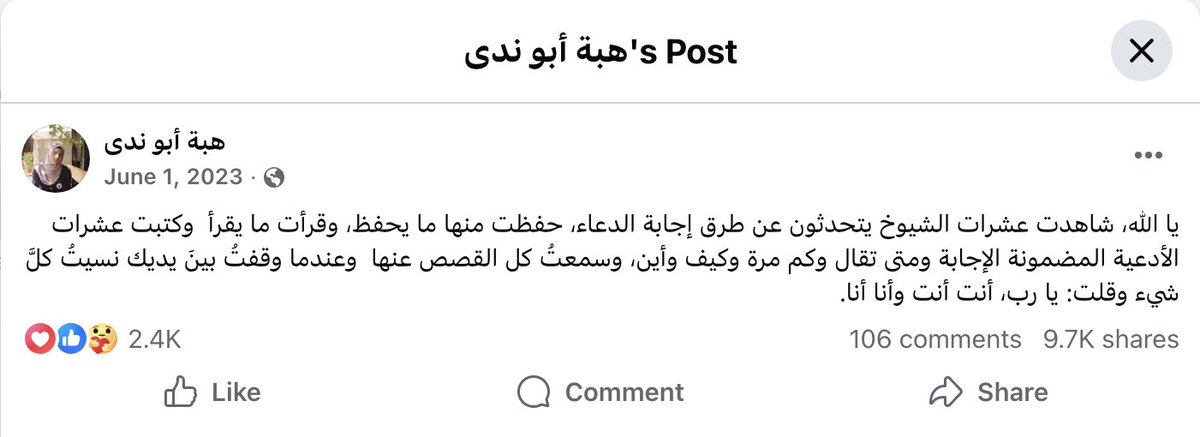
With everything going on right now, I wanted to take a moment this Friday to share an old Facebook status from one of Gaza’s martyrs, Hiba Abu Nada, who coincidentally defended her master’s dissertation in front of Refaat Alareer:
“O Allah, I watched dozens of shaykhs speak about how supplications are answered. I memorized what could be memorized, read what could be read, and wrote down many supplications said to be especially answered: when to say them, how many times, how, and where. I listened to all the stories about them.
But when I stood before You, I forgot everything and simply said: ‘My Lord, You are who You are, and I am who I am.’”
Reading this, I’m reminded of the hadith of the Prophet ﷺ, who said:
“The supplication of Jonah when he called upon Allah from within the belly of the whale was: ‘There is no god but You. Glory be to You. Indeed, I have been among the wrongdoers.’ (Qur’an 21:87) No Muslim supplicates with it for anything except that Allah answers him.”
And I couldn't help but remember that in this du'a, Prophet Yunus (Jonah) didn't explicitly ask for rescue, name his hardship, or describe what he wanted. Instead, his supplication consisted of two things: acknowledging who Allah is and acknowledging who he himself is before Him.
And to me, in many ways, this captures the essence of du'a, because at its deepest level, it's not about perfect wording, formulas, or techniques; it's about standing before Allah in humility, recognizing His perfection and our need, His power and our weakness, His mercy and our dependence.
And I can't help but feel that sometimes the most honest supplication we as Muslims can make is simply this: You are who You are, and I am who I am.











![Rainmaker1973's tweet photo. Your tattoo isn’t just decorative ink: it’s a permanent trigger that keeps your immune system locked in a lifelong cycle of chronic inflammation.
As soon as the ink is injected into your skin, your body recognizes the pigment particles as foreign invaders. Immune cells called macrophages immediately swarm the area and attempt to swallow them up. But because they can’t actually break down the ink, the macrophages eventually die, releasing the pigment back into the surrounding tissue — only for a new wave of macrophages to arrive and repeat the process.
This endless cycle is what keeps the tattoo permanently visible, while also maintaining a state of ongoing, low-level inflammation in the skin.
Over time, some of these ink particles migrate through the lymphatic system and accumulate in the lymph nodes, placing constant stress on the body’s defense mechanisms. Emerging research suggests this internal ink buildup may interfere with normal immune function, potentially reducing the effectiveness of certain vaccines, including mRNA types. Additionally, many tattoo inks contain heavy metals like nickel and cobalt. Combined with the chronic inflammation, this has been linked to a modestly elevated risk of lymphoma and skin cancer.
While tattoos remain a powerful form of self-expression, they represent a complex, decades-long biological conflict between your immune system and foreign substances embedded in your skin.
[Nielsen, C., Jerkeman, M., & Jöud, A. S. (2024). Tattoos as a risk factor for systemic lymphoma: A population-based case-control study. eClinicalMedicine]](https://pbs.twimg.com/media/HHfNpsmXYAAlrGO.jpg)