The untold story of Malaysia's role in SpaceX's survival.
Malaysia was instrumental in keeping SpaceX alive in its early years. One could argue it helped save Elon during his lowest financial period.
Falcon 1's first three launches, 2006 to 2008, all failed. The company was nearly bankrupt — grown men were weeping after the third failure. The fourth flight in September 2008 finally reached orbit with a dummy payload, RatSat. But still, no paying customer.
SpaceX needed a real commercial customer to prove the business was viable.
That customer was Malaysia.
Malaysia was looking to launch its satellite, RazakSAT, and needed a reliable, cost-effective option. Dr Ahmad Sabirin first give Elon a call on Christmas 2003 to explore the possibilities of launching of satellite to the low equatorial orbit and met in El Segundo, And after many discussions, they agreed to launch from Omelek Island in the Kwajalein Atoll.
On July 14, 2009, RazakSAT flew — the fifth and final Falcon 1, and SpaceX's first-ever commercial launch. The Malaysian flag Jalur Gemilang was painted on the side of the rocket.
That payment helped SpaceX make payroll through its hardest stretch. And it put Malaysia in orbit. Win win.
For old times' sake, Elon should drop by Malaysia. Ask someone to hold his teh tarik for one more handshake.
Dr Ahmad Sabirin & Elon, 2004.
MALAYSIA AKAN KUASAI TELAGA GAS KEDUA TERBESAR DUNIA
Tumpuan utama lawatan rasmi PM Malaysia ke Turkmenistan hari ini ialah tandatangan perjanjian untuk Petronas meneroka salah satu telaga gas yang dilaporkan kedua terbesar di dunia di Laut Kaspia. Telaga itu juga mempunyai bekalan minyak yang akan menambahkan lagi sumber minyak negata
Ini akan memperkukuhkan lagi Petronas sebagai kuasa Gas Dunia. Selepas Malaysia kini merupakan Pengeksport kelima terbesar Gas dunia
Projek ini akan menambah lagi pendapatan dan keuntungan Petronas. Pendapatan dan keuntungan Petronas disalurkan kepada rakyat melalui dividen kepada Kerajaan Persekutuan setiap tahun
Malaysia juga dijangka turut membincangkan untuk meningkatkan lagi perdagangan dalam industri halal, produk kelapa sawit. Meneroka kerjasama baru dalam perdagangan, pelaburan, pengajian tinggi dan pelancongan
Muhtemelen sağdaki bir matematik dahisi ya da yazılımcı olduğu için batı ülkelerinden birinde yüksek maaşlı bir işe girdi. Soldaki ise ye, yat, sıç, body çalış modunda yaşayıp ikoncanlık kovalıyor. Evet hayat hiyerarşik ve Hindistanlı kardeşim muhtemelen 145 IQ'ya sahip olarak Londra'nın gelecek belediye başkanını belirleyecek.
🚨 SOMETHING VERY ALARMING IS HAPPENING IN THE JAPAN BOND MARKET RIGHT NOW.
And it could become a problem for every stock market in the world.
The Bank of Japan spent the last two years trying to unwind one of the biggest money printing programs in history through Quantitative Tightening.
The goal was simple: reduce its massive bond holdings, normalize policy, and slowly return the bond market to private investors after years of central bank intervention.
Now that plan may be falling apart.
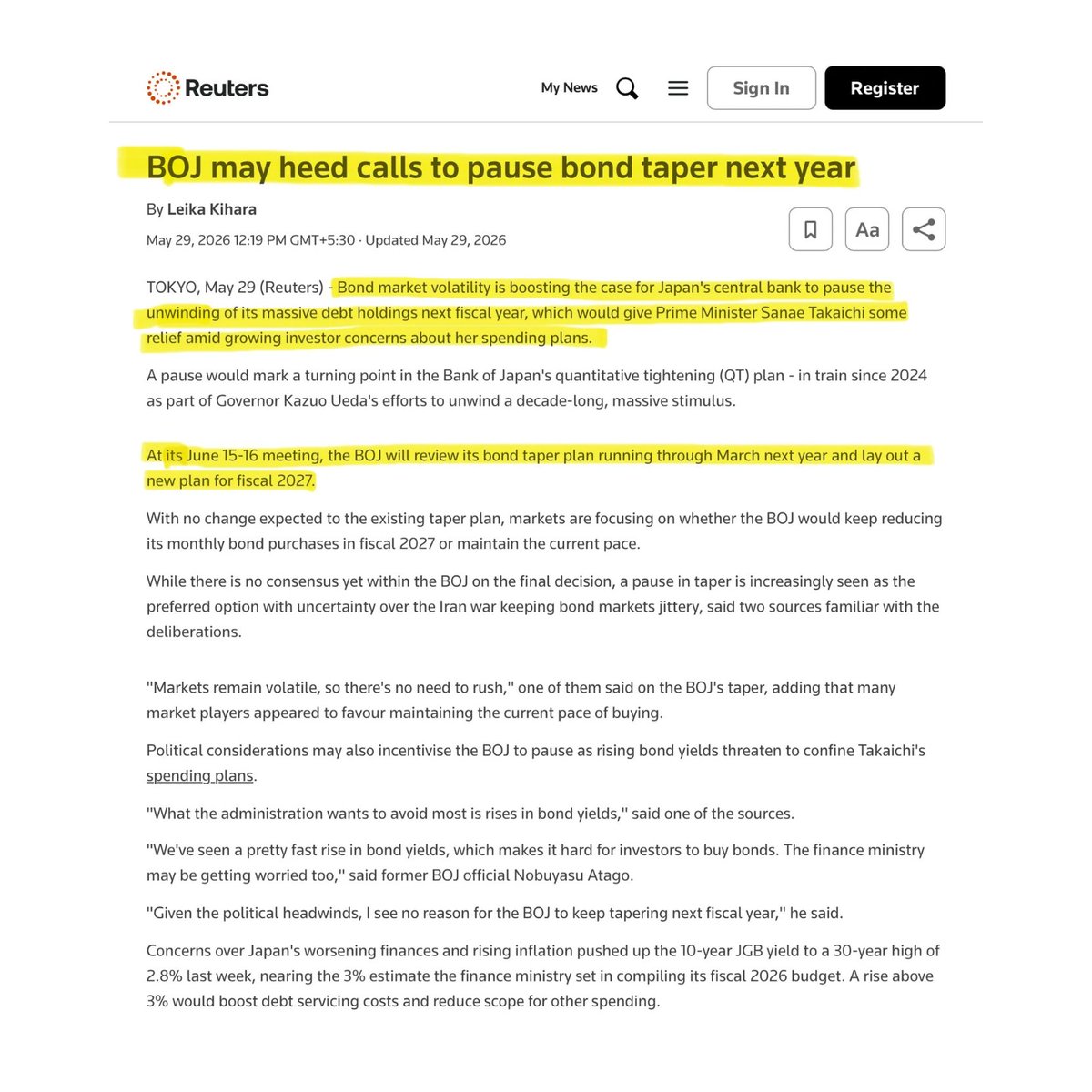
According to Reuters, BOJ officials are increasingly considering a pause to QT in 2027 as bond market volatility continues to rise.
This would be a major reversal for a central bank that has spent years trying to exit emergency-era policies.
The reason is the bond market itself.
Japan's 10-year government bond yield recently hit 2.8%, the highest level in nearly 30 years.
Long-dated bond yields have reached record highs, and investors are becoming increasingly concerned about Japan's debt burden and rising inflation.
This is becoming a serious problem because Japan has more than $8 trillion of government debt. The finance ministry built its entire 122.3 trillion yen budget assuming yields would not exceed 3%. Japan's debt servicing costs have already risen 10.8% this year to 31.3 trillion yen. Every move above 3% automatically wipes out spending room the government does not have.
At the same time, inflation is rising again.
For years Japan wanted inflation because the country was stuck in a low growth, low wage environment.
Now inflation is being driven by higher energy costs and imported inflation from the Iran conflict, which is a very different type of inflation and much harder to control. Japan has recorded above-target inflation for 45 consecutive months.
This leaves the BOJ trapped.
If it continues QT, bond yields could move even higher and put more pressure on government finances.
If it pauses QT, it risks showing that the bond market still depends on central bank support after more than a decade of intervention.
And this is where global markets come in.
Japan is the third largest economy in the world and the single largest foreign holder of US Treasuries. The BOJ currently owns 49% of all outstanding Japanese government bonds, 503 trillion yen out of a total 1,025.8 trillion yen market.
When Japanese bond yields rise, Japanese institutional investors stop buying US Treasuries and bring money home instead.
That reduces demand for US debt, pushes US yields higher, and tightens financial conditions for every market on earth that prices risk against the US 10-year rate.
But the bigger risk is the carry trade.
For years global investors borrowed money in Japan at near zero interest rates and invested those funds into higher yielding assets around the world US stocks, emerging market bonds, tech stocks, crypto. This trade worked as long as Japanese rates stayed low.
As the BOJ raises rates and Japanese yields rise, the cost of borrowing in yen increases. That forces carry trade investors to close their positions, selling the assets they bought and converting back to yen to repay their loans.
In August 2024 the BOJ raised rates by just 0.15%.
What followed was the single largest single day crash in the history of the Japanese stock market and a violent selloff across global equities, crypto, and emerging markets within 48 hours.
The BOJ is now expected to raise rates to 1% at its June 15-16 meeting. That is a significantly larger move than August 2024.
The carry trade built on decades of near zero Japanese rates is estimated at over $4 trillion globally.
That's why this should scare every investor in the world.
Elon Musk avait dit un truc qui m'avait marqué sur l'allocation de ressources. En substance : passé un certain niveau de richesse, l'argent n'est plus de la consommation, c'est de l'allocation de capital.
Cette phrase change tout.
L'économie, dans le fond, c'est juste un problème d'allocation. Tu as des ressources finies et des usages infinis. Qui décide où va quoi ?
Imagine une cour de récré. 100 enfants, des paquets de cartes Pokémon distribués au hasard. Tu laisses faire. Très vite, un ordre émerge. Les bons joueurs accumulent les cartes rares, les collectionneurs trient, les négociateurs trouvent des deals. Personne n'a planifié. Et pourtant chaque carte finit dans les mains de celui qui en tire le plus de valeur. Le système maximise le bonheur total de la cour. C'est ça, la main invisible.
Maintenant fais entrer la maîtresse. Elle trouve ça injuste. Léo a 50 cartes, Tom en a 3. Elle confisque, redistribue, impose l'égalité. Trois effets immédiats. Les bons joueurs arrêtent de jouer, à quoi bon. Les mauvais n'ont plus de raison de progresser, ils auront leur part. Les échanges s'effondrent. La cour est égale, et morte. Elle a maximisé l'égalité, elle a détruit le bonheur.
Le problème de la maîtresse, c'est qu'elle ne peut pas avoir l'information que la cour avait collectivement. C'est le problème du calcul économique de Mises, formulé en 1920. L'URSS a essayé de le résoudre pendant 70 ans avec le Gosplan. Résultat : pénuries, queues, effondrement. Pas parce que les Soviétiques étaient bêtes, parce que le problème est mathématiquement insoluble en mode centralisé.
Quand Musk a 200 milliards, il ne les consomme pas, il les alloue. SpaceX, Starlink, Neuralink, xAI. Chaque dollar est un pari sur le futur. Et lui a un track record. PayPal, Tesla, SpaceX. Il a démontré qu'il sait identifier des problèmes immenses et y allouer des ressources avec un rendement spectaculaire.
L'État aussi a un track record. Hôpitaux qui s'effondrent, éducation qui décline, dette qui explose, services publics qui se dégradent malgré des budgets en hausse constante. Le marché identifie les bons allocateurs, la politique identifie les bons communicants.
Le profit n'est pas une finalité, c'est un signal. Il dit : tu as alloué des ressources rares vers un usage que les gens valorisent suffisamment pour payer. Plus le profit est gros, plus la création de valeur est grande. Quand Starlink est rentable, ça veut dire que des millions de gens dans des zones rurales ont enfin internet. Quand un ministère est en déficit, ça veut dire qu'il consomme plus qu'il ne produit. L'un crée, l'autre détruit, et on appelle ça redistribution.
Dans nos sociétés il y a deux catégories d'acteurs. Les entrepreneurs et les bureaucrates. L'entrepreneur prend un risque personnel pour identifier un problème, mobiliser des ressources, créer une solution. S'il se trompe il perd. S'il a raison, ses clients gagnent, ses employés gagnent, ses fournisseurs gagnent, l'État collecte des impôts. Il est la cellule de base du progrès humain.
Le bureaucrate ne prend aucun risque personnel. Son salaire est garanti. Au mieux il maintient une rente existante. Au pire il la détruit par excès de réglementation, mauvaise allocation forcée, incitations perverses qui découragent ceux qui produisent. Mais dans aucun cas il ne crée.
Regarde les 50 dernières années. iPhone, internet civil, SpaceX, Tesla, Google, Amazon, Stripe, mRNA, ChatGPT. Toutes des inventions privées, portées par des entrepreneurs, financées par du capital risque. Pas un seul ministère n'a inventé quoi que ce soit qui ait changé ta vie au quotidien.
La France est devenue le laboratoire mondial de la dérive bureaucratique. 57% du PIB en dépenses publiques, record absolu. Une administration tentaculaire, une fiscalité qui pénalise la création de richesse. Résultat : décrochage face aux États-Unis, à l'Allemagne, à la Suisse. Fuite des cerveaux. Désindustrialisation. Dette qui explose.
Et le pire c'est que la mauvaise allocation s'auto-renforce. Plus l'État prélève, moins les entrepreneurs créent. Moins ils créent, moins il y a de base fiscale. Plus l'État s'endette et taxe. Boucle de rétroaction négative parfaite. La maîtresse pense qu'elle aide, et chaque année la cour produit moins.
Dans nos sociétés, ce sont les entrepreneurs, toujours, qui font avancer la civilisation. Les bureaucrates au mieux maintiennent une rente, au pire la détruisent. Aucune société n'a jamais progressé en taxant ses créateurs pour subventionner ses gestionnaires.
La question n'est jamais qui a combien. C'est qui alloue le mieux la prochaine unité de ressource pour maximiser le futur de l'humanité. La réponse depuis 200 ans n'a jamais changé. Ce ne sont pas les fonctionnaires.
Governments don't want you to learn history, because they literally repeat it.
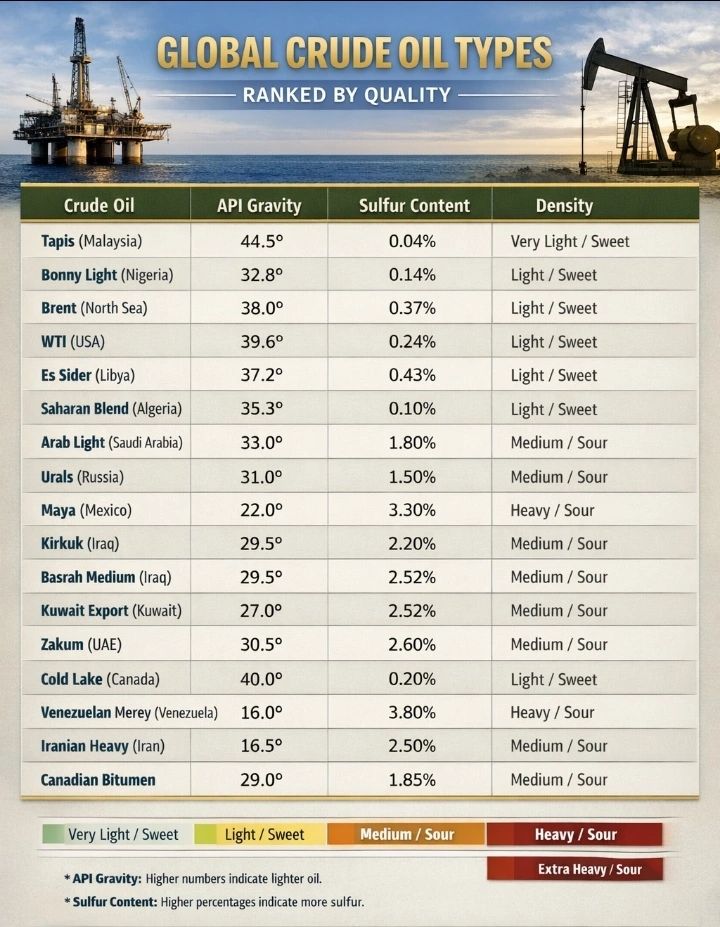
What happened in the 1970s is happening again, but this time instead of a 4% reduction in oil it's 20%. The U.S. is intentionally blowing up refineries in Russia & Australia, pipelines to Europe, capturing Venezuela so additional oil supply can't come online.
The goal is to starve China and the world of oil, collapsing industrial capacity outside of the U.S. and sucking all of the Dollars in circulation back into the U.S.
The U.S. doesn't care how bad the economy gets, as long as it's worse everywhere else.
Waktu krisis seluruh dunia ni lah kita boleh nampak "international diplomatic relations" PMX.
Masa tahanan peserta Sumud, peserta Malaysia antara yang terawal dibebaskan kerana hubungan baik dengan Turkiye.
Masa krisis ekonomi kesan penutupan Selat Hormuz, kapal Malaysia diberi pelepasan oleh Iran. Negara lain dah darurat, Malaysia masih boleh bagi subsidi petrol 200 liter dengan harga RM1.99.
REPORTER: Trump warns Iran to make peace or face consequences.
IRAN FM: "We signed a deal. The US withdrew. We were negotiating, then attacked.
Defending sovereignty isn’t aggression.
If this escalation isn’t condemned, what’s left of international law?"