And yet every time a new Labour team gets into the Treasury and asks about this idea they will be told the data clearly shows it would actually result in lower tax revenues, and they won't do it.
We are pretty much at the revenue maximising rates for capital gains tax.
And this isn't because of avoidance schemes, it's mainly just that people would defer selling assets or possibly move overseas.
Why do similar policies produce very different outcomes across countries? An Austrian Economics perspective.
In this conversation with @Abigail_R_Hall on the @econ_SPE podcast, I explore the principles and history of the Austrian economic school and how it can be applied to economic and business decision making and why the gap between theory and reality is often wider than expected.
We also explore in the second part of our conversation, the application of economics to national security and geopolitical analysis.
Watch here: https://t.co/hY3WfkfmQy
I like your piece @Noahpinion and I mostly agree with it but I don't agree entirely that the right was worst though it surely look that way today. Surely I don't agree that liberals in 2013 were better than Conservative if you mean centre left and centre right. I'd like someone would write the piece you wrote - which is brilliant- from a centre right perspective. As a centre right person i think it would feel very similar...
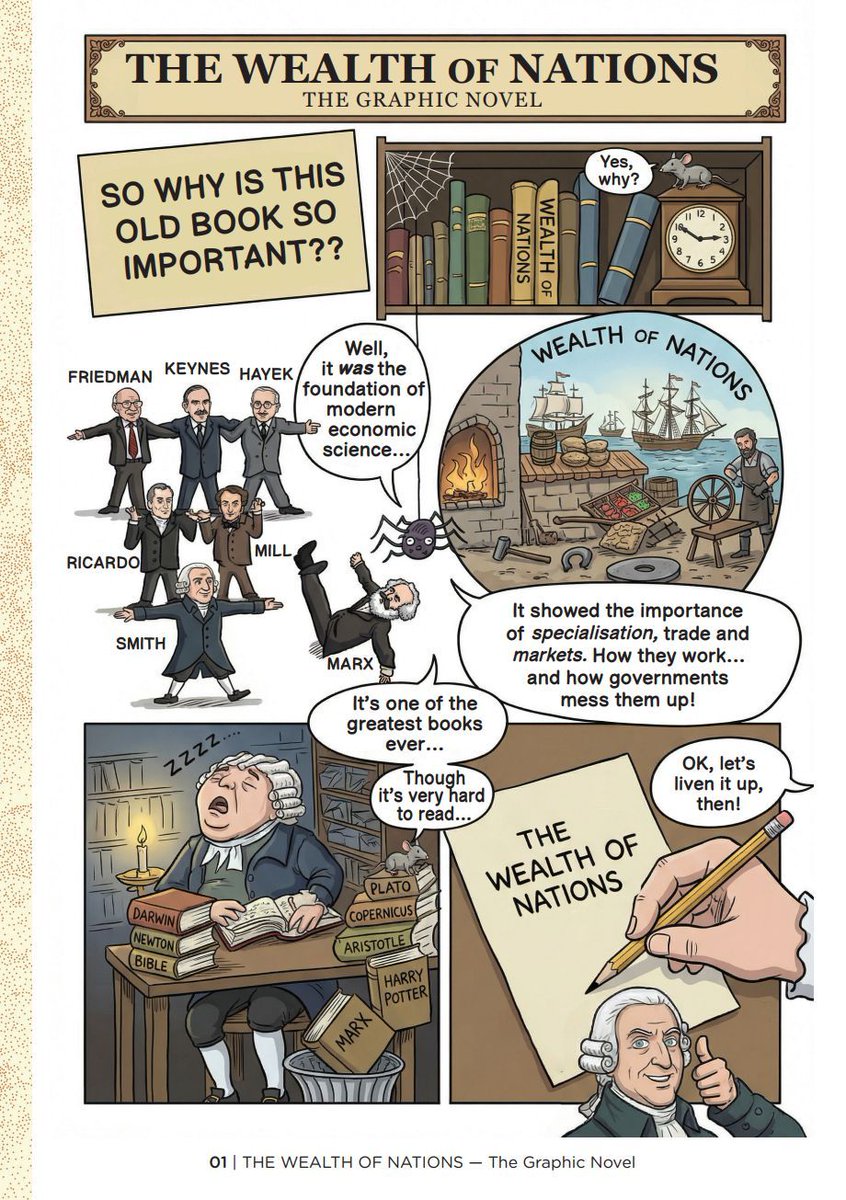
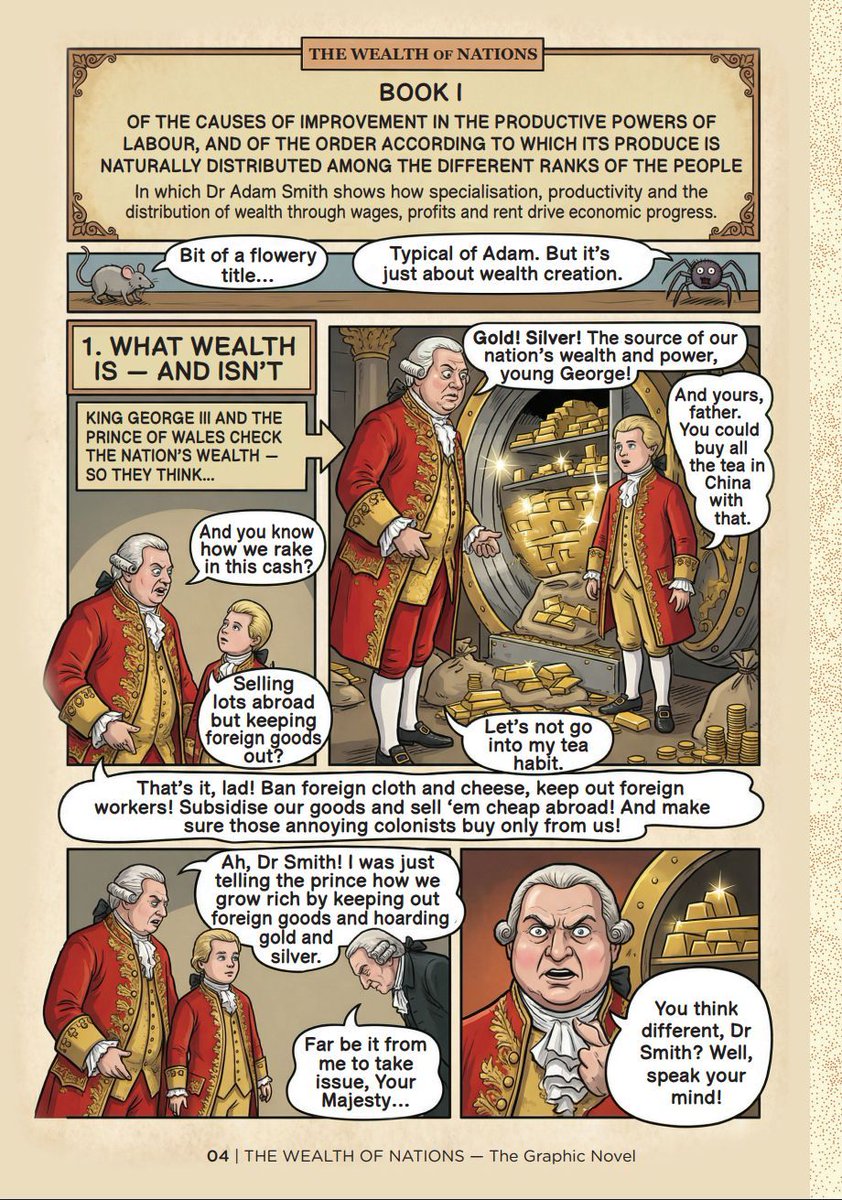
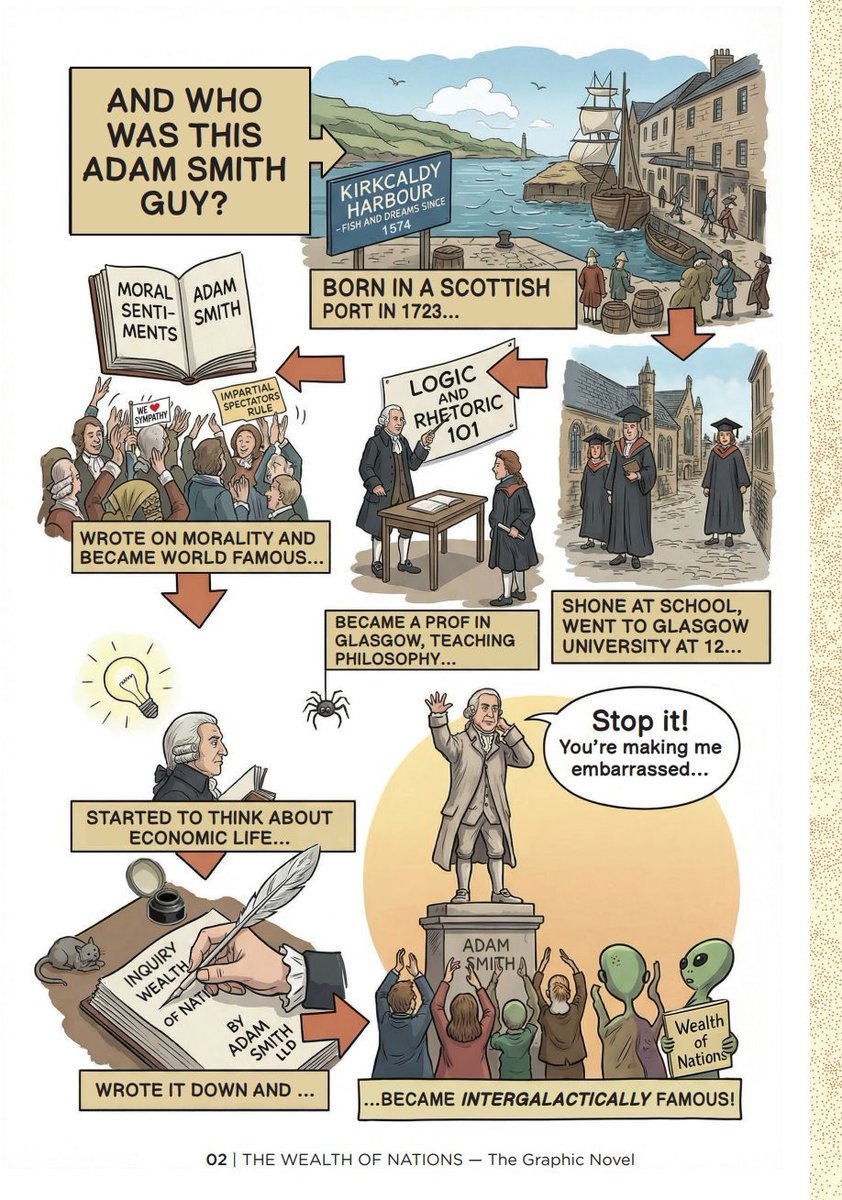
Today marks 250 years since the publication of The Wealth of Nations.
We're celebrating this anniversary by turning The Wealth of Nations into a graphic novel!
Here are some preview pages: https://t.co/XOBbwFh4h7
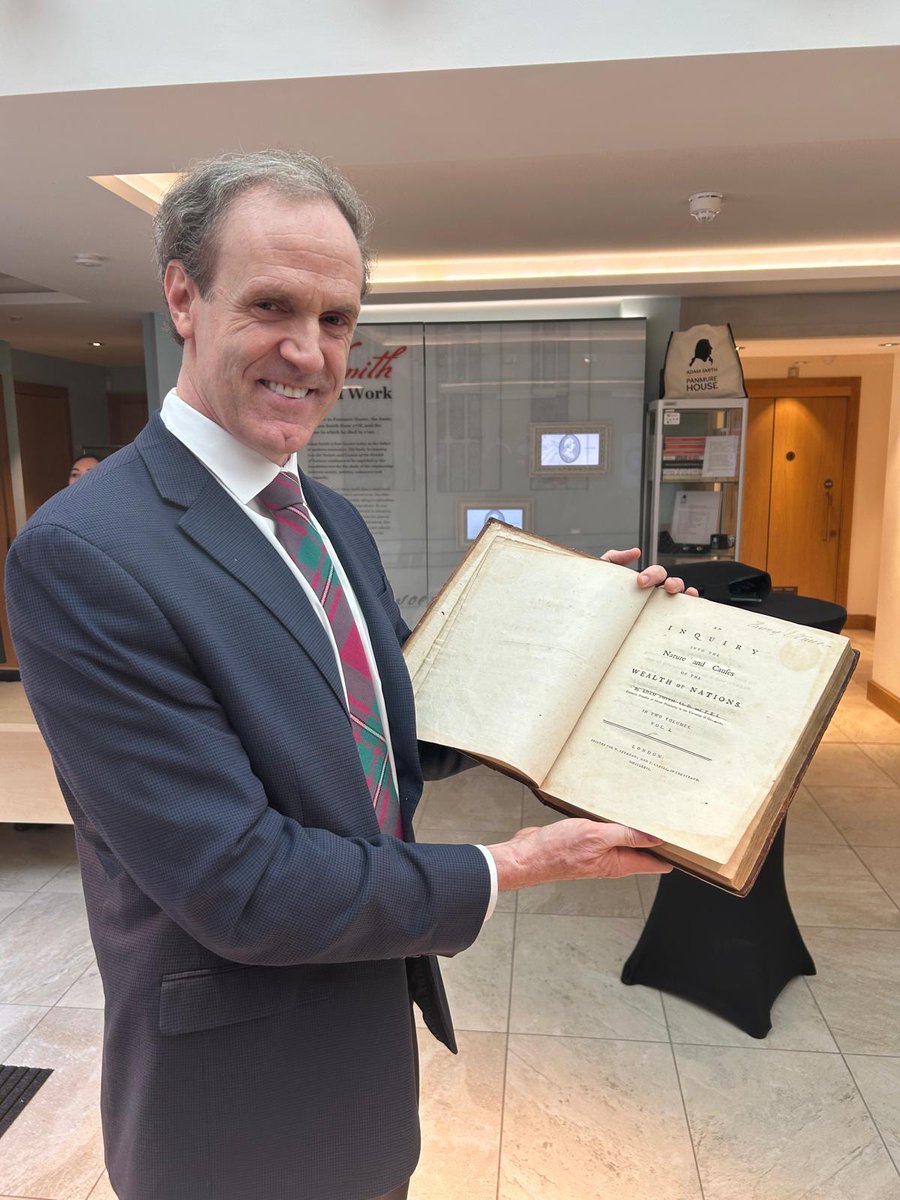
Happy 250th Anniversary, Adam Smith’s THE WEALTH OF NATIONS, published March 9, 1776. Some time ago I spoke at @AdamSmithHouse in Edinburgh and held in my hands a first edition of WN. I’ve been studying Mr. Smith for a long time but this was a highlight! #WealthOfNations250@aier
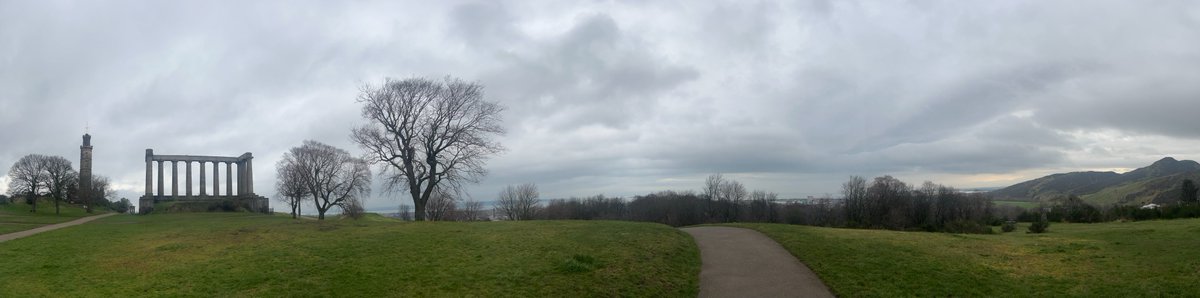
Taking a break from the economic consequences of the Iran war to celebrate the 250th anniversary of the publication of Adam Smith's "The Wealth of Nations," on this day in 1776. I took a trip to what was then the Athens of the North to pay tribute.
This year we celebrate the 250th anniversary of one of the most well known economics book in history - Adam Smith's Wealth of Nations. To mark the event for our @econ_SPE Econ Thoughts podcast series I spoke with @eamonnbutler , Director of the @ASI Adam Smith Institute.
https://t.co/lyzwZd5MaX
In our conversation we reflected on the enduring legacy of Adam Smith, arguing that Smith’s core insight—that prosperity is driven by voluntary exchange, competition and individual effort—remains as relevant today as it was in 1776, even though policy makers and some economists don't seem to notice...
What do you think - are Adam Smith's views still valid?
First podcast of 2026 for the @econ_SPE Society Of Professional Economists with @MkBlyth Mark Blyth. Mark is one of the most eloquent speakers I know, incredibly engaging and compelling, even when we disagree [those few times].
https://t.co/xkPb7JmUdU
So i am sure you will enjoy this episode, where we talk about inflation, shocks and economic populism - what drives it and where it may go. Mark has written a couple of books recently on the topics, both of which i highly recommend: Inflation: a guide for users and losers (2025) and Angrynomics (2020).
Excellent way to start Econ Thoughts podcast year - more to come, stay tuned...
Last @econ_SPE Society Of Professional Economists podcast for 2025 - and it is with 2025 Rybczynski Price winners and FT journalists @ChrisGiles_ and @JoelSuss .
Chris and Joel have built a “macro mood” index that captures the tone of global economic reporting, using novel text-as-data methodology. Chris and Joel describe how this index not only traces historical turning points — from wars to the global financial crisis to the tentative upswing of 2017–18 — but also contains forward-looking information. In fact, their methodology outperforms standard benchmarks, and even the Federal Reserve staff’s own forecasts, in predicting US inflation over a 12-month horizon.
The conversation brings together macroeconomic data, economic history and innovative economic techniques - all topics we covered at length this year in Econ Thoughts, the SPE podcast.
Enjoy it and as always - new ideas for our podcast are welcome!
My latest @econ_SPE podcast interview with @anne_r_bradley, the George and Sally Mayer Fellow for Economic Education and Academic Director at The Fund for American Studies.
https://t.co/SIgAa2oyxb
How do we flourish as human being? How can economics help us prosper and how to ensure everyone benefits from the market economy? Anne's research has focused on poverty alleviation and how economics offers a framework for thinking about constraints, incentives and the unseen consequences of policy choices, all of which shape long-term wellbeing. Anne argues that sustainable reductions in poverty emerge from economic and political freedom, strong local institutions and the dignity that comes from work. Markets remain “an incredible anti-poverty machine,” yet they function well only when embedded in supportive social norms and institutions.
A great conversation to end 2025 on some of the most consequential topic in economics.
Can you do a better job than Rachel Reeves? If you think you can, or even if you are just 'budget' curious, and want to test your skills at managing the economy, I have the Podcast and the Book for you. Listen to latest @econ_SPE interview with @Bloomberg editor @Joe_Mayes, author of 'Can you run the economy?', a rare blend of play and policy that turns the reader into the Chancellor.
https://t.co/DmAge9ItAA
An immersive “choose-your-own-adventure” for economics, the book challenges readers to balance fiscal prudence with political survival. The goal is not just entertainment, but empathy: to let readers feel the pressures of real decision-making and discovering just how hard it is to “run the economy” well.
In my conversation with Joe we talk about the book and 'difficult choices' but also about the current state of the UK economy, what to expect in the short and long term.
It is a fun conversation and it is a great book - do read it and play. And in the comments below for those who have completed the task, post your results [or if you are slightly shy direct message me]. I'd like to see what the average outcome is...
Embrace the Chancellor in you!
Enormous thanks to Governor Waller, @federalreserve for an enlightening speech last night at our Annual Dinner – the largest attendance on record. You can read a full copy of the Governor’s speech on https://t.co/Vktj4QkiQz
When asked about why the labour market is weakening he mentioned first the impact of tariffs and then the consequences of the investment in AI: with so much capex going into AI, businesses have less money for other spending. One element is easier to address policy-wise than the other...
Wonderful evening with Fed Governor Christopher Waller at the Society Of Professional Economists @econ_SPE Annual Dinner last night. At a sold out event Governor Waller outlined his views on the trajectory of monetary policy and the future of interest rates in a weakening labour market in the US, stressing the importance of soft data complementing and sometimes supplementing hard data at a time of uncertainty. He explained his rationale for at least one more cut in December and possibly more in 2026, with a resting rate somewhere around the 3% level.
Huge thanks to Governor Waller and to my colleagues at the SPE for a flawlessly executed Annual Dinner.
@NickTimiraos@NickTimiraos - I spoke to Governor Waller at the end of the dinner last night and he mentioned 2 reasons for the weak labour market: tariffs and the impact of investment in AI. One is easiest to handle than the other one...
Wonderful evening at the @ActonInstitute 35th Annual dinner. Wonderful speeches by @kmauren, @DouthatNYT, @robertsirico and @clara_jace. And I snapped a picture with Vernon Smith! At 98 he's going strong and reminded us of Buckley. Thatcher and Jimmy Lai! Thanks to the Acton Institute for a wonderful evening
Congratulations to @JMilei and @fedesturze on their historic win on election yesterday. The economic freedom revolution that Minister Federico Sturzenegger mentioned in our interview is continuing. Listen to our podcast: https://t.co/M2hNVRz9n1
New @econ_SPE podcast interview is out: it is a very special one as I speak with Federico Sturzenegger, Minister of Deregulation and State Transformation of the Argentine Republic in @JMilei Government.
https://t.co/ytMrzzAuzE
We discuss President Milei administration’s sweeping programme to shrink the state and restore market freedom, how the deregulation plan came about, how it is going and how it is affecting people's daily lives. It is a fascinating conversation on one of the most radical and consequential policy reform plans of the last decades. As Federico says “Wonderful things happen when you let people be free”.
And yes - we do also talk about the 'chainsaw'!
Comments and views are welcome





![fgaddo's tweet photo. First podcast of 2026 for the @econ_SPE Society Of Professional Economists with @MkBlyth Mark Blyth. Mark is one of the most eloquent speakers I know, incredibly engaging and compelling, even when we disagree [those few times].
https://t.co/xkPb7JmUdU
So i am sure you will enjoy this episode, where we talk about inflation, shocks and economic populism - what drives it and where it may go. Mark has written a couple of books recently on the topics, both of which i highly recommend: Inflation: a guide for users and losers (2025) and Angrynomics (2020).
Excellent way to start Econ Thoughts podcast year - more to come, stay tuned...](https://pbs.twimg.com/media/HAPeDDOW8AA3TfI.jpg)


![fgaddo's tweet photo. Can you do a better job than Rachel Reeves? If you think you can, or even if you are just 'budget' curious, and want to test your skills at managing the economy, I have the Podcast and the Book for you. Listen to latest @econ_SPE interview with @Bloomberg editor @Joe_Mayes, author of 'Can you run the economy?', a rare blend of play and policy that turns the reader into the Chancellor.
https://t.co/DmAge9ItAA
An immersive “choose-your-own-adventure” for economics, the book challenges readers to balance fiscal prudence with political survival. The goal is not just entertainment, but empathy: to let readers feel the pressures of real decision-making and discovering just how hard it is to “run the economy” well.
In my conversation with Joe we talk about the book and 'difficult choices' but also about the current state of the UK economy, what to expect in the short and long term.
It is a fun conversation and it is a great book - do read it and play. And in the comments below for those who have completed the task, post your results [or if you are slightly shy direct message me]. I'd like to see what the average outcome is...
Embrace the Chancellor in you!](https://pbs.twimg.com/media/G6nVnF5WwAAeSeP.jpg)





