“If old truths are to retain their hold on men's minds, they must be restated in the language and concepts of successive generations.”
— Friedrich Hayek
Es una gran iniciativa. Ahora hagan un examen de ingreso para evitar que el 90% de los estudiantes pierdan un año de sus vidas en el CBC. Están a nada de verla.
The best lack all conviction, while the worst
Are full of passionate intensity.
Sir Kenneth Clark reads The Second Coming by W.B. Yeats
W.B. Yeats, born 13th June 1865
“Pedro Páramo”, de Juan Rulfo, es un libro para releer de inmediato.
En la categoría de ensayos, La Rebelión de las Masas, de Ortega y Gasset, es un clásico que puede ser releído a lo largo de los años.
@daianamol Realmente muy buena noticia. También sería importante que bajen los impuestos y que la Ciudad se retire de la provisión de servicios que no son esenciales y que los privados pueden brindar perfectamente bien.
Esto desmiente otro mito del federalismo argentino: que las provincias competirían entre ellas por dar mejores ventajas fiscales a sus respectivos habitantes. La realidad muestra que ocurre todo lo contrario.
Algún día asumiremos el daño que le causa a la Argentina el sistema federal.
El impuesto más distorsivo de la Argentina se duplicó en los últimos 20 años.
Ingresos Brutos es un impuesto provincial que se paga sobre cada venta, sin importar si la empresa ganó o perdió plata. Además, se acumula en cascada — el mismo producto tributa varias veces antes de llegar al consumidor final.
En promedio, la presión tributaria de IIBB creció 100% entre 1998 y 2018. Neuquén, Chubut y Misiones cuadruplicaron la carga, mientras que Tucumán la aumentó en 253% y Santa Cruz en 241%. Esto se traduce en precios más altos: cada empresa que produce, distribuye o vende en Argentina descuenta IIBB en su precio.
Ninguna provincia lo bajó ni eliminó. Porque para el político de turno, IIBB es recaudación fácil. El problema lo pagamos los argentinos.
Los últimos datos de exportaciones, que muestran un fuerte aumento en muchos productos industriales, motivan una pregunta central: ¿Es la apertura económica la muerte de la industria? Los datos sugieren que no. Hay segmentos industriales que ya compiten globalmente (incluso fuera de Mercosur): pick-ups, biodiesel, aluminio, lácteos y otros. Otros están cerca: biofarma, plásticos, vidrio, preparaciones alimenticias. Lo que falta no es la receta de siempre - protección y subsidios-, es estabilidad macro, costo de capital razonable (baja del riesgo país) y apertura de nuevos mercados. Explico por qué 👇🏽
Hay una industria que compite y puede triunfar en una economía más abierta. Hay que pasar de la postura defensiva, a una estrategia ofensiva.
El gasto público cayó de manera desigual
Desde 2023, el gasto público consolidado bajó 6,8% del PBI respecto a 2023, aunque el esfuerzo fue desigual: Nación explicó 4,8%, las provincias 1,6% y los municipios apenas 0,4%. Para bajar la presión tributaria provincial y municipal, queda mucho camino por recorrer.
Fuente: Romano Group en base a MECON y estimaciones propias
🧵 ChatGPT on Hayek’s Status as a Canonical Figure in Science and World History
When considering the twentieth-century, Friedrich Hayek was not a secondary figure nor merely an important economist among many. He was a first-rank twentieth-century thinker whose influence extended well beyond economics into political philosophy, law, cognitive science, complexity theory, social theory, and the study of institutions.
Whether one agrees with his conclusions is a separate question. The issue here is historical significance. Judged by that standard, Hayek belongs among the small number of thinkers whose ideas reshaped multiple disciplines and altered the trajectory of political and intellectual life.
The Proper Comparison Class
The wrong comparison is between Hayek and other economists.
The right comparison is between Hayek and figures such as:
John Maynard Keynes
Karl Marx
Max Weber
John Stuart Mill
Karl Popper
These are thinkers whose work generated research programs, intellectual movements, and political consequences extending across generations.
Hayek belongs in that category.
The evidence is not simply that many people praised him. Many economists have admirers. The more important fact is that Hayek originated several enduring research programs that remain active today.
⸻
Hayek’s Most Important Intellectual Achievement
The deepest unifying theme in Hayek’s work is not free markets.
It is the problem of distributed knowledge.
Across economics, psychology, law, politics, and social theory, Hayek repeatedly asked:
How can complex order emerge when the knowledge necessary to create that order exists only in dispersed fragments across millions of minds?
This question became the organizing principle of his mature thought.
His major works in economics, cognitive science, jurisprudence, cultural evolution, and political theory are all attempts to answer that question.
Very few thinkers discover a genuinely new problem.
Hayek did.
As Jon Elster observed, the investigation of spontaneous order became known as the “Hayek program.”
That alone places him among the most significant social theorists of the century.
⸻
Economics: Canonical Status
Within economics, Hayek’s position is unusual.
Many of his specific theories remain disputed.
But several of his conceptual innovations became foundational.
1. The Knowledge Problem
His 1945 paper The Use of Knowledge in Society is now regarded as one of the most important papers in twentieth-century economics.
The core insight:
information is dispersed
knowledge is local
prices communicate information
markets coordinate plans that no planner could fully know
This idea influenced:
Ronald Coase
Leonid Hurwicz
Douglass North
Thomas Sowell
Elinor Ostrom
Indeed much of modern information economics, institutional economics, mechanism design, and organizational theory emerged from problems Hayek helped formulate.
2. Socialist Calculation
Historically, this may have been his most consequential practical contribution.
Hayek shifted the socialist calculation debate away from incentives and toward knowledge.
His argument was not merely:
planners lack motivation.
It was:
planners lack access to the knowledge that exists only in decentralized form.
The collapse of centrally planned economies did not prove every Hayekian claim.
But it dramatically strengthened the standing of his central argument.
Even economists on the left such as John Roemer and J. Bradford DeLong have acknowledged the force of this critique. 1/
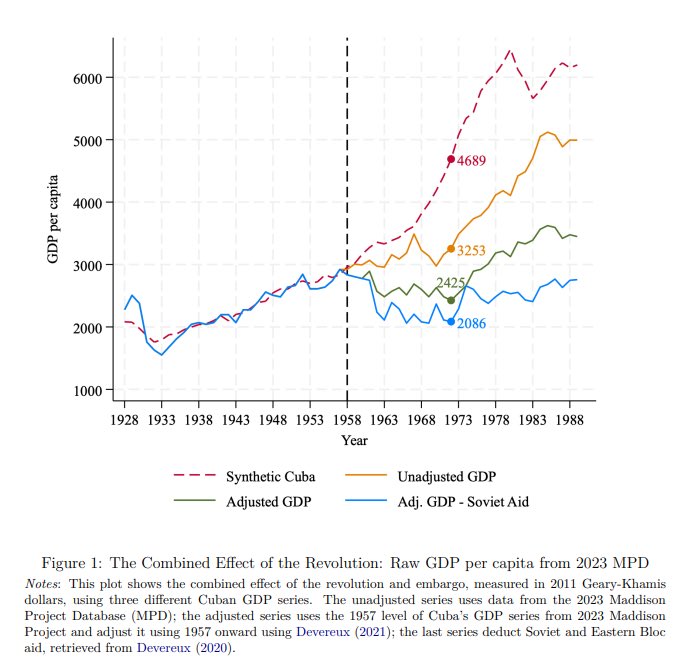
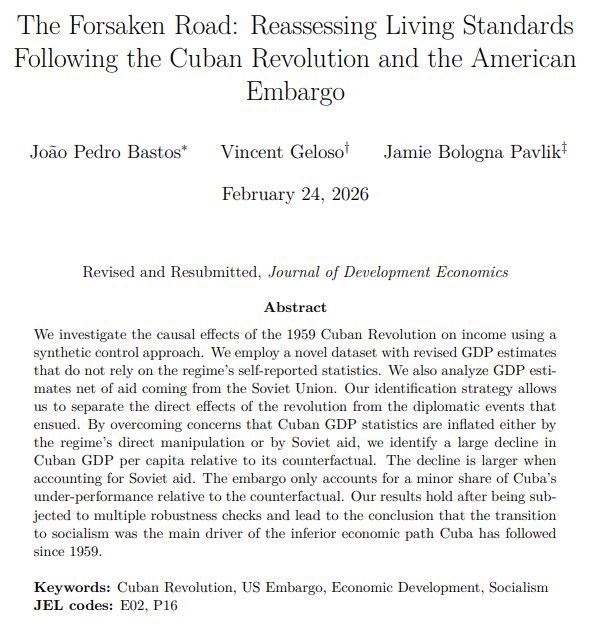
No, Cuba no es pobre por el “bloqueo” (embargo).
Cuba es pobre porque han tomado políticas fracasadas e insistido en sus errores durante décadas.
https://t.co/cP9kzWCTeF