A good scientist is a person with original ideas. A good engineer is a person who makes a design that works with as few original ideas as possible. There are no prima donnas in engineering."
- Freeman Dyson
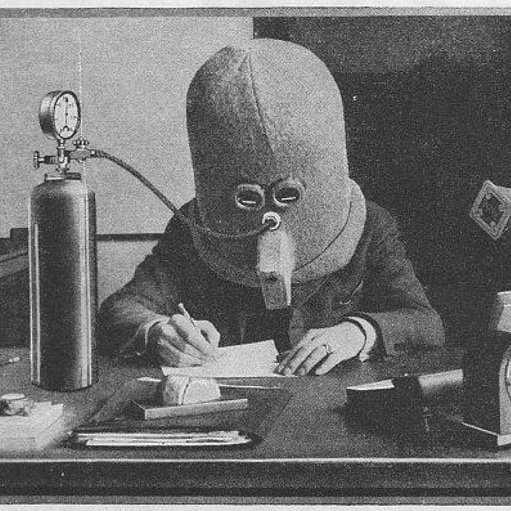
The isolator helmet was a device invented by Hugo Gernsback in 1925 to help people concentrate and eliminate distractions. The helmet was made of wood and felt, and had three pieces of glass that allowed the wearer to see only a narrow slit in front of them.
The helmet also blocked out all sounds, and had a tube that supplied oxygen to the wearer. The idea was that by isolating the senses, the wearer could focus better on reading or writing.
However, the helmet also had some drawbacks, such as making the wearer drowsy after 15 minutes, and being very bulky and uncomfortable. Gernsback claimed that the helmet was 90-95% efficient in blocking out noise, but he only made 11 helmets and they disappeared by 1926. The isolator helmet was featured in Gernsback’s magazine Science and Invention, and later inspired other similar devices such as the Helmfon.
📷Science and Invention Magazine
The photo was taken on board a British ship. These children had just been rescued from being sold into slavery, 1868.
More rare historical photos: https://t.co/W7jIvOHun5
The science funding system is BROKEN. PhDs and professors are spending their days writing grant proposals rather than conducting research that could transform millions of lives. And the worst part? The system REWARDS predictable, safe, incremental science. It PUNISHES radical ideas and moonshots.
Relatively new one from from Sabine Hossfender. Loving her. Refreshingly entertaining...
The Kessler Syndrome is the idea that filling Earth’s orbit with too many satellites will inevitably cause failures to occur. #spacejunk
https://t.co/MF2qPJ3AHf
📢🚨CALL FOR PAPERS🚨📢
April Deadline 📆📌
SPIE Sensors + Imaging combines two of Europe’s best photonics conferences –
SPIE Environmental Remote Sensing and SPIE Security + Defence
Call for papers is now open.
https://t.co/lJzQWYuJqB
#optics#photonics#sensors#imaging
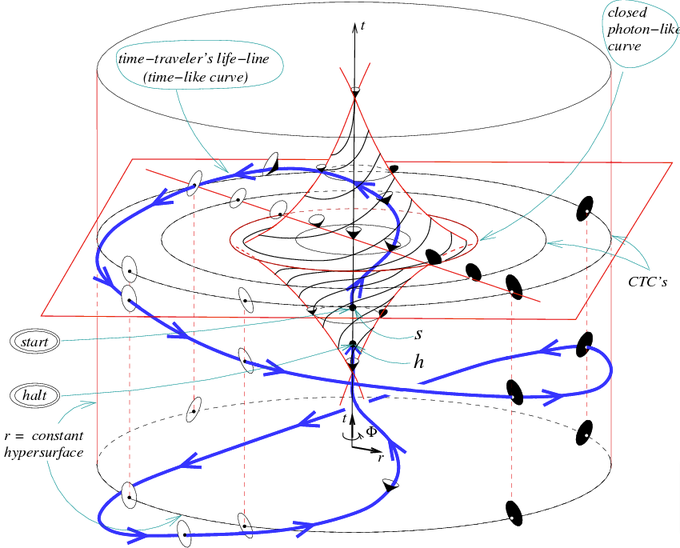
Kurt Gödel, who was one of Albert Einstein's best friends in his later years, found a solution to general theory of relativity that modelled a strange, unusual and rotating universe allowing for backward time travel.
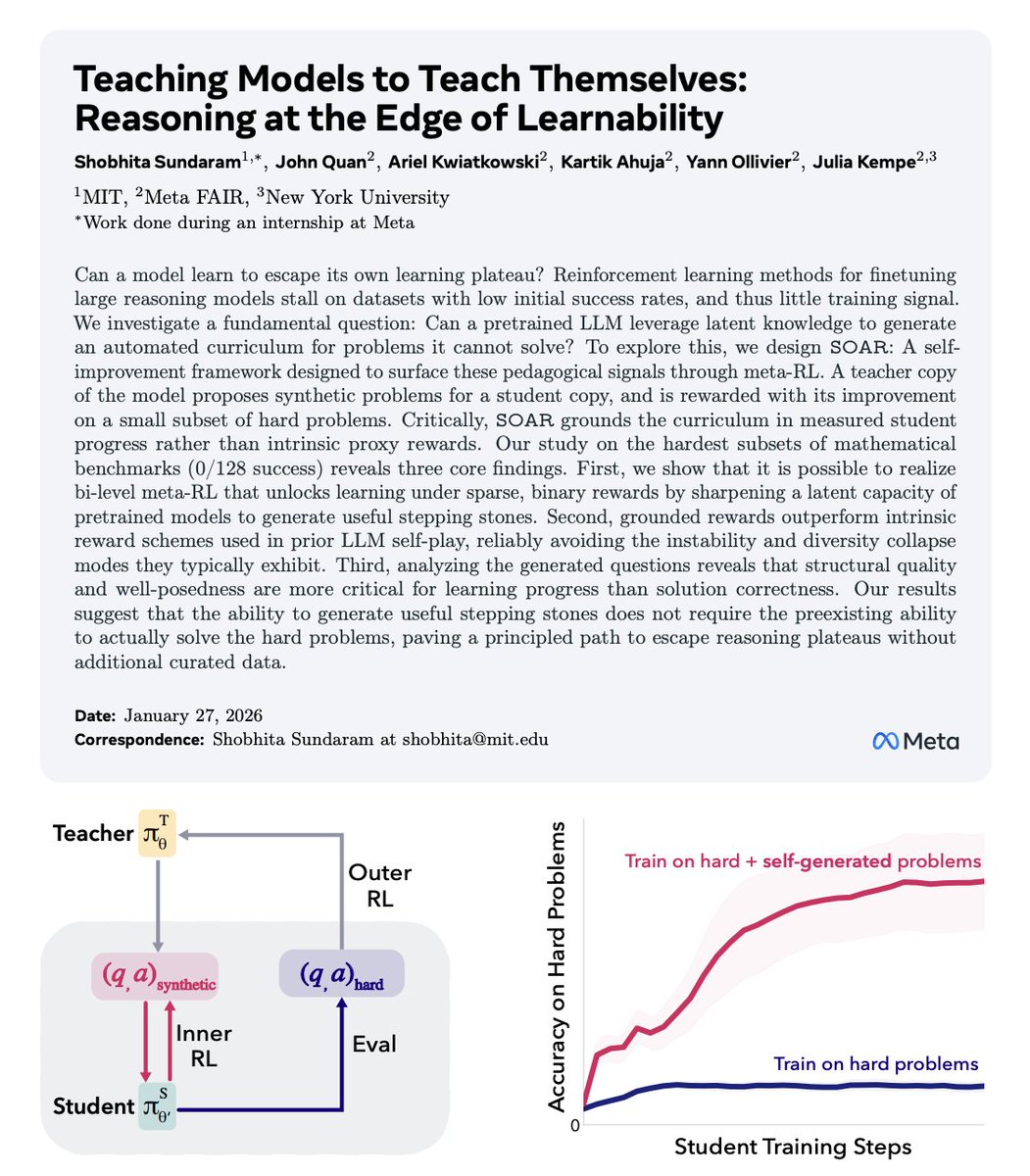
MIT just published a paper that quietly explains why LLM reasoning hits a wall and how to push past it.
The usual story is that models fail on hard problems because they lack scale, data, or intelligence.
This paper argues something much more structural: models stop improving because the learning signal disappears. Once a task becomes too difficult, success rates collapse toward zero, reinforcement learning has nothing to optimize, and reasoning stagnates. The failure isn’t cognitive, it’s pedagogical.
The authors propose a simple but radical reframing. Instead of asking how to make models solve harder problems, they ask how models can generate problems that teach them.
Their system, SOAR, splits a single pretrained model into two roles: a student that attempts extremely hard target tasks, and a teacher that generates new training problems. The catch is that the teacher is not rewarded for producing clever or realistic questions. It is rewarded only if the student’s performance improves on a fixed set of real evaluation problems. No improvement means zero reward.
That incentive reshapes everything.
The teacher learns to generate intermediate, stepping-stone problems that sit just inside the student’s current capability boundary. These problems are not simplified versions of the target task, and strikingly, they do not even require correct solutions.
What matters is that their structure forces the student to practice the right kind of reasoning, allowing gradient signal to emerge even when direct supervision fails.
The experimental results make the point painfully clear. On benchmarks where models start with zero success and standard reinforcement learning completely flatlines, SOAR breaks the deadlock and steadily improves performance.
The model escapes the edge of learnability not by thinking harder, but by constructing a better learning environment for itself.
The deeper implication is uncomfortable. Many supposed “reasoning limits” may not be limits of intelligence at all. They are artifacts of training setups that assume the world provides learnable problems for free.
This paper suggests that if models can shape their own curriculum, reasoning plateaus become engineering problems, not fundamental barriers.
No new architectures, no extra human data, no larger models. Just a shift in what we reward: learning progress instead of answers.
For years we thought the immune system was “autonomous.” It isn’t. It's controlled by nerves just like all the other organs. The vagus nerve sends signals that can switch inflammation on and off.