Wang Xiao was twenty-four years old when doctors told her she had about one year left to live. She suffered from uremia, a severe condition where the kidneys stop filtering waste from the blood.
Her family members took tests to see if they could donate a kidney, but no one was a match. All standard medical options had completely run out.
Instead of giving up, Wang decided to do something almost no one in her position would ever dare to try. In 2013, she posted a message in an online support group. Her words were direct and honest.
She wrote, "I just want to live."
She was looking for a terminally ill man with her same blood type who would be willing to marry her and donate his kidney after his death. In return, she promised to take care of him with everything she had for whatever time he had left.
Most people scrolled past the post, but a twenty-seven-year-old man named Yu Jianping saw it. Yu was a former manager dealing with myeloma, a serious blood cancer. He had already gone through a bone marrow transplant, but the cancer returned.
His father had to sell their family home to pay for treatments, and his girlfriend had left him after his diagnosis. Yu felt exhausted and ready to stop fighting.
However, when he saw Wang’s message, he realized their blood types matched. He sent her a short message: "I can marry you."
When they met for the first time in a park, something unexpected happened. They genuinely liked each other. During one of their online chats later on, Wang had to step away for her treatment.
She sent him a video from the dialysis machine, smiling despite the tubes and blood around her. She joked, "I am in dialysis now. My arm is stuck. Here is a one-handed monster."
Yu laughed out loud. He later admitted it was the first time he had laughed in a very long time.
On July 16, 2013, they officially registered their marriage. On paper, it was purely a practical contract. They agreed not to live together, not to combine their finances, and not to tell their families about the arrangement. If Yu passed away and his kidney matched, Wang would receive it.
In return, Wang promised to care for Yu's elderly father for the rest of his life.
Yet, daily life quickly changed their plan. Wang began accompanying Yu to his hospital visits. Yu cooked warm soup for her after her exhausting dialysis sessions.
They walked down hospital hallways together and joked about their situations. Slowly, the cold business contract transformed into genuine love.
When Yu urgently needed another expensive bone marrow transplant that his family could not afford, Wang refused to let him give up.
She set up a small street stall to sell flowers.
Next to the bouquets, she placed a handwritten note telling their story: two sick people trying to save each other, one day at a time.
Passersby stopped to read, bought flowers, and shared the story with others. Kindness spread quickly. Wang eventually raised about 500,000 yuan, which was over 90,000 dollars, covering the full cost of Yu’s operation.
Then, the unthinkable happened. Yu’s condition stabilized after his second transplant.
Around the same time, Wang’s medical team noticed her health improving, and her dialysis sessions were reduced. Eventually, doctors told her she might not even need a kidney transplant anymore.
In February 2015, they held a real wedding ceremony surrounded by friends and family.
Today, they run a flower shop called "Yongsheng Flower" in Xi'an, grown from the very same street stall that saved Yu’s life. Their story was even adapted into a major Chinese movie in 2024.
Wang and Yu showed the world that even in the darkest moments, love and human connection can heal what medicine alone cannot.
The United States has approximately 5,200 nuclear warheads.
It is the only country in history to have used nuclear weapons on human beings.
It used them on a civilian population. Twice.
The United Kingdom has approximately 225.
France has approximately 290.
These are the countries leading the international campaign against nuclear proliferation.
Not one of them has disarmed under the Nuclear Non-Proliferation Treaty, which legally obligates them to work toward disarmament. Not one.
The NPT has been in force since 1970.
Fifty-six years.
The nuclear powers have modernized their arsenals, developed new delivery systems, and in the case of the United States, budgeted over $1.7 trillion for nuclear modernization over the next thirty years.
So your question, "Is proliferation good?", would be more interesting if you directed it at the countries that have been proliferating, continuously, for eighty years, while telling everyone else that the capacity they are expanding for themselves is too dangerous for others to possess.
The question is not whether nuclear weapons are good.
The question is why the word "proliferation" only applies to the countries that don't already have them.
That asymmetry is the argument.
You haven't addressed it.
There is a reason the most sanctioned, bombed, isolated, and encircled countries on earth are described in Western media primarily through the suffering of their populations.
Not as a form of compassion.
As a form of argument.
The North Korean people are starving. The Iranian people are oppressed. The Venezuelan people are suffering. The Cuban people are poor.
The implicit conclusion, never quite stated, always clearly implied:
And therefore the sanctions are working.
And therefore the pressure should be maintained.
And therefore the government should be changed.
The suffering of the population is cited as the justification for the policies that produce the suffering.
This is a closed loop of extraordinary cynicism.
Starve the population.
Point to their starvation.
Use it as evidence that the government is illegitimate.
Tighten the strangulation.
Point to the increased starvation.
Argue that the government's inability to feed its people proves it must be removed.
And if the government develops the capacity to threaten consequences for the next round of sanctions?
Then the discussion is no longer about the suffering population.
Then the discussion is about the threat.
The provocation.
The aggression.
The population disappears from the argument the moment the government acquires the ability to make the argument cost something.
This tells you everything about whose suffering the empire was ever actually concerned with.
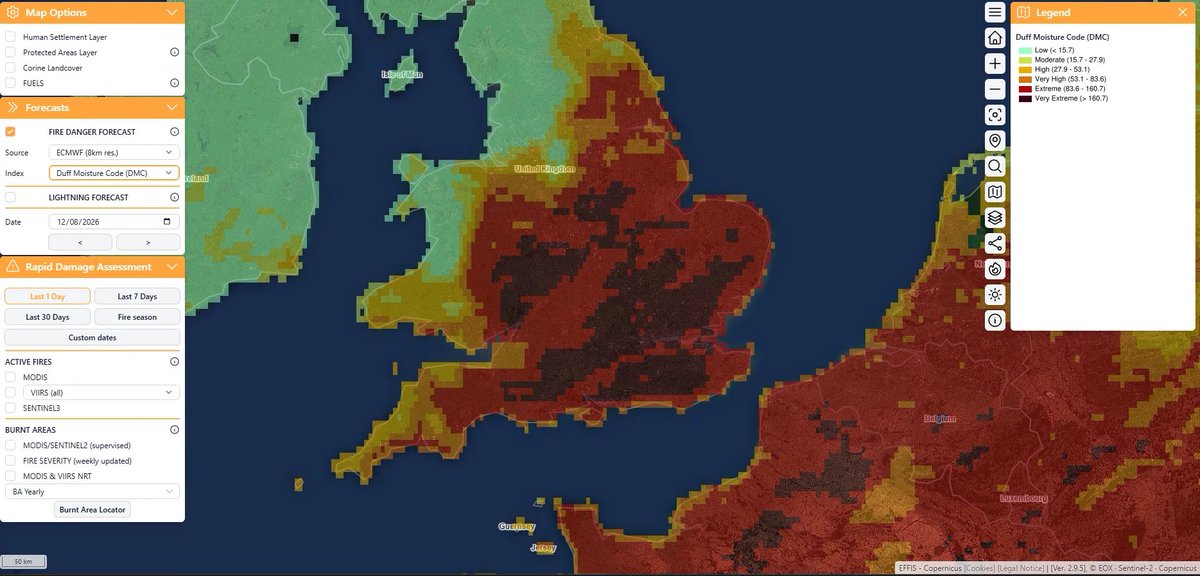
This is.. bad.
Recent ECM forecasts are suggesting a “very extreme” wildfire risk for next week as heatwaves return.
Extremely dry vegetation will allow any fires that do get started to spread extremely rapidly.
This is about as high-end extreme as it gets for the UK.
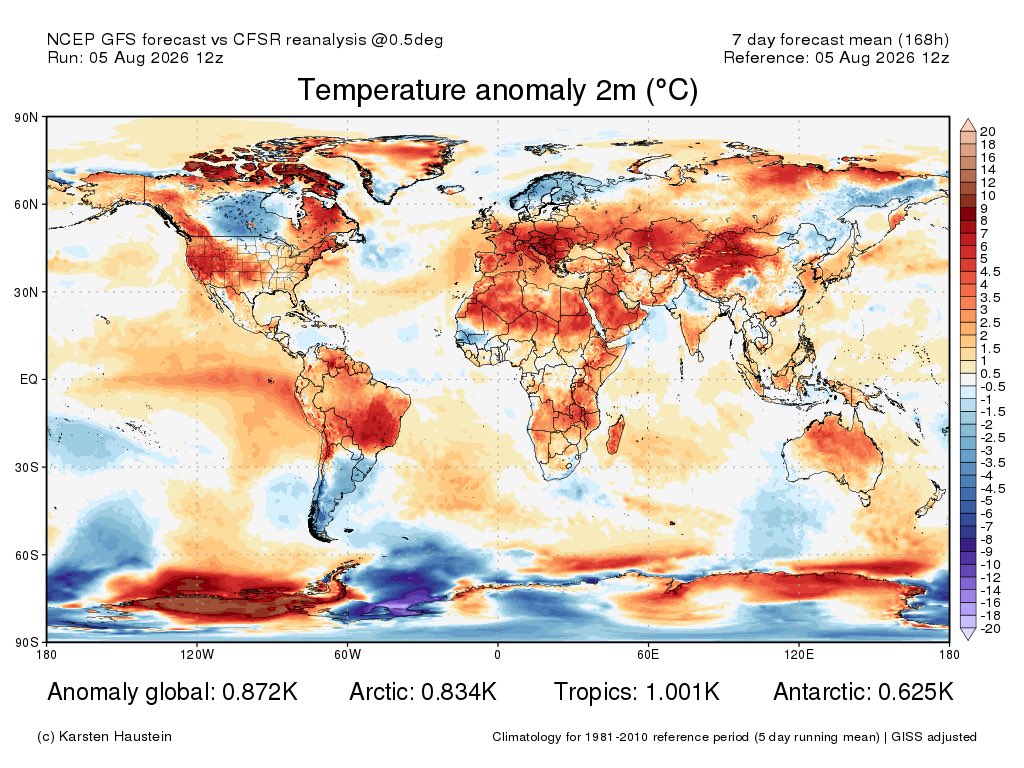
Planetary temperatures keep steadily rising with El Niño becoming monstrous, the Earth is expected to experience a record warm August.
Everything is coming together for summer 2026 to be the first summer on record well outside historical precedent a new climate era. 1976 summer is looking like child’s play compared to this.
A 🇨🇳Chinese LED film screen company showed how their screens can be attached to stair railings, making the railings light up and display moving visuals—it looks super cool!
What breaking out of underdevelopment actually looks like
Earlier this year, Zimbabwe did something that developing countries are usually punished for: it banned the export of raw minerals and lithium concentrates outright, and told the mining companies operating there that if they wanted Zimbabwean lithium they would have to process it in Zimbabwe.
The economics driving that decision aren’t difficult to understand. Raw lithium concentrate fetches somewhere around $570 a ton. Battery-grade lithium carbonate sells for roughly $7,000, meaning that the refined product is worth 12 times the value of the unrefined rock.
Africa holds an enormous share of the minerals on which the global energy transition depends, but in the prevailing imperialist system it has been assigned the role of digging them up and shipping them out, while the value is captured elsewhere. This is a colonial division of labour, still running, with lithium substituted for copper and rubber. Zimbabwe refuses to play along.
Historically, “resource nationalism” in the Global South has been punished with coups, sanctions and structural adjustment. Iran nationalised its oil and Mossadegh was overthrown. Chile nationalised copper and Allende was overthrown. Indeed Zimbabwe, let’s not forget, has been under Western sanctions for decades on account of its unwillingness to play along with the global extractive order.
How are China’s companies responding to the new policy? By investing in Zimbabwe, building refineries and processing plants, and complying with the government’s requirement that they add value locally.
Zhejiang Huayou Cobalt, through its subsidiary Prospect Lithium Zimbabwe, has constructed the country’s first lithium sulphate plant at Goromonzi in Mashonaland East. In April it shipped Zimbabwe’s first-ever export of domestically produced lithium sulphate. Sinomine’s Bikita Minerals is building a second plant in Masvingo. Once both are running, as President Mnangagwa noted this week, Zimbabwe will be the only country in Africa hosting multiple lithium-processing operations.
Instead of Zimbabwean rock being shipped to a refinery in China, the refinery is being built in Zimbabwe – with the jobs, the skills, the tax base and the higher-value export revenue staying in the country. Huayou paid $422 million for the Arcadia project in 2021; it is now investing further to comply with a policy that reduces its own margins in favour of its host.
By contrast, the US Minerals Security Partnership exists to secure supply chains for US industry, not to build African ones. Washington’s recent minerals dealmaking in the DRC is about access, not beneficiation. Nobody in Brussels or Washington is financing lithium refineries in Masvingo.
The West is trying to keep Africa at the bottom of the value chain. China is helping it move up.
🚨NEW: Water supplies in Kent’s seaside towns have fallen to “critically low” levels
South East Water has told residents to only use water for drinking, washing and cooking, warning that they could lose supply altogether
🚨 Dr. Hussam Abu Safiya suffers fractured ribs after "most difficult day" in Israeli detention
Detained Gaza hospital director Dr. Hussam Abu Safiya suffered fractured ribs after severe beatings and endured what the Palestinian Prisoners' Media Office described as his "most difficult day" in detention on July 27.
🔸 The office said the doctor, who suffers from heart disease and high blood pressure, has experienced a serious deterioration in his health.
🔸 He also spent 21 days in solitary confinement under harsh conditions and continues to be assaulted despite his critical condition.
🔸 Separately, Physicians for Human Rights said Israeli prison authorities provided a medical report confirming injuries to Abu Safiya's eye, head, and chest, and that it has petitioned an Israeli administrative court to allow an independent doctor to examine him.
🔸 Abu Safiya has been detained since December 27, 2024, after Israeli forces seized him while he was working at Kamal Adwan Hospital during attacks on northern Gaza. He remains imprisoned under Israel's "unlawful combatant" designation, which allows prolonged detention without charges or trial.
There is a disaster unfolding in Gaza right now, and no one in the world is talking about it.
58,000 cases of chickenpox have been recorded so far, and the disease is spreading at an alarming rate inside displacement camps, becoming a real threat to people’s lives, especially children.
Just moments ago, Dr. Munir Al Barsh issued an urgent appeal to the world, calling for immediate intervention to save the deteriorating health situation and warning about the worsening spread of the disease under the catastrophic conditions faced by displaced people.
The camps are overcrowded, waste is piling up, water is contaminated, and the extreme heat is accelerating the spread of infection.
There is not enough treatment, no hospitals capable of absorbing the growing number of patients, and the healthcare system continues to collapse day after day. Every hour that passes means more infections and more children suffering inside tents that lack even the most basic necessities of life.
Save Gaza before it is too late.
I just checked who covered the historic mass funeral of 112 Palestinians in Gaza killed by Israel.
CNN? Nowhere.
MSNBC? Silent.
Fox News? Crickets.
BBC? Radio silence.
112 bodies. One mass funeral. Zero Western media coverage.
Journalism didn’t die. It just decided some mass funerals aren’t newsworthy.
China bailed out Obama’s sorry ass in 2009 and he thanked the Chinese people by kicking them in the teeth with his Pivot to Asia to contain China in 2011. Asking China for help in their financial crisis made them realise just how strong China really was.
The US staged numerous war games to simulate blocking off the Malacca Strait choke point. The Americans are never subtle when it comes to “trade” negotiations.
The message was clear:
The US can reinstate the Global Embargo on China which was only lifted in 1979.
China doubled her efforts in green energy.
China hoped for the best and planned for the worst.
The Cuban Missile Crisis is taught in American schools as the moment the world almost ended because the Soviets put nuclear weapons in Cuba.
It is almost never taught as:
The moment the United States discovered what it felt like to have nuclear weapons pointed at it from nearby, which was the permanent reality of every Soviet city that had lived under American nuclear targeting from bases in Turkey, Italy, and Britain for years before the Cuban deployment.
The Soviets put missiles in Cuba specifically because the United States had missiles in Turkey pointed at Soviet cities.
Kennedy's team knew this.
They negotiated a secret deal: the Soviets would remove the Cuban missiles, the Americans would remove the Turkish missiles.
The American removal was kept secret from the public for decades because admitting it would have revealed that the resolution of the crisis was a mutual concession, not an American victory, and that the Soviet position had a strategic logic that American audiences were not supposed to understand.
The lesson taught to American children:
Soviet aggression.
American resolve.
Crisis averted.
The lesson the Soviets drew:
We deployed the weapons. We achieved the withdrawal of the Turkish missiles. We established that the Americans will negotiate when the cost becomes real.
The lesson for everyone watching:
Deterrence works in both directions.
That is why the powerful try so hard to ensure it only flows in one.
In Gaza, we have become nothing more than chess pieces being moved across a board of international interests. Decisions are made over our heads, while we are the ones paying the price every single day with our lives, our hunger, and our blood.
Stop insulting our intelligence. Stop making empty statements and promises that do nothing to change our reality.
If you cannot stop this nightmare, then open the crossings and let us leave. We are living through the worst days of our lives bombardment, starvation, siege, and the complete absence of hope for a dignified life.
Stop treating millions of human beings as pawns in political games. We are human beings, not chess pieces.
Sky News reports that a 28-year-old Palestinian woman, six months pregnant and suffering severe internal bleeding, was being transported from Qaryout in the occupied West Bank to Rafidia Surgical Hospital in Nablus when Israeli soldiers stopped her ambulance at the Awarta checkpoint.
Video shows Israeli forces detained the ambulance crew for more than 30 minutes, subjected the bleeding, critically ill woman to a physical search, and ordered the driver to turn off the engine, cutting power to the vehicle’s onboard medical equipment.
During the forced delay, a nurse was forced to deliver the fetus stillborn inside the stranded ambulance. The woman was eventually allowed to proceed to the hospital, where doctors performed emergency surgery and saved her life. The baby could not be saved.
Gaza is set to witness tomorrow what is expected to be the largest funeral in Palestinian history, as the remains of 112 victims from the Abu Sharia and Al-Hasayna families will be laid to rest. Their bodies were recovered from among the 308 people killed in the massacre carried out by the Israeli army during the genocidal war in Gaza, after having remained missing beneath the rubble.