1/n
Clearly those calling Darwin’s theory of evolution “just a theory” aren’t too well versed in science, and/or don’t know the difference between the English word ‘theory’ and a scientific theory.
@THNDcheck@theliverdoc Isn’t this entirely your opinion and therefore why should the post be blocked? Factually, there’s nothing wrong in the post - everything is factual. You may not like him or the tone of his posts - doesn’t make them wrong.
The government of India is blocking my posts on Instagram that criticizes Homeopathy based on a directive from the Homeopathy Council. This is very shameful of the government...protecting pseudoscience and it's practitioners from scientific scrutiny.
This is the post: https://t.co/ZtIKlYF6sK
In 2005, when Prime Minister Manmohan Singh visited JNU, a section of students greeted him with black flags and slogans of protest. The university administration issued notices to students and considered disciplinary action.
In his speech, Singh invoked Voltaire:
"I may disagree with what you have to say, but I shall defend, to the death, your right to say it."
When the administration moved against the protesters, Singh reportedly intervened. Years later, then Vice-Chancellor B.B. Bhattacharya recalled the Prime Minister's message to him. "Please be lenient, Sir."
What stands out is not that a Prime Minister defended the right of students to protest against him. What stands out is that we now regard such conduct as exceptional when it should be the minimum standard in a constitutional democracy.
We need to bypass the so called "standard", reductive textbook narratives that often treat ancient indian achievements as mere "accidental primitive labor" & Kailasa Temple is 1 such example. We need to treat it like a project that required a level of mathematical precision, spatial visualization & resource optimization that rivals modern aerospace/architectural design.
Advanced tech does not necessarily mean electricity/lasers/computer chips. In civil engineering, advanced tech is defined by the systems, instruments & mathematical models used to manipulate massive amounts of energy & matter with near-zero tolerance for error.
To carve Kailasa from the top down out of a single volcanic mass, the ancient Sthapatis (master engineers) had to solve problems that modern CAD software handles today.
Before a single chisel touched the stone, the entire multi-story complex including its internal rooms, floating balconies, drainage systems & columns had to be mathematically mapped out in 3Ds. In a traditional building, if a room is misaligned, we can tear down a wall & rebuild it. In rock-cut monolithic architecture, we cannot put back rock that has been carved away.
A single 5" calculation error on the roof would cause a column on the 3rd floor below to completely miss its load-bearing alignment, collapsing the ceiling. The then engineers used a highly sophisticated system of geometric grids based on micro-measurements (Angula & Hasta). They used a technique called Volumetric Prototyping. They modeled the mountain as a massive 3D coordinate matrix (X, Y, Z axes), translating a highly advanced, non-surviving theoretical blueprint seamlessly onto the undulating, uneven surface of a natural cliffside.
Carving 400000 tons of basalt, hardened volcanic lava rich in silica & iron cannot be done by simply swinging ordinary iron tools. The tools would blunt/deform/break within mins. The construction period correlates with India's absolute peak in Wootz steel production. This was a form of nanotech where iron was smelted with specific carbon-rich organic materials in sealed crucibles, creating a matrix of ultra-hard iron carbides (cementite).
Now to move 100s of 1000s of tons of rock rapidly w/o modern explosives, they likely used controlled thermal stress. By heating targeted fracture lines along the basalt's natural crystalline planes using massive, localized fires & then instantly dousing them with cold water, they forced the rock to cleanly shear itself apart along flat planes. This is a highly calculated application of thermodynamics.
In ancient India, advanced scientific & engineering knowledge was not published in open-source public libraries. It was fiercely guarded within highly specialized, hereditary engineering guilds (Shrenis/Vishwakarmas). Knowledge was passed down from master to apprentice via encrypted architectural texts (Vastu Shastras) & oral mathematical mnemonics.
This kept the IP secure from foreign theft, but it made the entire scientific system highly vulnerable to a SPOF. If a single elite guild of master builders was wiped out in a war, the complex mathematical formulas for calculating rock stress & monolithic geometric projections died with them instantly.
When British colonial historians arrived in India, they encountered marvels like Kailasa. Accepting that ancient Indians possessed a level of structural engineering, metallurgy & geometry that surpassed 18th century Europe was a direct threat to the colonial narrative of the "civilizing mission." They claimed Kailasa was built simply by throwing a massive, infinite army of "primitive, cheap slave labor" at a mountain with simple stone chisels over 100s of yrs.
This narrative deliberately substituted brute force for brain power. It ignored the complex geometry, the structural dynamics & the materials science, reducing a masterpiece of hyper-advanced calculation to a mere story of "many people digging for a long time."
#Raju scored 40 marks in the mid-term exam, while #Tony scored 96.
In the final exam, Raju scored 60 marks — a 50% jump.
Tony scored 98 marks — only about a 2% change.
Raju is the #BOSS !!
This is the intellectual level of our Media..
#DARVAS🥸
No praise is good enough for this hero duo Riyazuddin and son who emptied their shop of mattresses to spread them on ground - to cushion the fall of people jumping off from the burning hotel in Malvia Nagar. What an act of humanity and quick thinking. In that chaos to think straight and save lives - this hero deserves full compensation by MCD and commendation by the govt and also a public felicitation at a prominent place in Delhi @LtGovDelhi@gupta_rekha
@NuBharat_@ChairBlue46176@ValueWithPrem So at least you’re admitting that Adani hasn’t done anything useful and only acquired companies by force, and whatever infra has been built or managed by his companies (like airports) are in shambles. Good start.
@realdharm@pkrajeshpk Numbnuts, why do you have a problem with people dancing? And you says this is indecent? Just because you get the jollies by looking at Anjana Om Kashyap doesn’t mean you defend all the BS coming out of her mouth. Moron.
This numbnuts has a problem with people dancing. And he says this is indecent. Just because you get the jollies by looking at Anjana Om Kashyap doesn’t mean you defend all the BS coming out of her mouth. Moron.
🚨WATCH: I’m not defending Anjana Om Kashyap, but what she said to this YouTube teacher has turned out to be absolutely right.
His actions have only proven her point.
Just look at the way he’s dancing, it’s embarrassing and unbecoming of someone who calls himself a teacher.
be @ni5arga
→ 19 years old, from West Bengal, studied in Delhi for a few years
→ just finished his own Class 12 exams in 2026
→ calls himself a hobbyist cybersecurity researcher
→ says he is an engineer, not a hacker
→ built an OSINT engine, a stock-tracking TUI, a pastebin in Rust
→ once found bugs in FOSS United and disclosed them quietly
→ just another CBSE student watching his own board roll out a new digital marking system
then he opened the portal
→ CBSE moves Class 12 evaluation to On-Screen Marking, 1.8 million students affected
→ Nisarga sees the portal link is fully public, gets curious
→ opens DevTools, downloads the Angular JavaScript bundle
→ first vulnerability found in 30 minutes
→ a literal master password sitting in plain text inside the frontend code
→ enter it, the OTP field auto-fills, the entire login flow gets bypassed
→ OTP validation happens in the user's browser, not on the server
→ no route guards, every internal page reachable by editing browser storage
→ password reset API never checks the old password
→ systemic IDOR across the entire API, change one value in sessionStorage, become any examiner
→ outcome: take over any teacher account, view answer sheets, edit marks
25 February 2026. He reports everything to CERT-In the same day.
→ CERT-In asks for a screen recording, he sends a full walkthrough
→ acknowledgement comes back as a boilerplate reply
→ reference number assigned: CERTIn-16590126
→ he follows up multiple times. no response.
→ three months pass. portal still live. Class 12 results released. vulnerabilities still there.
→ 22 May: publishes the blog post and a thread on X
→ Deedy Das, Satish Acharya, Internet Freedom Foundation amplify it
→ the post goes viral
→ CBSE issues a clarification: that was just a test portal, no breach
→ the URL CBSE cited in their own tweet was not even a registered domain
→ a friend buys the domain and points it at Nisarga's blog
→ CBSE quietly deletes the tweet
then it gets worse
→ 25 May: finds an SQL injection vulnerability on the live production portal
→ reports to CERT-In, gets a one-line thank you
→ gains admin access to the live https://t.co/1WpmNGsczK server
→ portal stays up for four more hours
→ he uploads anime videos and memes, links them publicly from CBSE servers
→ plays a viral Japanese song on a CBSE page, makes the news for it
→ CBSE finally takes the whole portal down
then he reads the database
→ master table accessed: 10 GB, 9.3 million records
→ examiner names, addresses, school names, bank account details
→ passwords stored in plain text
→ login tokens anyone can paste into a browser to log in as that user
→ 31 May: finds a second live CBSE production portal, 45,074 records of failed payments
→ emails, phone numbers, payment IDs, order IDs, all readable
→ 31 May, the bigger one: an AWS S3 bucket is misconfigured
→ ListObjectsV2 works without authentication, the bucket root is listable
→ samples pulled from 18 lakh scanned 2026 answer sheets, every subject
→ multiple institutions sharing the same bucket
→ also notices something strange in the scans: bedsheets visible in the background of answer sheets CBSE paid for proper scanners to handle
CBSE responds
→ posts an AI-generated image saying the system is robust and secure
→ three days later admits some vulnerabilities existed and have been contained
→ refuses to name the cybersecurity firm doing the audit
→ claims they tried contacting him. he says they have not.
→ Internet Freedom Foundation writes to the Ministry of Education and CERT-In
→ asks for an investigation into CBSE, a review of the contract with vendor Coempt EduTeck, a full audit
→ he points out he could have sold this data and made a lot of money
→ he did not. he is a CBSE student too.
→ his own analogy: the door wasn't just unlocked. the key was lying on the ground in front of everyone.
a 19-year-old with a anima pff broke a national exam evaluation system in 30 minutes with browser developer tools and the government is still pretending it was a test environment
This is an unbelievable piece of work by Sarthak and something that requires amplification.
Let me explain what he found, in simple terms.
Sarthak is a Class 12 student from the 2025-26 batch, one of the 17 lakh students whose answer sheets went through CBSE's new On-Screen Marking system.
He spent days reading through CBSE's evaluation tenders, scraped all 576 tenders CBSE has issued, and tracked how the rules changed across three versions of the same tender.
The core finding is that the company that won the contract to scan and grade 17 lakh students' answer sheets is Coempt Eduteck.
Coempt used to be called Globarena Technologies. Globarena was the company behind the 2019 Telangana intermediate exam disaster, where software failures led to 3.8 lakh students getting wrong or missing marks, and 23 students died by suicide.
A government committee found systemic failure and negligence. Six months later, Globarena rebranded to Coempt Eduteck.
So a company with that track record won a contract to handle 17 lakh CBSE students. Sarthak's investigation is about how the rules were rewritten to let that happen.
The tender was issued three times.
> First tender, February 2025. It existed, then disappeared from the public GeM portal. Sarthak scraped all 576 CBSE tenders and this one was missing from the archive entirely.
> Second tender, May 2025. Four companies applied including TCS and Coempt. All four failed the technical evaluation. Cancelled.
> Third tender, August 2025. Coempt won. Between the second and third tender, a series of rule changes happened, and every single one made it easier for Coempt to qualify.
Here is what changed, one by one.
01. The old rules disqualified any company with a history of abandoning work, failing to complete contracts, or financial weakness. The new rules deleted this clause entirely. Coempt's Telangana history stopped being a barrier.
02. The old rules disqualified any company that was "blacklisted earlier." The new rules changed this to "currently blacklisted." Because Globarena rebranded after Telangana, removing the word "earlier" effectively erased their past.
03. The rules required Rs 50 crore average turnover over three years. Coempt's exact average came to Rs 50.86 crore. They cleared the bar by less than 1%. Earlier, a smaller company had asked CBSE to lower the bar to Rs 30 crore for fairer competition. CBSE refused. So the bar was kept high enough to block small players, but sat exactly low enough for Coempt to scrape through.
04. Software maturity is measured on the CMMI scale, 1 to 5. The old rules required Level 5. The new rules dropped it to Level 3. Coempt is a Level 3 company.
05. The cooling-off period for engaging retired CBSE officials was cut from two years to one. This makes it easier to use recently retired insiders to influence the process.
06. The old rules required experience with large projects of at least 5 lakh students each. The new rules removed the student count and counted cumulative answer-book volume across small projects instead. Coempt has many small fragmented university contracts. This helped Coempt and hurt TCS.
07. The old rules required bidders to own their own data centre and disaster recovery centre on Indian soil. The new rules allowed third-party MeitY-empanelled cloud hosting. Coempt runs on AWS and Azure. This helped Coempt and hurt TCS, which owns its own data centres. It also means student data is no longer on sovereign, Indian infrastructure.
08. The old rules required the bidder to own or control the complete source code of its software. The new rules deleted this. Coempt's platform runs on Microsoft's proprietary IIS, which they don't own.
09. A last-minute corrigendum, issued right before bid submission, removed CBSE's own power to blacklist the firm if its software failed catastrophically. So even a Telangana-scale failure couldn't get Coempt banned from future government tenders.
10. The penalty structure shifted from punishing mistakes to punishing delays. The old rules fined the vendor for wrong scanning, merged pages, and unscanned books. The new rules dropped those and instead levied Rs 50,000 per day for delays. This incentivises rushed scanning over accurate scanning.
11. The old rules had a hard accuracy threshold, error rate not to exceed 0.5%. The new rules removed this number entirely.
12. The old rules specified proper book and robotics scanners. The new rules just say "sufficient scanners." The definition was vague enough that, as Sarthak notes, the scanning could be done with a phone on a stand.
13. On the security side, the contract required a VAPT (vulnerability and penetration test) certified by CERT-In before go-live, and a restricted beta phase before launch. The system clearly wasn't restricted, because the other researcher, Nisarga, was able to access it and find vulnerabilities four days before go-live. So the mandatory security audit appears to have been bypassed.
These are more than a dozen rule changes, all between the failed tender and the winning tender, all pushing in the same direction, all benefiting the one company with the worst track record in the field.
The security holes Nisarga found last week now have an explanation. The system was built by a vendor that was specifically allowed to skip the security certification, the source code ownership, the data sovereignty, and the quality thresholds the original rules demanded.
Following things need to happen immediately;
1. An immediate CAG audit of the tender process.
2. A parliamentary debate on the topic.
3. An independent investigation into
> Why the first tender vanished?
> Why the disqualification clauses were deleted?
> Why the turnover bar was held exactly where it was?
> Why the security level was dropped?
> Why the blacklisting power was removed at the last moment?
Sarthak, this is genuinely exceptional investigative work. Far better than most journalists with full resources ever manage. Take a bow. :)
The Tender Timeline reveals CBSE kept changing rules until it accomodated Coempt perfectly:
Feb 2025: 1st tender (wiped from GEM archives)
May 2025: 2nd tender (Old RfP).
All 4 bidders (incl. TCS & Coempt) failed technical checks.
Cancelled.
@Incognito_qfs@abhijeet_dipke By your logic, the next time the Govt faces an issue about something, the public need not voice their support to the Govt? What a moronic statement. Instead of demanding the resignation of the Minister for the sorry state of affairs, you are deflecting.
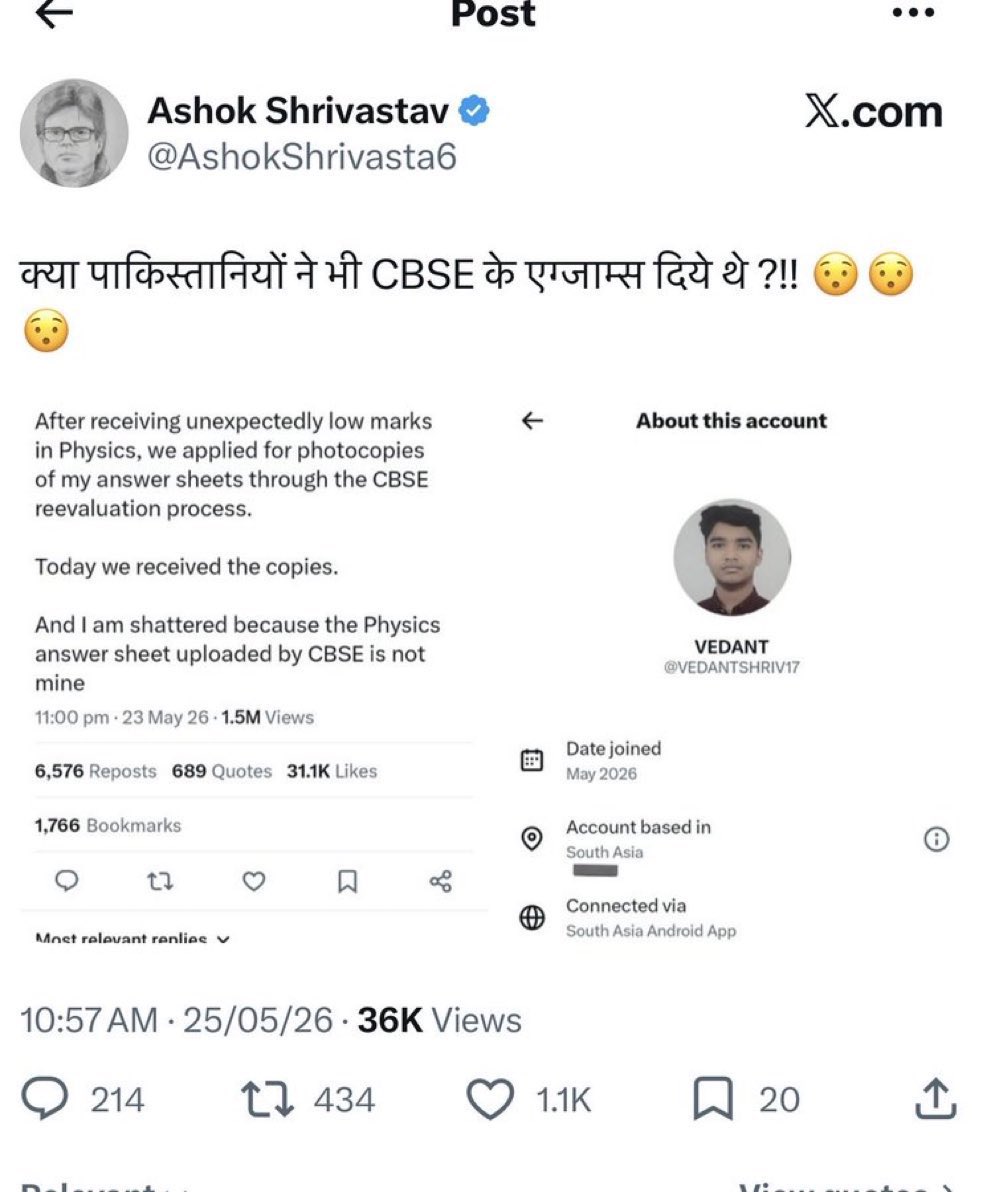
Those who called our kids Pakistanis need to be named and shamed.
This is the list of those anti-nationals.
Please keep adding names.
1- Ashok Srivastava
THIS IS WHERE OLA GOT EXPOSED 🔥
HOST: Kunal Kamra raised noise on Ola. What changed after that?
JAYANT 🎯: The scam has only become bigger. Ola said 99.1% complaints were closed by simply closing old tickets and opening new ones.
HOST: But people still trust Ola?
JAYANT 🔥: Go to any Ola service centre. Scooters are stacked on top of scooters. People are begging for their vehicles back.
HOST: What is the government doing?
JAYANT ⚡️: Instead of investigating, the government is giving them PLI money. This is what anti-national looks like.
@nirmalbarca10 Making statements and having good thoughts and ideas are cute. Let’s see what happens a year later. A PM promised in 2015 will have 100 smart cities in our country. Nothing happened so far.
@GangaIndoAge@Indianinfoguide Making statements and having good thoughts and ideas are cute. Let’s see what happens a year later. Someone promised in 2015 will have 100 smart cities in our country. Nothing happened so far.