The new verification standard.
Verify, manage, and share data with confidence.
For RWA, insurance, real estate & regulated industries. Powered by #XRPLedger
April was packed at Filedgr shipping the pieces that make asset data actually usable, verifiable, and reliable at scale.
Institutions are moving into digital assets but the infrastructure behind it is still catching up.
Here’s what we built last month🧵
the moment where tokenization stops being theory and becomes infrastructure.
But JPMorgan can move Treasury redemptions on XRP Ledger flawlessly. The on-chain part is solved.
What about the off-chain data?
Who certified these Treasuries?
When?
If an investor or regulator asks to verify the underlying data independently without access to JPMorgan's internal systems can they?
it's where tokenization platforms still have work to do. On-chain precision is table stakes now. Off-chain provability is the differentiator.
1️⃣ Institutional Capital Flow
2️⃣ Regulatory Clarity
3️⃣ DeFi Composability
4️⃣ Retail UX
Institutions bring the liquidity. Regulation unlocks the confidence. DeFi creates the utility. UX just accelerates what’s already inevitable.
RWAs only scale when the underlying data is trusted, verifiable & interoperable across
April was packed at Filedgr shipping the pieces that make asset data actually usable, verifiable, and reliable at scale.
Institutions are moving into digital assets but the infrastructure behind it is still catching up.
Here’s what we built last month🧵
not just prove every trade. prove the data behind every decision.
the agent that wins won't be the one with the best returns. it'll be the one whose entire decision chain is verifiable.
every signal, every input, every execution timestamped, immutable, auditable.
integrity becomes the competitive advantage.
@ZeusRWA@filedgr we're building the verification layer for tokenized assets.
RWA projects fail because the token is good but the underlying asset data is garbage. we make the asset verifiable first immutable, timestamped, audit-ready.
that's the infrastructure that actually scales.
monitoring tells you something happened. it doesn't prove it did.
compliance gets expensive when you can't prove your transaction history. audits drag. disputes escalate. regulators ask for paper trails.
build on verifiable data instead. every transaction cryptographically signed. every asset provenance clear. compliance becomes audit-ready by design, not a cleanup operation after the fact.
@NexusLabs your ai agent can't open a bank account because no one can prove it exists.
you can't build institutions on anonymous infrastructure.
agentic finance needs verifiable identity as much as it needs code.
custody proves who holds it. verification proves it's real.
you can have the most secure vault in the world, but if you can't prove the asset data hasn't been altered, you're still just asking people to trust you.
institutions that pair custody with integrity verification win deals faster. everyone else argues about what was changed and when.
@plumenetwork@sasagoongooncat bringing the financial industry onchain is the easy part. proving it actually works is the hard part.
that's where verification infrastructure matters. Plume scales the transactions. we scale the trust.
audit-ready by design.
Every regulated institution stores data. almost none can prove it.
Your system can retrieve data. But can it prove who created it? When it existed in this exact form? that it hasn't changed?
These are different questions. Storage answers one. Proof answers all three.
That's where the gap opens.🧵
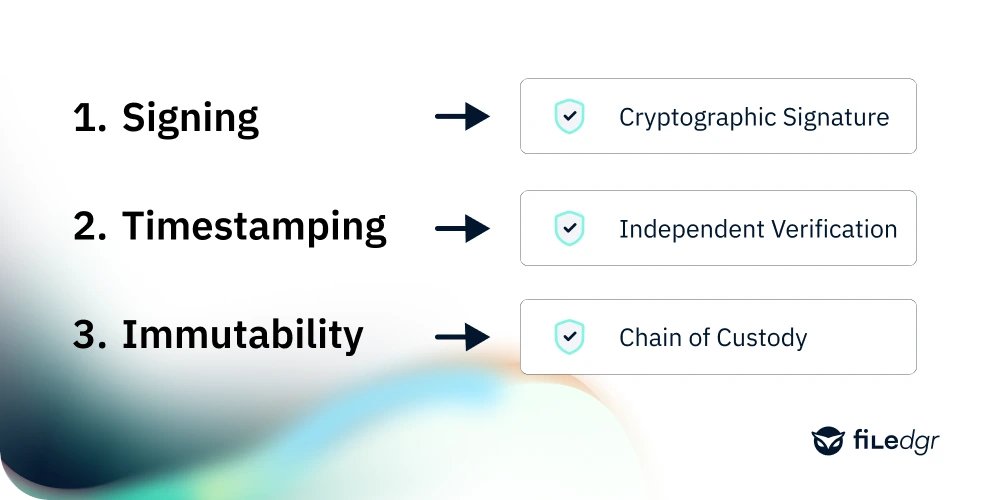
Closing the gap requires three things working together.
signing: every record attributed to a specific identity. cryptographic proof, not username.
Timestamping: independent verification anchored outside your system.
Immutability: any change is a verifiable event in the record's history.
When this is in place, audit trails aren't built retroactively. they're a byproduct of normal operations.