We're having a lot (A LOT!!) of people switching to Omarchy from Mac and Windows right now. Here's some sympathy expressed by yours truly on how hard it can be to break habits, but also how rewarding it is if you push through. Stick with it!
@levelsio@dhh Isn't all of this just fixing a broken manual config? Standard UniFi defaults and its native dashboard/insights already flag these retries and channel overlaps without needing an AI agent to read the API
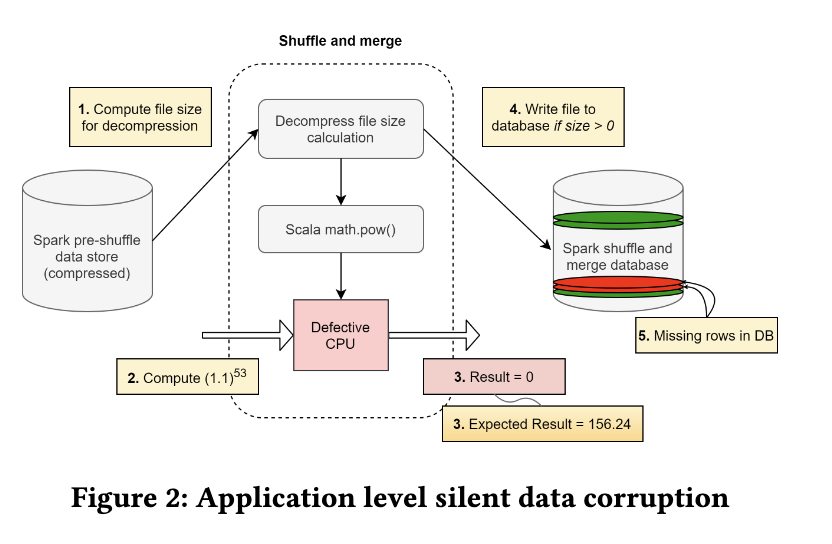
If you want to skim the original paper, Silent Data Corruptions (SDCs) at Scale, it’s a fun read.
We take for granted the reliability of CPUs; not many think about the implications of getting a bad core once in a while!
https://t.co/IwQQqNY7b1
@felipeleon88 Muchos no usan el carril derecho en la ruta viva por que esta lleno, o de huecos, o de protuberancias.
Así se vaya a 50 por ese carril vas saltando todo el camino 🤷♂️
(no se puede negar que hay tarados, en todo caso)
For decades SDCs were considered a myth, only caused by cosmic rays and such.
We’ve only just entered the magic era where:
1. silicon is being pushed HARD
2. hyperscalers are getting SO big the issue is statistically visible
Humanity is *just* starting to enter an era of needing to accept potentially imperfect compute.
Current metrics imply about ~1 in 1000 CPUs are mercurial. Every indicator is pointing towards the issue getting worse in the future.
A good (broad) overview about the subject is available from IEEE Computer magazine here, although I’d also encourage you to search the Meta, Google, and Alibaba research on the subject:
https://t.co/OqvqRBvw89
There are so many spectacular features of MacOS classic (9 and earlier) that newer systems could learn from.
- The ability to move an entire, bootable OS installation simply by copying it to another drive.
- The ability to enable and disable Extensions (aka drivers) by drag and drop from a simple folder.
- Recordable, scriptable UI automation system (AppleScript).
- Application in a single file (no need for installers or external dependencies).
- True, system wide theming (some still have this, others don’t).
- Light and fast.
- Windowshade.
Just off the top of my head.
The fact that we don’t have most of those on modern systems, in 2026, is a travesty.
The reason why RAM has become four times more expensive is that a huge amount of RAM that has not yet been produced was purchased with non-existent money to be installed in GPUs that also have not yet been produced, in order to place them in data centers that have not yet been built, powered by infrastructure that may never appear, to satisfy demand that does not actually exist and to obtain profit that is mathematically impossible.
Microservices is the software industry’s most successful confidence scam. It convinces small teams that they are “thinking big” while systematically destroying their ability to move at all. It flatters ambition by weaponizing insecurity: if you’re not running a constellation of services, are you even a real company? Never mind that this architecture was invented to cope with organizational dysfunction at planetary scale. Now it’s being prescribed to teams that still share a Slack channel and a lunch table.
Small teams run on shared context. That is their superpower. Everyone can reason end-to-end. Everyone can change anything. Microservices vaporize that advantage on contact. They replace shared understanding with distributed ignorance. No one owns the whole anymore. Everyone owns a shard. The system becomes something that merely happens to the team, rather than something the team actively understands. This isn’t sophistication. It’s abdication.
Then comes the operational farce. Each service demands its own pipeline, secrets, alerts, metrics, dashboards, permissions, backups, and rituals of appeasement. You don’t “deploy” anymore—you synchronize a fleet. One bug now requires a multi-service autopsy. A feature release becomes a coordination exercise across artificial borders you invented for no reason. You didn’t simplify your system. You shattered it and called the debris “architecture.”
Microservices also lock incompetence in amber. You are forced to define APIs before you understand your own business. Guesses become contracts. Bad ideas become permanent dependencies. Every early mistake metastasizes through the network. In a monolith, wrong thinking is corrected with a refactor. In microservices, wrong thinking becomes infrastructure. You don’t just regret it—you host it, version it, and monitor it.
The claim that monoliths don’t scale is one of the dumbest lies in modern engineering folklore. What doesn’t scale is chaos. What doesn’t scale is process cosplay. What doesn’t scale is pretending you’re Netflix while shipping a glorified CRUD app. Monoliths scale just fine when teams have discipline, tests, and restraint. But restraint isn’t fashionable, and boring doesn’t make conference talks.
Microservices for small teams is not a technical mistake—it is a philosophical failure. It announces, loudly, that the team does not trust itself to understand its own system. It replaces accountability with protocol and momentum with middleware. You don’t get “future proofing.” You get permanent drag. And by the time you finally earn the scale that might justify this circus, your speed, your clarity, and your product instincts will already be gone.
I restore old computers, and am always curious how their classic performance compares to modern PCs.
Are they a hundred times faster? A thousand? A million?
Here are the stats. I wrote a Dhrystone test in K&R C that runs on everything I own, unmodified, from the PDP-11/34 up to my M2 Mac Ultra Pro.
FWIW, the Mac Pro is 200000X as fast as the 11/34!
Code: https://t.co/7AU7HFifuY
Our Docker images had 847 vulnerabilities. All from the base image.
We were using ubuntu:latest.
The fix:
- Switched to distroless images
- Reduced image size from 420MB to 28MB
- Vulnerabilities dropped to 3
- Container startup time improved by 60%
Then discovered our CI/CD was pulling images without verification.
Added:
- Image signing with Cosign
- Vulnerability scanning in pipeline
- Admission controller to block unsigned images
Security and performance often align.
Smaller surface area equals fewer problems.
as someone who worked on video engineering for a long time im really disappointed with how cringe that account is
but, i would ask that people try to separate the actions of the twitter account from the project itself tho
every contributor to ffmpeg i've crossed paths with has been nothing but nice to me and even gave good feedback on my shitty c and assembly code when i was working on my own ai video codec. they didnt ask for contributions back. and they encouraged the learning process for everyone taking their free assembly course
ffmpeg is a mature project with many contributors that have done some amazing stuff and really pioneered the space. i've fought with many higher ups to approve sponsorships (it worked once)
theres a crazy stark difference between the community and this twitter account and im not sure why
the positive, indirect effect ffmpeg has had on the video space is insane. back in the day companies were constantly trying to find ways to monopolize, monetize and gatekeep video encoders/decoders for codecs that they themselves created. everything required a license
the code really innovated and sped up algorithms that some already thought were impressively optimized.
but as of the past couple months suddenly the account is getting into petty fights and acting like everyone owes them
you dont see linus torvalds going around asking people for thank you's. he saw a gap in the industry and democratized something that wasnt open for all
also, i think its good there are people challenging it, trying to make alternative, figuring out why its hard, and gaining a new appreciation for video transcoding. its part of the learning process
Open Source isn't going to help.
There's a way to invisibly compromise all software.
A perfect, self-replicating "sin" passed down for generations of compilers.
It's not just theoretical, and Ken Thompson showed us how.
Okay hahaha
I liked omarchy so much on my laptop i ended up booting it on my pc and getting rid of windows lol
No need to setup everything from scratch or installing literally everything from the terminal, you can setup everything so fast from the menu it self.
How awesome is that!!!
I wasn’t a linux guy cuz I just want smth to work, not be bothered to tinker around and just focus on work
Omarchy gave me that
@dhh legend