So excited to share the publication of our work in @JACCJournals#JACCEP entitled "Comparing Inducibility of Re-Entrant Arrhythmia in Patient-Specific Computational Models to Clinical #AtrialFibrillation Phenotypes." https://t.co/w6ZE8XbvXR
Thank you to @CircAHA for the opportunity to reflect & write this perspective on the current state of Electrophysiology. The data on how we impact human lives has never been stronger– yet we can do even better.
The relative progress in technology (tools) and intelligence (physiologic understanding) is quite disparate across three evolving areas:
Conduction System Pacing: High anatomic and physiologic understanding, limited tools. LBBaP was created to overcome limitations of His bundle pacing but has definitional challenges. Maybe we need to focus back on #dontdistheHis.
Atrial Fibrillation: High tech without new physiological insights. We remain at an intellectual impasse to find new mechanistic targets beyond PVI. Our ceiling has not changed significantly despite an explosion of new technological tools.
Ventricular Tachycardia: Tools driving understanding. We have evolved HD mapping tools to advance our working understanding of the elusive VT circuit and can make predictions from sinus rhythm. Now, we await technology that can penetrate deeper into the myocardium to address #VTin3D.
Technology and Intelligence: Staying on Target for the Next Decade of Electrophysiology | Circulation https://t.co/maJtUAoSnw
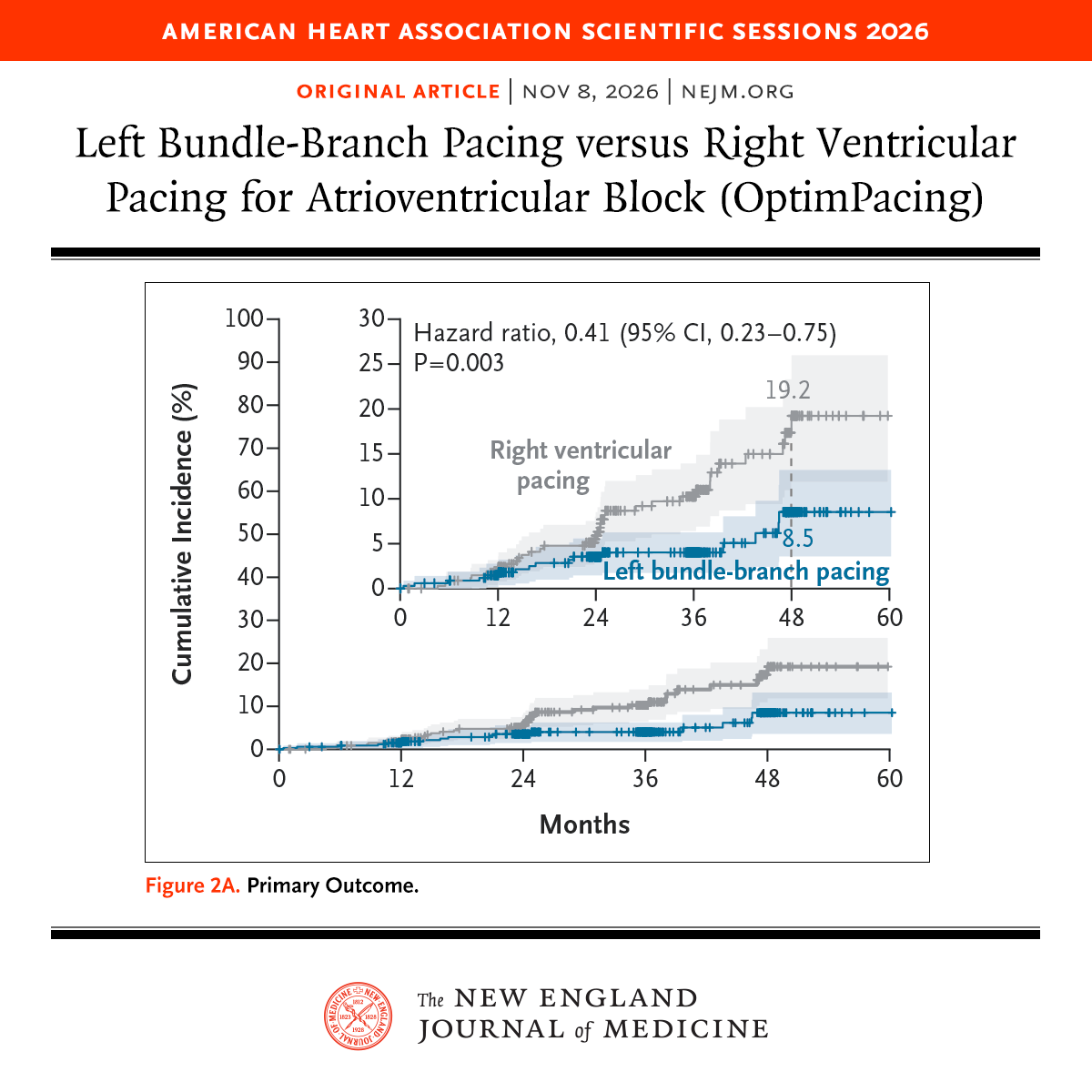
Presented at #ScientificSessions26:
In patients with atrioventricular block, left bundle-branch pacing resulted in a lower incidence of a composite of death, hospitalization for heart failure, or pacing-induced cardiomyopathy than right ventricular pacing. Full OptimPacing trial results: https://t.co/Fg0lv9xcka
@AHAScience
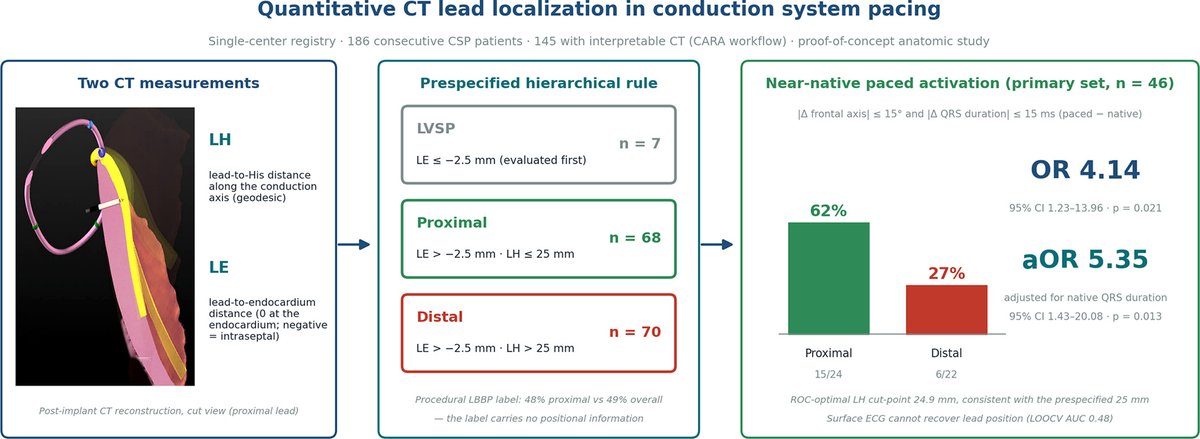
📣Quantitative CT Lead Localization Reveals Proximal Left Bundle Targeting Facilitates Superior Physiologic Pacing — @shunmug_his_mdu@pvijayaraman1 @KennethEllenbog1
#HRX2026 LBCT | Simultaneously published in @hrs_journal
⭐️The Lead to His (LH) and Lead to Endocardium (LE) distances have previosuly been shown to be predictive of ideal CSP.
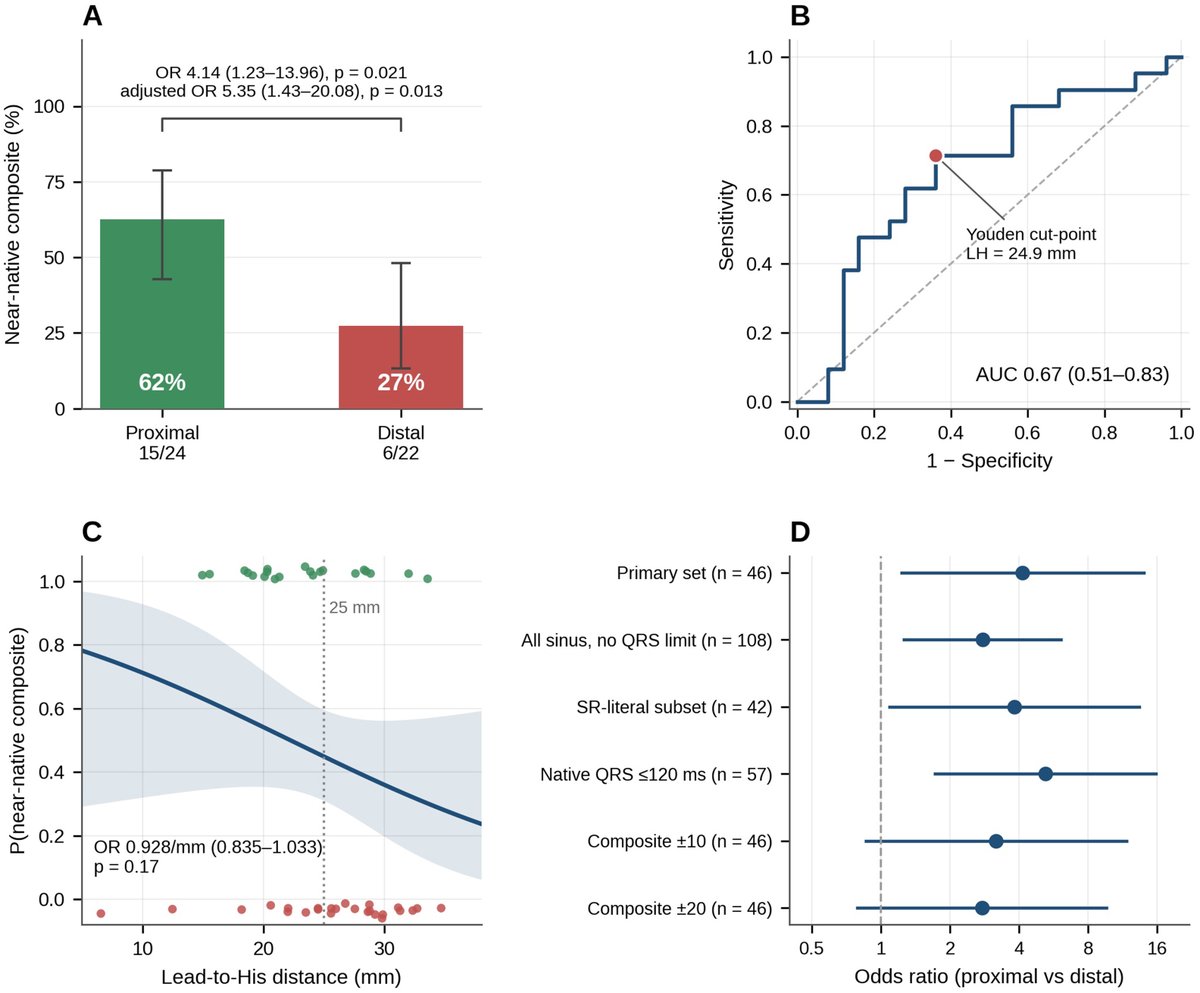
⭐️ In this single-center study of 186 consecutive CSP patients, 145 had interpretable post-implant CT. A quantitative CT workflow (CARA) classified leads using lead-to-His distance (LH) and lead-to-endocardium distance (LE).
➡️CT classified 68 leads as proximal (LH ≤25 mm), 70 distal (LH >25 mm), and 7 LVSP
➡️In the primary analysis, near-native paced activation was significantly more frequent with proximal vs distal pacing: 62% vs 27% (OR 4.14, P=0.021; adjusted OR 5.35, P=0.013)
➡️The ROC-derived optimal LH cutoff was 24.9 mm, close to the prespecified 25-mm anatomic threshold
➡️Importantly, he procedural LBBP label did not predict proximal vs distal lead position, and neither did the surface ECG (AUC 0.48).
🤔Not all confirmed LBB capture may be physiologically equivalent—the site of capture along the conduction axis matters, and our usual electrical criteria cannot tell us where the lead actually sits.
🎯Proximal LBB targeting (≤25 mm from the His) was associated with substantially greater odds of near-native ventricular activation. Quantitative anatomic localization may add an important new dimension to how we think about—and ultimately target—CSP.
https://t.co/7PiE6fl5AY
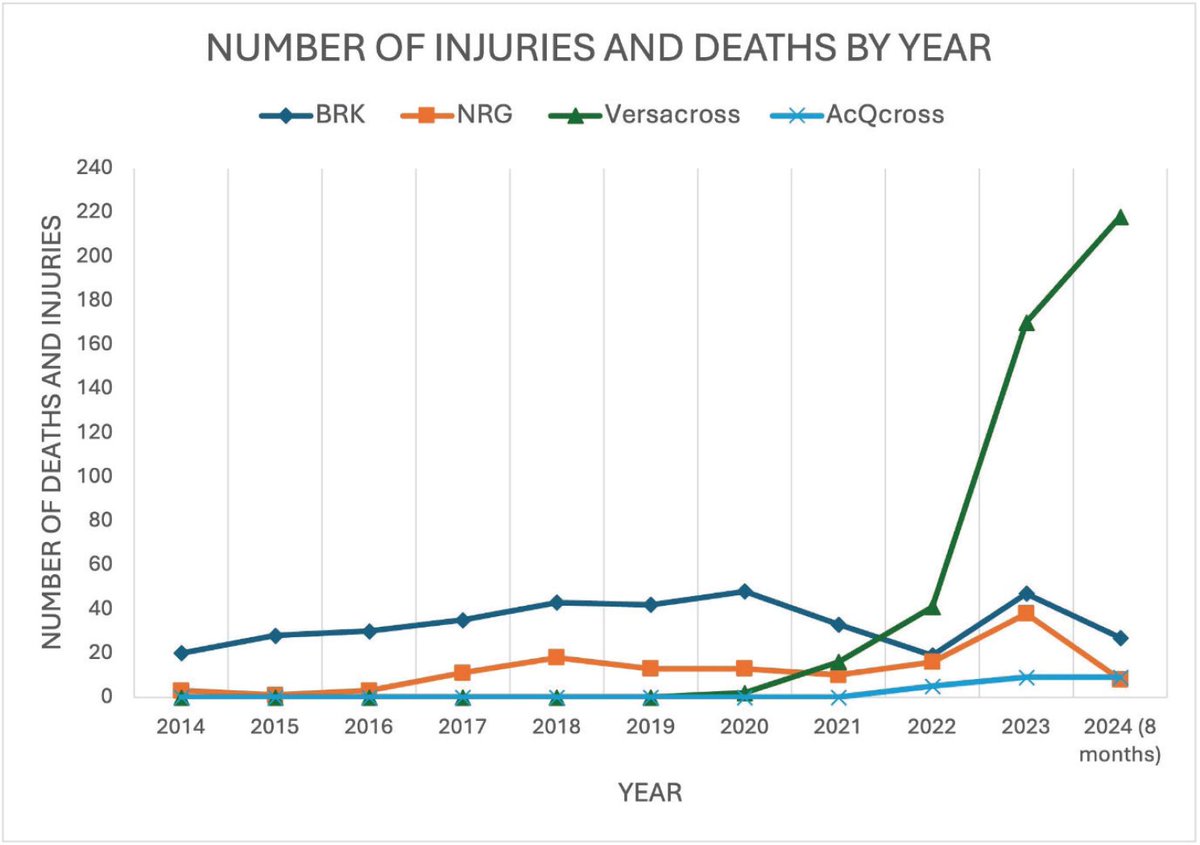
Injuries and deaths associated with transseptal punctule aquired from the MAUDE database
Fatal cases associated with transseptal puncture:
Left atrial ablation (n=24)
Left atrial appendage clousure (n=22)
Rapid rise in injuries started in 2023 (Versacross)
Authors: AlleaBelle Bradshaw @alleabelle , Jessica Briscoe @jessicabrisso11 , Rachael Quinn, Hanghang Wang @HH__Wang and James S. Gammie
https://t.co/zdmBB43PMB
Atrial Fibrillation Ablation Energy Source Transition and Adjunctive Lesion Set Utilization After Commercial Release of Pulse Field Ablation
@DanFriedmanMD@jfreeMD
https://t.co/3HuUCfLCn4
Thrilled to share our latest study in @CircAHA: we ran one of the largest comparative safety analyses of #PFA vs radiofrequency #ablation for #AF, performed
@BIDMChealth (>1,500 #PVI/year). We found a significantly higher stroke risk with PFA. Read on👇
https://t.co/sFECm0SFaY
Effect of Anterior vs Posterior Dispersive Patch Placement on Radiofrequency Ablation Lesion Size in Swine | JACC: Clinical Electrophysiology https://t.co/QwjcjcqeDl
@DocDifferently Interesting re 10h, I have requested 4h retainer typically. For most of my cases, that has been enough for chart review and opinion. I’d be curious to know how many hours are typically billed for most basic case reviews. I realize these will vary by field.