Over the past week, I’ve been overwhelmed by the love and support of friends, industry colleagues, and people I've never met. Thank you to everyone who has shown kindness to my family and me. It means the world to me.
I came to the United States 53 years ago, and becoming an American citizen is one of the greatest gifts and proudest moments of my life. NVIDIA has been my life’s work. Building it into the company it is today alongside my colleagues has been a privilege and an honor. Nowhere but in America could a company like NVIDIA be possible. I love our country, and I love NVIDIA.
I did not live up to the standards expected of everyone at NVIDIA, and I have made serious mistakes in my personal life. I created problems for the Board that I deeply regret. I own my mistakes completely, and I am committed to cooperating with the Board’s independent investigation.
Since my departure, I’ve seen an outpouring of calls from NVIDIA’s employees, investors, business partners, and customers for me to return as CEO. Many continue to reach out to me directly as the company navigates complex technology, market, competitive, and geopolitical dynamics. NVIDIA is a once-in-a-generation company. If the Board of Directors decides that my return is in the best interest of our shareholders, our employees, the company, and America, I would be honored to answer these calls and return as CEO.
Thank you again to everyone who has shared their good wishes. I am profoundly humbled by your support. To my family: I love you, and I will spend the rest of my life being worthy of yours.
Jensen
This 50-minute lecture by Jeff Bezos will teach you more about business than a 2-year MBA program.
Bookmark it and give it 50 minutes today, no matter what
Do u see why this is important yet?
Access every AI model in the world, $1/day per DIEM in perpetuity.
No account, no KYC, private, and uncensored.
Point agents here:
https://t.co/MQDTCr6hdA
Acquire DIEM onchain here:
https://t.co/Oe6cu9tGDP
Ben Goertzel told me two years. Emad Mostaque puts a sharper number on it: 800 days.
@EMostaque built Stable Diffusion: he put AI image generation in the hands of millions. Now he's warning about what he helped start:
"In crypto it's not your keys, not your crypto. And with AI, it's not your models, not your mind."
His argument goes further than jobs. Within a couple of years, he says, the value of human cognitive labor goes to zero. And while that happens, governments move in with licenses, KYC and surveillance to control who gets access to the most powerful models. The people who own their own AI stay sovereign. Everyone else rents their mind from a platform.
We cover:
- The 800-day timeline, and why most people aren't ready
- Why you'll soon need a license just to use frontier AI
- Why an open-source model you run yourself is the only real form of sovereignty
- Digital feudalism: what happens if five companies own all the intelligence
- Why owning your models could become as important as owning your Bitcoin keys
Thanks for @OKX for being our sponsor of this episode.
Timestamps:
00:00 - The 800-Day Countdown
03:16 - What AI Breaks First
06:01 - Not Your Models, Not Your Mind
16:53 - The License You'll Need To Use AI
24:05 - The Ethics Nobody Agrees On
27:30 - The Jobs That Don't Survive
32:33 - When Cognitive Labor Goes To Zero
39:47 - Investing In A World That Thinks
51:44 - Escaping Digital Feudalism
55:41 - What To Do Differently Tomorrow
@StabilityAI@ii_posts
Elon Musk just proved that ownership in America is a legal fiction.
Musk: “You get taxed on what you earn, you get taxed on what you buy, and you get taxed on what you own.”
Think about what property tax actually means.
You worked for decades. Paid it off in full. The deed is in your name.
Stop paying the government its annual fee. Watch them take it and sell it to someone who will.
You never owned that house. You were leasing it from an entity you never signed a contract with.
Income tax tells the same truth in softer packaging.
The government does not take a portion of your earnings. They decide how much of your own labor you are permitted to keep.
That is not semantics. It is a confession of who the system believes your time belongs to first.
Sales tax buries itself in the receipt. Two people exchange value voluntarily. A third party who contributed nothing takes a cut simply for allowing it to happen.
Now stack all three.
Taxed when you create. Taxed when you spend. Taxed when you hold. Taxed again when you die and try to pass it to your children.
At no point in that cycle does the system recognize your output as yours.
Because money is not an abstraction. It is crystallized human lifespan.
Every dollar taxed is an hour you already lived, already bled for, already gone.
The state is not managing an economy. It is claiming dominion over time you will never get back.
And spending it on systems you never asked for and actively oppose.
The institution extracting all of it faces zero obligation to perform. A contractor who delivers nothing gets fired. A bureaucracy that burns through trillions gets a budget increase the next fiscal year.
SpaceX pays taxes to the agencies that obstruct its launches. Tesla funds the regulators drafting rules to shield its competitors.
The builders are not subsidizing government. They are financing their own friction.
The tax code is 74,000 pages long. Not because the economy demands it. Because the extraction had to be buried in enough complexity that you would stop asking who it was designed to protect.
The past belonged to the people who taxed the world.
The future belongs to the people who build it.
$VVV : Review 📜
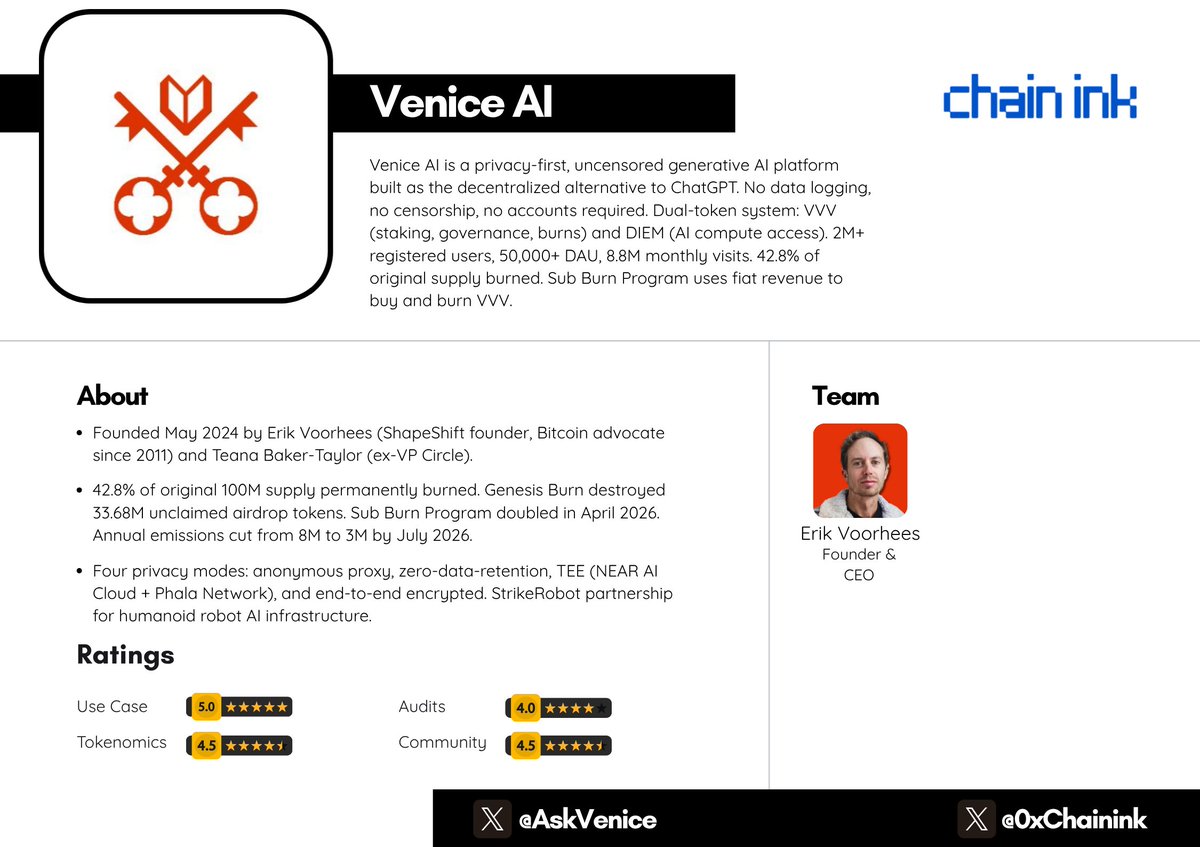
What if one of Bitcoin's earliest advocates built the private, uncensored AI platform that ChatGPT should have been, and then burned 42% of the token supply just to prove he wasn't in it for the money?
Meet Venice AI - a privacy-first generative AI platform where your conversations are never logged, your data is never stored, and the models are never censored.
2 million+ users. 50,000+ daily active. 42.8% of supply permanently burned. Fiat revenue buying and burning tokens monthly. Built on Base by Erik Voorhees, the man who created ShapeShift and has been in Bitcoin since before most people knew what a blockchain was.
Let's explore how Venice is building the AI platform the cypherpunks would have designed. 👇
⚪ Venice at a Glance
Venice AI is a privacy-focused decentralized inference platform designed as an alternative to centralized AI systems such as OpenAI and Google Gemini. Unlike traditional AI platforms that store user data, impose restrictive moderation systems, and collect behavioral data, Venice positions itself as an uncensored, privacy-preserving infrastructure layer for AI.
The ecosystem uses a dual-token system: $VVV (staking, governance, burns, yield) and $DIEM (AI compute access). VVV launched January 27, 2025 on Base with a genesis supply of 100 million tokens.
As of May 2026, $VVV trades around $18 with a market cap of approximately $800M. Since December 2025, VVV has surged more than 1,500%. ATH was $23.45. 2 million+ registered users and 8.8 million monthly visits. Venice has now permanently destroyed approximately 42.8% of the total supply.
Marketplace Insight: VVV was listed on Robinhood for spot trading in May 2026, surging 17-22% on the announcement. Whale accumulation continues with large holders steadily buying through the $19 resistance level. The Sub Burn Program rates doubled in April 2026. Annual token emissions are being cut from 8M to 3M by July 2026. When a platform with 2M users burns 42% of its supply and then doubles its burn rate, the supply math gets very simple.
⚪ Mission
Venice's mission is to provide private, uncensored, and open-source generative AI to everyone. "In a world of growing AI integration into our daily lives, we believe it is crucial that humans are able to interact with machine intelligence without centralized surveillance and control," Voorhees said. Venice exists because ChatGPT logs your data, censors your prompts, and sends your conversations to corporate servers. Venice does none of that.
🔵 A Brief History
Venice AI was founded in May 2024 by Erik Voorhees and Teana Baker-Taylor, reaching 1.3M+ users by March 2026.
Erik Voorhees is one of the most important figures in Bitcoin history. He's been in the space since 2011, founded ShapeShift (one of the earliest crypto exchanges), and has been a vocal advocate for financial privacy and individual sovereignty for over a decade. He self-funded Venice entirely, with no need for outside capital.
Venice launched in May 2024 offering free access to open-source AI models for text, image, and code generation, with no account required for basic use. By late 2024, it had grown to 450,000+ registered users and 50,000 daily active users making 15,000+ inference requests per hour.
VVV launched on January 27, 2025, with 50% of the genesis supply airdropped: 25% to 100,000+ early Venice users and 25% to the broader crypto-AI community on Base. Within two hours, VVV reached a $1 billion fully diluted valuation. Coinbase listed VVV within hours of launch.
In March 2025, the Genesis Burn destroyed 33.68 million unclaimed airdrop tokens, permanently removing a third of the supply. In August 2025, Venice launched the DIEM token, creating a dual-token system where DIEM provides AI compute access while VVV handles staking, governance, and value capture. In May 2025, Venice launched a $27 million Incentive Fund for developers building private AI applications.
Venice rolled out new encrypted AI interface models in March 2026, adding Trusted Execution Environment (TEE) and End-to-End Encrypted (E2EE) modes via partnerships with NEAR AI Cloud and Phala Network.
Four distinct privacy modes now let users choose their level of data protection.
By May 2026, VVV listed on Robinhood and Crypto com, the Sub Burn Program doubled its rate, and annual emissions were cut from 8M to a planned 3M by July 2026. StrikeRobot partnership provides AI infrastructure for humanoid robots, expanding Venice beyond chat into physical AI applications.
🔵 Ecosystem Narrative
Venice's ecosystem is built on one radical idea: AI should be private by default, uncensored by design, and owned by its users. Every product decision flows from this principle.
Key dynamics include:
➛ Four privacy modes give users verifiable privacy, not just promises: anonymous proxy access, zero-data-retention processing, TEE (hardware-secured enclaves via NEAR AI Cloud and Phala Network with cryptographic attestation), and end-to-end encryption.
➛ Dual-token system: VVV for staking, governance, yield, and burns. DIEM for AI compute access, decoupling compute costs from token price volatility. Staking 100 VVV unlocks Pro features.
➛ Sub Burn Program uses fiat revenue to buy VVV from the open market and permanently burn it. Rates doubled in April 2026. This creates a direct link between platform revenue and token scarcity.
➛ 42.8% of original supply burned. Genesis Burn (33.68M tokens) + ongoing Sub Burns + emission cuts (8M to 3M by July 2026) = one of the most aggressive deflationary models in crypto.
➛ Open-source model access including GPT 5.2, DeepSeek, and leading open-source LLMs. Text, image, video, and code generation. No centralized censorship on outputs.
➛ Venice API enables developers and AI agents to access private inference programmatically, turning Venice into infrastructure, not just a consumer product.
➛ $27M Venice Incentive Fund supports developers building private AI apps, agents, integrations, model tooling, and dApps on the Venice API.
➛ StrikeRobot partnership extends Venice's AI infrastructure to humanoid robots, expanding the use case from digital chat to physical AI applications.
⚪ Token Utilities
$VVV powers the private AI economy:
➛ Staking & Pro Access - Stake 100 VVV to unlock Pro features: faster processing, latest experimental models, higher-resolution image generation, and enhanced API access.
➛ Sub Burn (Revenue-Driven Deflation) - Fiat revenue from Pro subscriptions buys and burns VVV monthly. Rates doubled April 2026. Direct link between platform usage and token scarcity.
➛ Emissions Yield - Stakers earn yield from token emissions. APR varies based on platform usage and utilization rate. Emissions being cut from 8M to 3M annually by July 2026.
➛ Governance - VVV holders participate in ecosystem governance decisions.
➛ API Compute Access - Developers and AI agents use VVV/DIEM to access Venice's private inference API programmatically.
➛ DIEM (Companion Token) - Provides stable-priced AI compute access decoupled from VVV price volatility. Developers budget in USD terms while stakers benefit from VVV appreciation.
⚪ Key Features
➛ Privacy-First AI - Four verifiable privacy modes: anonymous proxy, zero-data-retention, TEE with cryptographic attestation, and end-to-end encryption. Not promises. Provable privacy.
➛ Uncensored Models - Access GPT 5.2, DeepSeek, and open-source LLMs without centralized content moderation. "If you want to use DeepSeek but don't want all your convos going to the CCP, use Venice."
➛ 42.8% Supply Burned - Most aggressive burn ratio in the AI token space. Genesis Burn + Sub Burns + emission cuts. Supply is actively shrinking.
➛ 2M+ Users, 50K+ DAU - Real platform with real users making real inference requests. 8.8M monthly visits. Not speculative infrastructure.
➛ Dual-Token (VVV + DIEM) - VVV for value capture, DIEM for compute access. Decouples developer costs from token price volatility.
➛ $27M Developer Fund - Funding private AI apps, agents, integrations, and infrastructure on Venice API.
➛ Robinhood & Crypto com Listed - Tier-1 retail exchange access as of May 2026.
➛ Erik Voorhees Founded - ShapeShift creator, Bitcoin OG since 2011, self-funded Venice with zero VC. One of crypto's most respected founders.
🔵 Meet the Venice Team
Venice is led by two of the most credentialed people in the intersection of crypto and fintech, one a cypherpunk Bitcoin OG, the other a former VP at the company behind USDC.
▶️ Core Members:
➛ Erik Voorhees [ @erikvoorhees ] - Founder & CEO | One of the most important figures in Bitcoin history. In the space since 2011. Founded ShapeShift, one of the earliest and most influential crypto exchanges. Vocal advocate for financial privacy, individual sovereignty, and uncensored technology. Self-funded Venice entirely with no outside investors. Has been publicly buying tokenized gold ($23M+ across 28 addresses), signaling conviction in both crypto and hard assets.
▶️ Former:
➛ Teana Baker-Taylor [ @TeanaTaylor ] - Previous Co-Founder | Now CEO of BasedAI. Former VP at Circle (USDC issuer), previously worked at UK HM Treasury. Board advisor to CryptoUK Association. Contributed to Venice's early growth and institutional positioning before departing.
🔵 Ratings
➛ Use Case: ★★★★★ (5/5) - Venice is the most important consumer AI product in crypto. Not another "AI token" with no product. A real platform with 2M+ users, 50K+ DAU, and 8.8M monthly visits using GPT 5.2, DeepSeek, and open-source models with verifiable privacy. Four privacy modes including TEE with cryptographic attestation and E2E encryption. Uncensored inference that ChatGPT and Gemini won't provide. Venice API turning privacy AI into developer infrastructure. StrikeRobot extending to humanoid robots. In a world where every centralized AI platform logs your data, censors your prompts, and feeds your conversations to corporate training datasets, Venice is the product that cypherpunks, developers, and privacy-conscious users actually want. And 2 million people are already using it.
➛ Tokenomics: ★★★★✦ (4.5/5) - Venice has one of the most aggressive deflationary models in all of crypto. 42.8% of original supply permanently burned. Genesis Burn removed 33.68M tokens. Sub Burn Program uses real fiat revenue to buy and burn VVV monthly (rates doubled April 2026). Annual emissions being cut from 8M to 3M by July 2026. No presale. 50% airdropped to community. VVV surged 1,500%+ since December 2025. The dual-token system (VVV + DIEM) elegantly separates value capture from compute pricing. The 0.5 deduction is for the remaining team/Venice allocation vesting through 2026 (potential sell pressure), and the fact that despite the burns, the token is still emitting new supply (even if decreasing), meaning it's not yet net deflationary on an annualized basis.
➛ Audits: ★★★★ (4/5) - Venice holds a 4.2 star rating on CertiK, validating the project's security posture. The privacy architecture is genuinely innovative: TEE via NEAR AI Cloud and Phala Network with remote attestation, E2E encryption, and zero-data-retention processing. The codebase runs on Base (inheriting Ethereum L2 security). Coinbase listed VVV within hours of launch, implying institutional-grade due diligence. The $27M Incentive Fund and API infrastructure show real engineering investment. The 1-point deduction is because the platform is barely a year old, the privacy modes are novel and haven't had years of adversarial testing at scale, and for a platform handling private AI conversations for 2M+ users, continued security hardening and more visible formal auditing of the inference infrastructure would strengthen confidence.
➛ Community: ★★★★✦ (4.5/5) - Venice has built a community that spans crypto natives, AI enthusiasts, privacy advocates, and developers. Erik Voorhees' personal reputation as a Bitcoin OG brings immediate credibility and a loyal following. 2M+ registered users and 50K+ DAU are real product metrics, not speculative wallet counts. The Robinhood listing expanded retail access massively. Whale accumulation through the $19 resistance shows institutional conviction. The $27M developer fund is attracting builders. VVV's 1,500% surge since December 2025 generated massive organic attention. The 0.5 deduction is that the community is still young (VVV launched January 2025), and the intersection of AI users and crypto holders is still a niche audience. Most Venice users likely care about the AI product, not the token, which creates a gap between product adoption and token community depth.
🔵 Conclusion
Venice AI is what happens when one of Bitcoin's earliest and most respected advocates decides that AI privacy is the next great battle for individual sovereignty, and then self-funds the entire solution himself.
Erik Voorhees didn't raise VC money. He didn't do a presale. He airdropped 50% to the community, burned 42.8% of the supply, and built a product that 2 million people are actually using every day.
The Sub Burn Program converts real subscription revenue into permanent token removal. Annual emissions are being cut from 8M to 3M. The supply is actively shrinking while the user base is actively growing. That's the math that matters.
The privacy innovation is real: four verifiable modes including TEE with cryptographic attestation and end-to-end encryption. The product is real: GPT 5.2, DeepSeek, text, image, video, and code generation with no logging and no censorship. The adoption is real: 2M+ users, 50K+ DAU, 8.8M monthly visits. The institutional validation is real: Robinhood, Crypto com, Coinbase all listed.
The risks are clear: the platform is barely a year old, the team is small (two founders), the privacy modes are novel and haven't been adversarially tested at scale, no formal third-party audit has been published, and the AI space moves so fast that today's innovation is tomorrow's baseline. The token still emits new supply, even if decreasing.
But here's the fundamental question the market is wrestling with: in a world where OpenAI logs everything, Google trains on your data, and governments demand backdoors into AI systems, how much is a private, uncensored AI platform worth? Venice has 2 million users who already answered that question with their wallets.
And with 42.8% of supply burned, emissions halving, and fiat revenue buying more tokens to destroy every month, the answer is getting more expensive to arrive at.