We crossed $500M in tokenized equities under management while the announcements were still being written.
$30B + volume. 150+ assets. 170K+ holders. 100+ partners. 1:1 backed. Live today.
Good to see the rest of the world catching on.
Are tokenized equities on your radar? If you're heading to Amsterdam for @money2020 next week then you don't want to miss @xStocksFi's side event June 3rd. 🚀
.@money2020 Europe is this week.
We're hosting an evening with the decision makers building on tokenized equities.
Drinks. Food. Networking.
June 3. It's where you need to be.
I think it’s important to note that, according to
@NickKristof’s own memoir, Chasing Hope, his father fought on the side of the Nazis: "When I was growing up and other kids talked about their dads heroically battling the Nazis, I kept quiet. I didn't want to admit that my father had actually fought for a year on the same side as the Nazis."
As reported by Free Beacon https://t.co/P1ihuymcdM
@benln Do you think that when people of that caliber update their LinkedIn to show that they've left, they have already accepted an offer from some other firm?
Senator @ChrisMurphyCT, now do iRobot and Amazon! Oh wait, Democrats already scuttled that deal in 2024, forcing iRobot, yet another American company, into bankruptcy in 2025 and handing the market to Chinese brands. Beijing thanks you for your service.
So a federal count just blocked a merger between JetBlue and Spirit Air, at the request of the Biden Administration.
Give me 3 minutes to explain why this is such a big deal, and why it's part of a bigger strategy to finally return power to regular people.
xStocks is now live on @BitsoArg — one of the largest crypto platforms in LATAM, with millions of users.
The @Bitso team pulled off in weeks what takes others months.
Stablecoins gave the region access to dollars. @xStocksFi gives it access to the U.S. equity market.
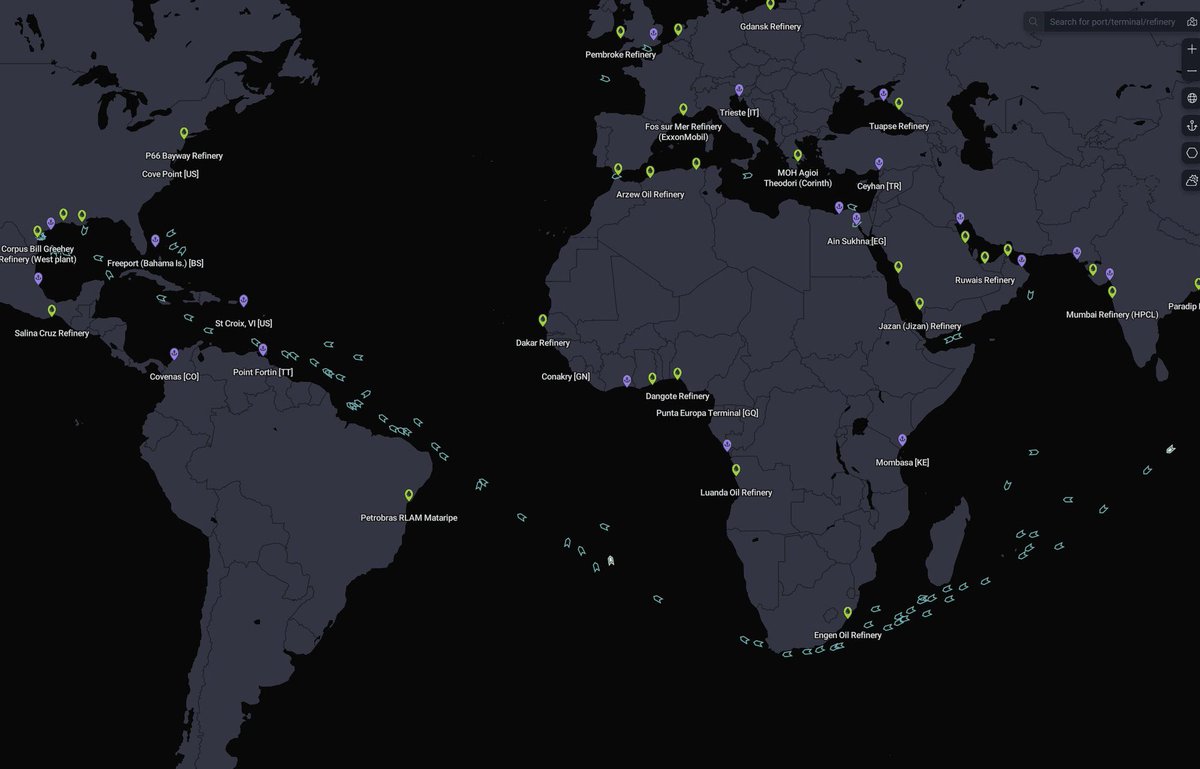
JUST IN: Sixty-eight empty supertankers are sailing toward the US Gulf Coast right now. Each one carries approximately two million barrels of capacity. They are coming from Asia. They are coming from Europe. They are coming because 20 percent of the world’s seaborne oil and LNG is trapped behind a strait full of mines that Iran cannot find and tolls that Iran will not stop collecting.
US Gulf Coast crude exports are on track to average 4.9 million barrels per day in April, a record. That is up 23 percent from March and 30 percent from February. For May, 28 supertankers have already been booked at a point in the month when the typical number is five. Bloomberg projects May exports will exceed 5 million barrels per day for the first time in history. Refined product exports hit a record 3.11 million barrels per day in March. LNG exports set new weekly and monthly records as Asian and European buyers pivot from Qatar, whose Ras Laffan complex is offline for years, to American terminals that can load and ship within days.
The United States just became the world’s swing energy supplier. Not through strategy. Through subtraction. Iran closed the strait. Qatar’s helium and LNG went offline. Russian supply is sanctioned. And the only major producer with scalable export infrastructure, deepwater port access, and no geopolitical encumbrance is sitting on 13.6 million barrels per day of production, 70 to 75 percent of it from shale, with the Permian Basin alone pumping six million barrels per day.
Trump posted on April 9: “Iran is doing a very poor job, dishonorable some would say, of allowing Oil to go through the Strait of Hormuz. That is not the agreement we have!” On April 8 he called the Hormuz toll “a beautiful thing” and proposed a “joint venture.” The reversal took 36 hours. But while Trump reversed his rhetoric, the tankers did not reverse course. They are still heading to Texas.
American gasoline is above four dollars a gallon for the first time since 2022. The export surge that enriches US producers simultaneously drains domestic supply and raises prices at the pump. The war that makes American oil companies the most profitable entities on earth is the same war that makes American drivers pay more at every station. The barrels that could have stayed home are loading onto VLCCs bound for Yokohama and Rotterdam because the arbitrage is too large to resist.
And here is the structural irony. The same Hormuz crisis that sends 68 tankers to Texas also sends 1.5 million barrels per day through Iran’s ghost fleet to China, settled in yuan via CIPS. The war is simultaneously reinforcing the petrodollar (US crude in dollars, loaded onto dollar-denominated charters) and accelerating the petrodollar bypass (Iranian crude in yuan, tolled in Bitcoin). Both monetary systems are being fed by the same crisis. Both sides are profiting from the same strait.
The ceasefire was supposed to reopen Hormuz. It has not. The mines drift. The tolls continue. And every day the strait stays partially closed, another VLCC books a slot at Corpus Christi, another Asian refiner signs a dollar contract, and another Iranian tanker loads crude for Shanghai in yuan.
The war made America indispensable. The war also made the bypass irreversible. Nobody in Islamabad tonight has the authority to undo either.
https://t.co/0fIdGsM5qH
Heading to @ParisBlockWeek this week and I can’t stop chuckling at this meme I whipped up.
In France, they don’t call a two-day event a two-day event…
They call it Paris Blockchain Week™ 🇫🇷🥖
I suspect @compliantvc and @WorkMJ would approve of this level of European optimism 🇪🇺💪
But I’m still going, to catch up with former colleagues, connect with current partners, and line up future ones.
Who else is heading to PBW? DM me if you want to connect.
#ParisBlockchainWeek #crypto #rwa