“the authors estimate that CA billionaires pay $3.3- 5.8b in annual income taxes. they assume a midpoint of $2b lost in annual collections from departed billionaires. the net present value of that lost income stream is -$68.9 billion.” The Laffer curve laughs last, again.
this California wealth tax thing is just incredible.
so in October 2025, a California healthcare union proposed a "one time" 5% tax on any billionaire's wealth. the ballot measure will be voted on next month. In early December 2025, California announced that it would be a retroactive tax if passed, applying to anyone with CA residency as of Jan 1, 2026. The objective is to pay for Medi-Cal, California's incredibly dysfunctional healthcare system. (which also functions as a glorified welfare apparatus, but that's a discussion for another time).
polls reveal that the CA electorate is split around 50/50 on the tax, but prediction markets only give Prop 40 a ~23% chance of passing (there are competing measures on the ballet that would nullify it).
there are 200 billionaires in CA, worth collectively somewhere between $2.3 and $2.6 trillion. 5% of that is around $100b, accounting for a small amount of attrition. proponents of the tax forecasted a significant windfall, assuming only a 10% departure rate.
supporters thought they were being clever with the retroactive concept. no billionares would leave CA in the few short months between the tax being proposed and the residency cutoff date, without the tax even having passed yet, right?
well as it turns out, they did.
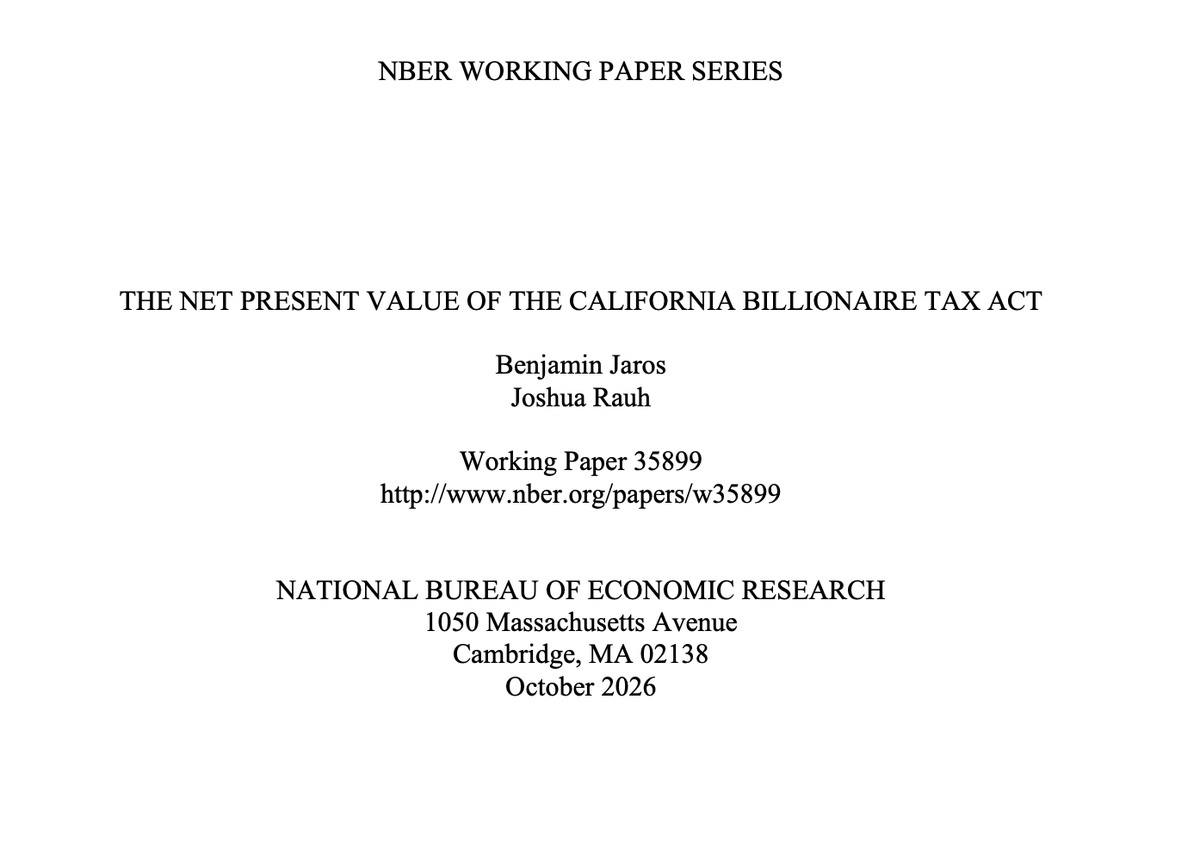
a new paper [1] from two academics at Stanford called "The Net Present Value of the California Billionaire Tax Act", argues that not only did more billionaires leave due to the proposed tax than its proponents expected, but that the value of the tax, if it does pass, is actually negative.
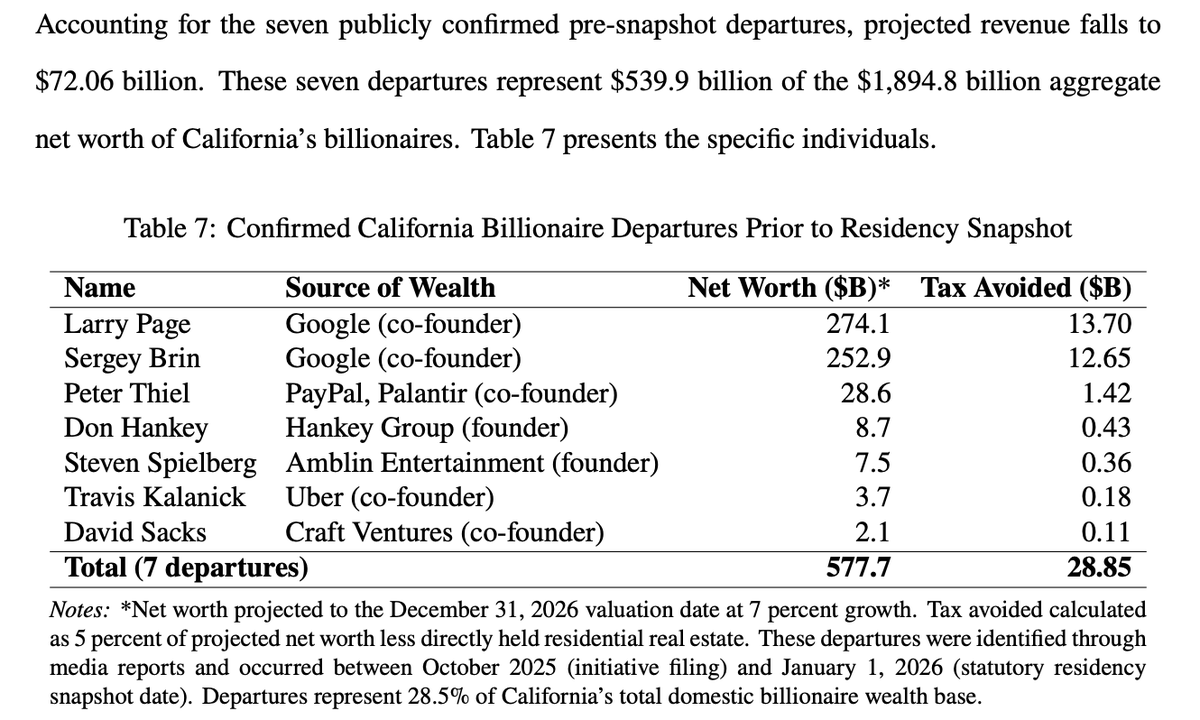
proponents of the tax only assumed 10% avoidance, that is, only 10% of the taxable base of targeted billionaires would leave CA within the very short Oct-Dec 2025 window. Jaros and Rauh, the Stanford academics, find that a lower bound of 28.6% of the taxable base managed to leave.
just based on known departures, those departures total $577b in net worth, or $28.8b in potential tax lost. this of course does not capture everyone (many left without announcing their departure), so the authors normalize to departure rates estimated from other wealth tax events, and apply other discounts for litigation, arriving arrive at a figure of only $28-$36b in forecasted tax revenues.
but this isn't all! all of the income taxes paid by the departed billionaires are also forsaken. the authors estimate that CA billionaires pay $3.3- 5.8b in annual income taxes. they assume a midpoint of $2b lost in annual collections from departed billionaires. the net present value of that lost income stream is -$68.9 billion.
so when you add it all up you get:
+ $30b one-time tax windfall (estimated)
- $69b in present value of lost future income taxes
= - 38.9b overall net present value of the tax
of course, this analysis is highly estimate driven. the authors simulate the parameters 100k times and find a negative NPV of the implemented tax 85 percent of the time.
and if the tax doesn't pass, which it's not looking like it will, California still ended up losing at least $577b in departed net worth, and they have permanently poisoned the well with entrepreneurs who will now worry about future wealth taxes.
[1]: https://t.co/1lbZgnMTG9
Nvidia: We're guiding to 70% revenue growth next year. There's incredible AI demand for 100% growth, but we can't supply it.
Google: Everyone wishes they had DOUBLE the compute capacity right now. There's so much AI demand.
Bloomberg/FT: There's a $500 million market-cap Korean neocloud no one has ever heard of and it traded poorly on its IPO first day. AI IS DEAD. EVERYONE FREAK OUT AND PANIC!
"Ursula von der Leyen is afraid to do anything except talk. She's useless."
@Ryanair CEO Michael O'Leary tells #EuropeToday the EU Commission president is doing "nothing" to make Europe more competitive.
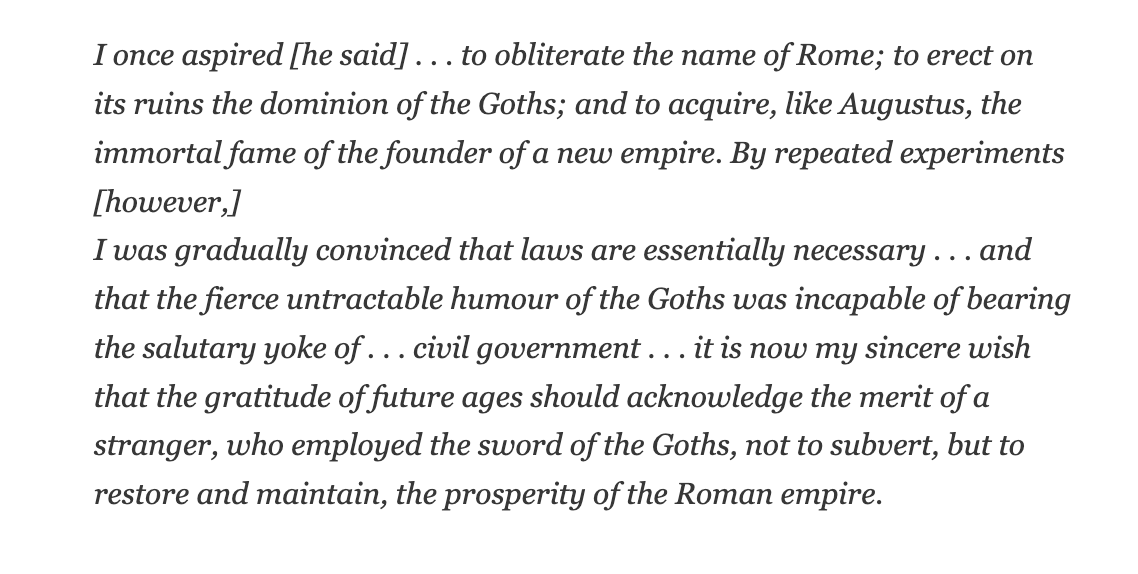
The below is from Norman Davies’ book Vanished Kingdoms. It is a declaration by Ataulf — “the Noble Wolf” –, the Visigoth leader who succeeded Alaric — the sacker of Rome.
I think what people are getting upset about is they’re slowly realizing that they are dumb and somehow blaming this on AI, even though it’s not really AI’s fault.” - Richard Borcherds https://t.co/msT8AX5gKT
German chancellor Merz asks Jensen Huang for advice on how Europe should regulate AI.
Jensen: “You can’t regulate if there’s no technology.”
“The technology industry must invent the technology for safety. […] Safety is not hopes and dreams. Safety is technology and engineering. Second, the companies need to have best practices. […] And then lastly there’s industrial and government regulations. […] Regulating the internet is hard, but regulating internet applications is not so hard. We should be regulating the applications right way. […] There’s nothing to regulate if the industry doesn’t thrive. You want the German AI industry to thrive as well as do it safely, responsibly. […] We know there’s technology we can invent and deploy in order to have AI safety. We know that there are best practices that we can adhere to as companies and industries. And then in addition to that, if necessary, we’ll make sure we regulate.”
Amazingly, onions are the only American agricultural commodity explicitly banned from futures trading.
This is thanks to an overzealous federal reaction to Chicago-based market manipulation in the late 1950s.
Now these heroic UChicago students are campaigning to overturn the Onion Futures Act of 1958.
This echoes what Nebius and CoreWeave have been saying too
"With GPU paybacks of around two years on our recent 3-year contracts"
"There's more customer demand than we can build for."
"2026 is largely sold out, recent 3-year contracts are at more than double the prior year's pricing"
Quiz: A French teacher costs ~€85k a year. How much of that goes to him?
~€37k (43%)
How much goes to paying retired teachers?
~€35k
French teachers see less than half of what they make because of the egregious French pensions.
But there's more:
Excellent from @nfergus
His is the correct diagnosis I think:
"Today, by historical standards, the young are an endangered species. They are dimly aware that they are being screwed, but they don’t appear to understand who’s doing the screwing.
A clue for the European young: It’s not Donald Trump or Benjamin Netanyahu or whoever else you want to burn in effigy. Mais, non: It’s your grandparents."
I strongly believe the right way of thinking about this entire debacle is from the perspective that it was the arrogance of the boomers that got us here in the first place. They, however, remain totally oblivious to the blowback of their own policies. They continue to see themselves as enlightened humanitarians. Yet, one of the most anti-humanitarian policies they championed was radical feminism.
After major wars we mourn the death of the young who fought in them. We should be mourning all the lives that boomer policies ensured were never born in the first place. These are the lost combatants of our time. A function of young working families being too indebted to afford families, and/or women being manipulated into life choices that most regret by their 40s.
https://t.co/KpKFjilkBR?
Brad Gerstner asked Jensen Huang if AI revenue can grow fast enough to pay back trillions of dollars of capex.
Gerstner's numbers: the labs bring in about $200B this year, and that needs to double to $400B next year and $800B the year after.
Jensen says people only see "a couple of labs, but I see more than that."
His breakdown of Nvidia $NVDA's business:
About a third is classic computing with no AI at all, the frontier labs are about 25-30%, and thousands of startups that "rent Nvidia computers" make up much of the rest.
FT @JensenHuang@BradGerstner@bgurley@Bg2Pod