Every Sunday at exactly 3:17 p.m., my father called me.
Not 3:15.
Not 3:20.
3:17.
It started a month after he retired.
At first, I thought it was boredom. Then habit. Then aging.
But it never changed.
If I picked up, he’d say the same thing:
“Are you home?”
If I said yes, he’d reply, “Good. Just checking,” and hang up.
If I said no, there’d be a pause.
Then he’d say, “Alright. Call me when you’re back.”
That was it.
No small talk. No updates. No “how are you?”
Just… checking.
My wife thought it was sweet.
I thought it was strange.
One Sunday, I decided not to answer.
I was home. I just let it ring.
At 3:18 p.m., he called again.
I ignored it.
At 3:19 p.m., my wife’s phone rang.
She frowned. “It’s your dad.”
I gestured for her not to answer.
The phone stopped.
At 3:21 p.m., the landline rang.
No one even has that number.
We stared at it.
It stopped after five rings.
At 3:24 p.m., someone knocked on the door.
Three sharp knocks.
Not aggressive.
Precise.
I opened it.
My father stood there.
Calm. Neatly dressed. Slightly out of breath.
“Why didn’t you answer?” he asked.
“I was busy.”
He looked past me into the living room.
“You’re home.”
“Yes.”
He nodded slowly.
Then said something he’d never said before.
“Good.”
And he left.
That night, I drove to his house.
I needed to understand.
He lived alone since my mother passed. Same house I grew up in. Same curtains.
He opened the door before I knocked.
“You came,” he said.
“Dad, why do you call every Sunday?”
He studied me for a moment.
“Come in.”
We sat at the dining table.
He didn’t speak immediately. He rarely does.
Finally, he stood up and walked to a locked drawer in the hallway.
He pulled out a thin folder.
Inside were newspaper clippings.
House fires.
Robberies.
Gas leaks.
Carbon monoxide deaths.
All circled in red.
“Every single one,” he said quietly, “happened on a Sunday afternoon.”
I blinked. “That doesn’t mean..”
He held up a hand.
“When your mother died, I was in the garden.”
I swallowed.
“I was ten feet away. Ten feet. She called once. I didn’t hear her.”
Silence stretched between us.
“I promised myself,” he continued, “that if something ever happened to you, I would not be in the garden.”
My chest tightened.
“So you call me to make sure I’m alive?”
He looked at me steadily.
“No.”
A long pause.
“I call to make sure you answer.”
I frowned. “What’s the difference?”
He leaned back in his chair.
“If you answer, I know you can.”
The words didn’t land immediately.
Then they did.
“If you couldn’t answer,” he continued calmly, “I would already be driving.”
My stomach dropped.
“You’ve been ready to come over every Sunday?”
“Yes.”
“Even when I said I wasn’t home?”
He nodded.
“I wait ten minutes. Then I check.”
A cold realization crept up my spine.
“Dad… how many times have you come?”
He didn’t answer right away.
Instead, he looked toward the window.
“Six.”
Six Sundays.
Six times he drove to my house.
Six times he must have stood outside.
Watching.
Making sure.
I tried to laugh it off.
“That’s extreme.”
He didn’t smile.
“You think emergencies schedule appointments?”
We sat there in heavy silence.
Then I asked the question that had been building all evening.
“Why 3:17?”
For the first time, his composure cracked.
“That’s the time on the hospital clock,” he said softly, “when they told me she was gone.”
The air left my lungs.
He wasn’t checking on me.
He was trying to outrun a minute.
Every Sunday.
For years.
I drove home that night differently.
The following Sunday at 3:16 p.m., my phone was in my hand.
At 3:17, it rang.
I answered on the first vibration.
“Hi Dad.”
There was a pause.
Then, for the first time ever, he said something new.
“I know.”
And he hung up.
My parents were married for 33 years.
I never once heard the word “Divorce” in our house.
Not during fights, money stress, hard seasons. Never.
Before my wedding, my father pulled me aside and said a few things that still live in my head to this day....
I went to the shelter just to drop off towels.
That’s it.
Old towels from my linen closet.
A fifteen-minute errand on my lunch break.
But then I heard them.
Not barking.
Not whining for attention.
Crying.
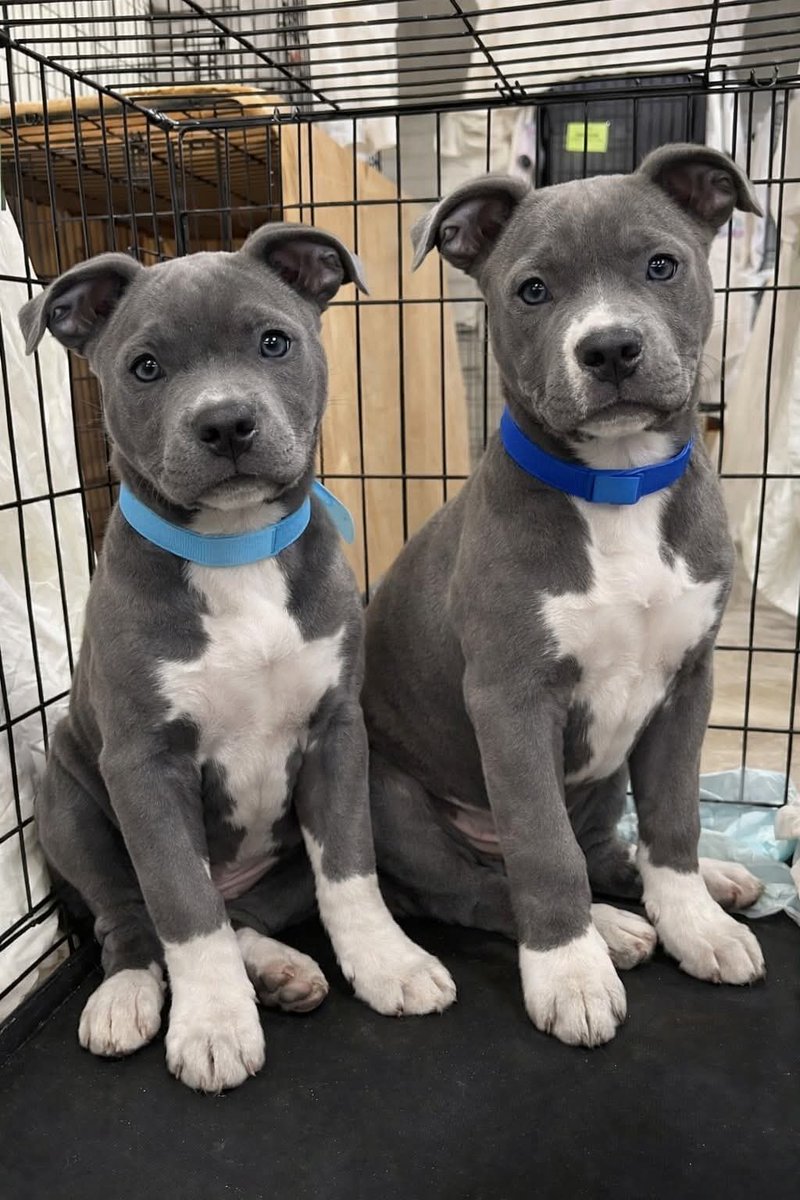
Two blue-gray pitbull puppies—maybe ten weeks old—curled up in a kennel near the back, making these tiny, broken sounds that went straight through me. The kind of cry that doesn’t ask for food…
It asks not to be left.
I walked over slowly, trying not to startle them.
One pup sat up first—stiff, brave, trying so hard to look tough.
The other stayed pressed right against him, like his whole world was “as long as we’re together, we’ll be okay.”
I asked the volunteer at the front desk,
“What’s their story?”
She didn’t sugarcoat it.
“Owner surrender this morning,” she said. “The dog had puppies unexpectedly. They kept the mom… and brought the babies here.”
Then she sighed, almost like she was tired of repeating the same heartbreak.
“They said taking care of two together was ‘too much work.’”
I just stood there for a second, staring at them.
Because those two didn’t look like “too much work.”
They looked like two little souls who had no idea why their whole life suddenly changed.
They were bonded—like truly bonded.
Not just siblings.
Not just kennel mates.
The kind of bond where one puppy won’t even blink unless the other one is breathing beside him.
The volunteer lowered her voice.
“They’ve been like this since they came in. They’ve never been without their mom… and they’ve never been without each other.”
I swallowed hard and asked the question I didn’t want the answer to.
“What happens if someone only wants one?”
She hesitated.
“We try to keep bonded pairs together. But we’re overwhelmed right now. If someone wants one but not the other…”
She didn’t finish the sentence.
She didn’t have to.
Because right then, the smaller pup leaned into the other—no playing, no excitement.
Just… needing contact.
Quiet reassurance.
Like, “Don’t leave me too.”
And that was it.
That was the moment.
I called my husband.
“Hey… don’t freak out.”
There was a pause.
Then he said,
“What did you do?”
“Nothing yet,” I whispered. “But I’m about to.”
“How many?”
I hesitated.
“…Two.”
He laughed. Like genuinely laughed.
“You went there to donate towels.”
“I know.”
“And now we’re getting dogs.”
“Pitbull puppies,” I said. “Yes.”
Another pause.
Then his voice got softer.
“Send me a picture.”
So I did.
A few seconds later, my phone buzzed.
“Bring them home.”
That was eight months ago.
Now they’re bigger, stronger, and somehow even more dramatic.
One is pure chaos—zoomies, kisses, and zero personal space.
The other is all attitude—side-eye, confidence, and acting like he pays the bills.
But some things never changed.
They still sleep in a pile.
They still check for each other in every room.
And if they’re apart for more than five minutes?
They act like it’s the end of the world.
And the towels?
They’re still in my trunk.
Never made it inside.
Because sometimes the best things in life aren’t planned.
Sometimes they don’t come when you’re ready.
They come when you’re just trying to do something small and good…
And they find you.
My dad ran a small jewellery shop. This was about 15 years ago. Business wasn’t great.
Gold prices were high. People mostly came to ask rates and leave.
One afternoon, an old customer walked in. He looked tense. He said he wanted to mortgage his jewellery.
My dad asked why. After a long pause, he finally said: Credit card loans and losses in F&O. It didn’t happen overnight. One thing led to another and He was trapped.
My dad didn’t begin with the jewellery.
He asked about his EMIs. They sat and talked for nearly an hour.
My dad helped him understand what to clear first. What to pause. What not to touch again. My dad asked about other deductions. There was an LIC policy too.
He suggested closing it.
He gave him a little more than the jewellery so that the most urgent EMIs could be cleared.
“Clear the highest interest first,” he said.
“When things are better, come back.”
The man left silently. A few months later, he returned. This time, he didn’t need a loan.
“My friend is getting married,” he said.
“She wants to buy jewellery.”
My dad helped her choose within budget.
No pressure. No upsell. Then her cousins came. Then other relatives.
They invited us to the wedding.
At the wedding, they introduced my dad to others and After that, more people started coming to the shop.
People didn’t argue over price anymore. They were real buyers. Buying jewellery & Asking for advice. Many people took advice from him.
My dad passed away years ago.
But even today, people remember him for that.
It was never about jewellery.
It was about trust.
I own a small bakery. Business has been slow. Rent is up. I was thinking about closing.
Last Friday, a teenager came in. He looked nervous. He counted out change for a cookie. He was short 50 cents.
"It's okay," I said. "Take it."
He ate it at a table, looking at his math homework. He looked stuck.
I used to be a math tutor.
I walked over. "Quadratic equations?"
He nodded. "I don't get it."
I sat down and helped him for 20 minutes. He got it. He left smiling.
The next day, he came back with two friends. They bought cookies.
The day after that, five kids came.
Apparently, he told the school, "The lady at the bakery helps with homework."
Now, my bakery is the after-school hang-out spot. It's loud. It's messy. There are backpacks everywhere.
Yesterday, I found a note in the tip jar. It was wrapped around a $20 bill.
"Thanks for helping my son pass math. A Mom."
I'm not closing the bakery.
I think I finally found my purpose.
It's not cookies. It's community.
"My son, Leo, is autistic. He’s non-verbal and terrified of loud noises. Haircuts are a nightmare. We’ve been asked to leave three different salons because he screams when the clippers turn on. I walked into a small barbershop on 4th Street, ready for another disaster. 'He has autism,' I told the barber, a heavily tattooed guy named Mike. 'If he screams, we’ll leave.' Mike looked at Leo, who was hiding behind my leg. Mike didn't say a word. He walked over to the door and flipped the sign to 'Closed.' He turned off the music. He turned off the buzzing fluorescent lights. Then, he sat on the floor next to Leo. He pulled out a pair of scissors and a comb. He didn't force Leo into the chair. He cut his hair right there on the floor. He let Leo hold the comb. He stopped every time Leo flinched. It took an hour. Usually, a haircut takes 15 minutes. When he was done, Leo looked handsome. And he was smiling. I went to pay. 'How much extra for your time?' I asked, reaching for my wallet. Mike shook his head. 'No charge,' he said. 'He sat still better than most of my regular customers.' He handed Leo a lollipop. 'See you next month, buddy.' I walked out to the car and cried. In a world that demands we all fit in, thank God for the people who make room for those who stand out."
Anonymous
@MumbaiRTO@MTPHereToHelp can we have some rules where heavy trucks, smaller tempos that cannot pick up speed on an incline be banned from busy flyovers? They not only slow down traffic but also are hazardous since other cars try to overtake & lead to blind spots. #Mumbai
I was in the grocery store today and the man in front of me… his card kept declining. He had two kids with him and they were slowly putting their items back one by one. He kept whispering, “Daddy’s trying. I’m sorry.” Then the lady behind me tapped him and said, “Put everything back in the cart. All of it. Kids shouldn’t feel their parent’s stress.” She paid the whole bill and walked off like it was nothing—no bragging, no camera, no attention. Just pure humanity. People like that still exist and they deserve every blessing coming their way.