When you use a credit card, a 1¢ payment costs 31¢.
That math doesn't work for AI agents making thousands of tiny payments a day.
@samrags_ of @merit_systems explains why stablecoins could be the rail the agent economy runs on.
“It feels like the world is going to forget that pre-stablecoins was even a thing.”
Stablecoins are already moving hundreds of billions of dollars through the financial system.
@PrimordialAA of @LayerZero_Core says demand is only accelerating.
SpaceX has exercised the option to acquire @cursor_ai in an all-stock transaction with the goal of building the world’s most useful AI models.
For the past few months, SpaceXAI has been jointly training a model with Cursor, which will be released in Cursor and Grok Build soon.
We look forward to working closely with the Cursor team to advance our frontier AI capabilities
Prediction markets hit a record $10.8 billion in weekly trading volume in the week ending June 15 — their biggest week ever. Several big events coincided that contributed to the all-time high: the SpaceX IPO, a U.S.-Iran peace deal, the NBA Finals, the Stanley Cup, and the opening of the World Cup, among them.
A year ago, a typical week on prediction markets ran around half a billion dollars, and even the busiest weeks stayed under $1 billion. That floor has climbed steadily since. It climbed past $1 billion last fall, past $4 billion by winter, and into the $6–7 billion range this spring.
Even a quiet week today dwarfs the biggest week of a year ago.
Companies capture value. Networks distribute it.
For years, crypto builders had to fit network-shaped systems into company-shaped rules. CLARITY changes that.
Not every tokenized asset is equally onchain.
Bonds are by far the largest tokenized asset category with $15.2 billion in market cap. But only about 5% of that supply is being used in DeFi. Precious metals look similar: they’re onchain, but mostly just sitting there.
Smaller categories look different. Reinsurance tokens have 84% of their supply deployed in DeFi, while private credit sits at 33%. This makes sense: The categories with the highest DeFi usage were built for DeFi from the start, through protocols like Nexus Mutual and Maple Finance.
Much of what gets called “tokenization” today is actually closer to digitization: moving records onto blockchains without unlocking much more new functionality. This matters because one of the core value propositions of onchain financial systems is composability.
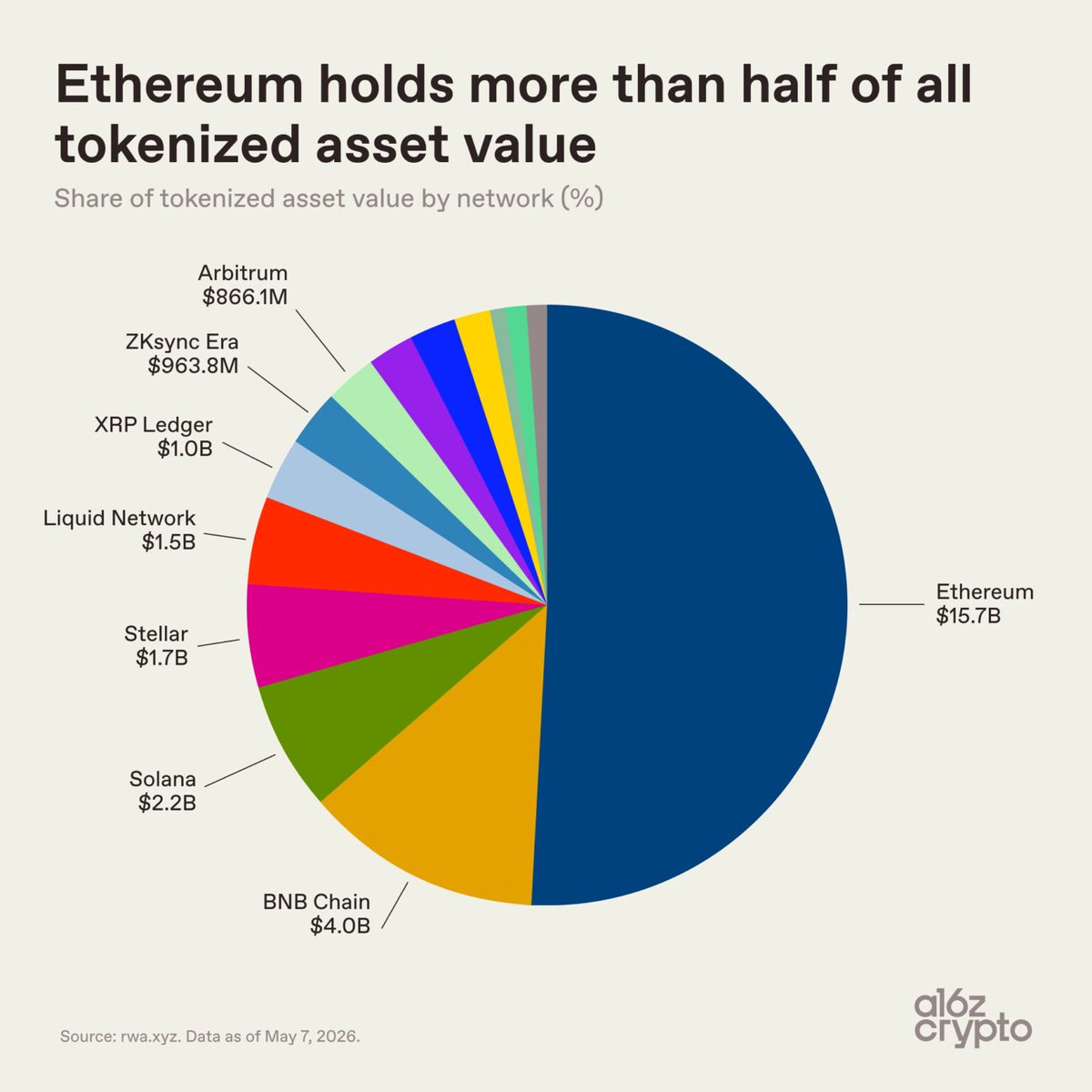
Ethereum still dominates tokenized assets, consistent with its headstart in DeFi and institutional adoption.
Ethereum: $15.7 billion
BNB Chain: $4B
Solana: $2.2B
Stellar: $1.7B
Liquid Network: $1.5B
XRP Ledger, ZKsync Era, Arbitrum: ~$1B each
Rather than converging around a single chain, tokenized assets are spreading across multiple blockchain ecosystems — given criteria like cost, liquidity, compliance requirements, and go-to-market relationships.
Different categories of tokenized assets have scaled at very different rates.
Asset-backed credit hit $1 billion in market cap in just 185 days. Specialty finance crossed the same threshold in under two years.
At the other end of the spectrum, venture capital took more than seven years to reach $1 billion, while active strategies took nearly as long.
More complex structures with longer time horizons take more time.