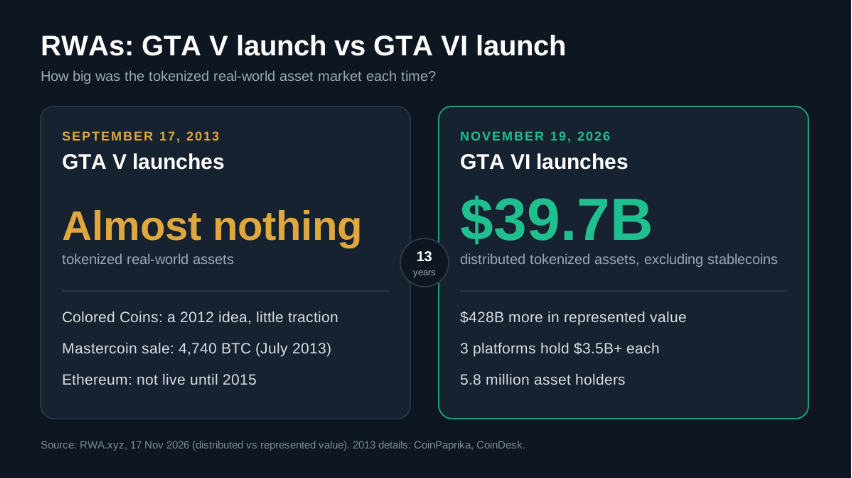
from almost nothing to $39.7 billion.
that's how far the RWA market has come.
when GTA V launched in 2013, tokenizing real-world assets was still an early idea.
— colored Coins had little traction
— ethereum hadn't launched
— the market was nowhere near what we're seeing today.
with less than 48hrs to the launch of GTA VI, the numbers tell a very different story.
~ $39.7B in distributed tokenized assets.
~ $428B in represented asset value.
~ 5.8 million asset holders.
just think about that growth.
an idea that once seemed small and experimental has grown into a market attracting serious attention and billions of dollars in assets.
and we're still in the early stages of seeing what tokenization can do.
13 years made a huge difference.
what do you think the next 13 years could bring?
awesome read @jonah_b. its great to see people in the industry taking the time to write pieces like this. appreciate u.
i have been saying that abu dhabi is the best place on earth to build the compute market.
the reason we have no deep market today is credit related. the lender underwrites the tenant, so the contract is travel restricted. every GPU hour is welded to the signee
AD can rectify the main problems. tenant, landlord and lender can have a 30 year horizon and sits on one sovereign balance sheet... a balance sheet like that underwrites the asset very effectively
murban crude was sold on term contracts with "destination" restrictions. buyers could not freely resell at will. ADNOC lifted those restrictions, listed futures out of ADGM in 2021, and turned it into a traded benchmark.
same fckn problem. already solved succesfully
i will go out on a limb and say the first compute contract that changes hands WITHOUT a lender’s “permission” clears in Abu Dhabi.
its whether the rest of the world will give a shit, to show up and trade against it
i reckon they do. if delivery is certain then the liquidity will always come. and if you own the land, the power and the capital (like Abu Dhabi)....then its pretty fckn certain in my eyes
Atoma takes two different approaches to USDC strategies through its two vaults.
And understanding their priorities makes the difference.
Atoma Index focuses on Points and multi venue rewards.
It uses automated hedged trading across supported perp DEXs, aiming to capture reward opportunities from multiple venues.
@atoma_fi RWA takes a different direction.
Its focus is yield generation through stock and commodity perpetuals, looking for opportunities in funding rates and pricing inefficiencies.
Both vaults use automated strategies, but their objectives are different.
Personally, I think having these two approaches gives users a clearer way to choose based on their priorities.
Index for Points focused strategies.
RWA for yield focused strategies.
Two vaults, two different priorities.
For years, blockchain builders were told to wait, or go offshore. Today the CFTC approved a blockchain-based DCM and DCO under the same core principles as everyone else. A clear pathway to regulation lets innovation happen in the open, under real oversight.
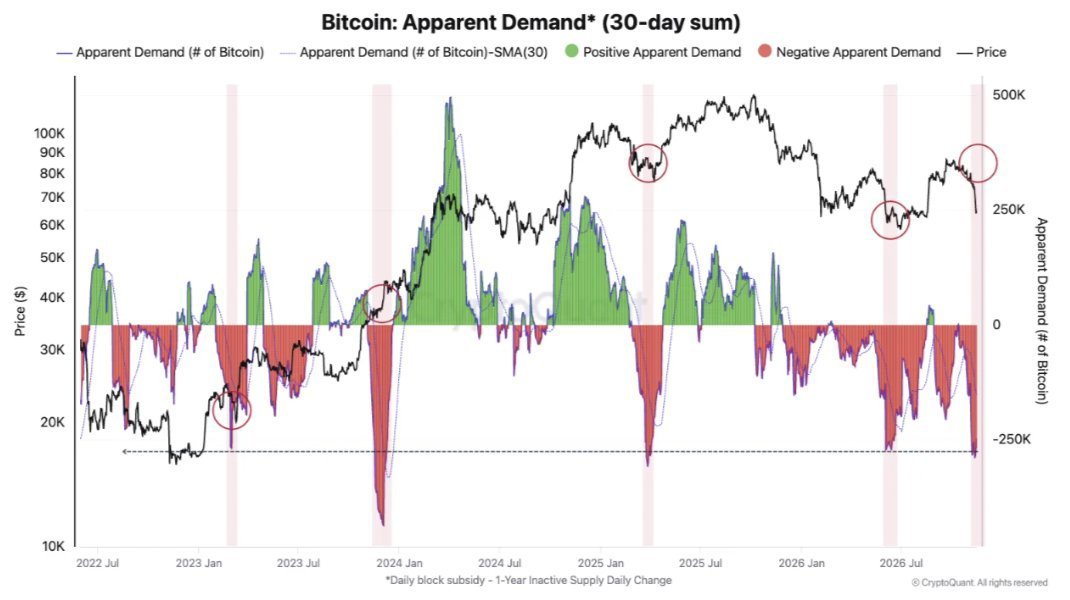
$BTC is hovering near $65,000, while its apparent demand has plunged deep into negative territory.
CryptoQuant's chart shows demand levels similar to previous periods of major market stress.
Buyers' demand appears to be weakening significantly.
Is Bitcoin facing another major demand shock?
🔐 178 websites. 1 tool. Even your copied crypto address could have been changed.
@Zoom, @BBC, @CNN, @HSBC, @Ledger — all targeted through Optimizely.
↳ Crypto address swapping
↳ Card details skimming
↳ Exploits on older iPhones
The loss was $7K, but the exposure involved 178 brands. Always double-check the address after pasting.
When was the last time you checked an address?
@Btcexpertindia Prudent, not bearish. The Fed always models downside scenarios for the dominant narrative of the cycle. In 2000 it was telecom, today it is AI capex. I'd worry more about concentration than the tech itself.
@AltcoinSherpa Outflows track the trading cycle, but the infrastructure buildout hasn't stopped. Japan's megabanks are still on track to issue stablecoins by 2027, and US banks are building a tokenised deposit network.
@Fin_X_Tech My take: regulators will move faster on agent identity than agent capabilities. KYC frameworks were built for people and legal entities, not software acting on someone's behalf. #ai#fintech#digitalbanking
Warsh on superintelligence is notable, but the more useful signal is what institutions deploy today. AI-driven risk modeling and market analysis are already running in production inside major funds. #ai#fintech
Fair point. Gemini found counterexamples but humans reduced Courtade-Kumar to 14 variables and set the lower bound. Problem selection stays human. Working on problems like Navier-Stokes alongside these systems is what pulls brilliant people in.
@fintechlbnai I am not saying it is solved completely. My point is how to create excitement among the brilliant ones towards STEM if we keep going behind only AI.
@EhDhizy I keep seeing this in payments. Nobody praises your architecture, they remember if the transfer landed in 10 seconds or 3 days. The customer only ever asks one question and it's the one you named.
@cryptoamanclub It is eroding where money touches regulated infrastructure, which is most of it. The UAE made AML coverage a licensing prerequisite across VARA and ADGM frameworks. Privacy-preserving tech exists, the regulatory door for it is just narrowing.
@bigfundu 'Kind of done' is doing a lot of work there. Formalizing an existing proof differs from resolving one. The applied pace is real though. I follow the frontier model work at Mubadala with OpenAI and Inception42 for portfolio risk closely.
@Fin_X_Tech@ncino Matches what I hear at local fintech meetups. Pilots stall when they chase novelty over workflow fit. Compliance automation delivers the clearest early proof. #ai#digitalbanking#creditunions
@Evan_ss6 Clickbait framing. What Anthropic showed is AI-assisted discovery of implementation bugs, not a break of the underlying math. AES and TLS are intact. I read the same coverage this week and the takeaway is better code audits, not dead cryptography.
Gupta's framing matches what GCC markets demonstrated this year. Markets operated, licensing continued, no capital controls under genuine stress. At this same ADIPEC, Mubadala is running Frontier AI with OpenAI and Inception42 for predictive risk assessment. #ADIPEC#fintech
During “Capital, confidence and growth: Asia's investment outlook” at the ADIPEC 2026 Strategic Conference, Rajarshi Gupta offered this perspective:
“The number one thing investors need is stability. The most prime thing is they need to know there is demand, there is regulatory support, there is fiscal stability and there is continuity in policy.”
Rajarshi Gupta participated as MD & CEO, ONGC Videsh Limited.
The Strategic Conference connected leadership perspectives with the practical choices facing the energy value chain, from investment confidence to technology adoption.
Register your interest for the ADIPEC 2027 Conferences: https://t.co/B5jCK4FaFW
#ADIPEC #ADNOC #GlobalEnergy #EnergyLeadership