Code → Context. Enter the CDLC (Context Development Lifecycle). I wrote up my thoughts on where this is going and the parallels with what we learned from DevOps.
https://t.co/bpi9WGXRxa
The most whitty techie in NZ has kicked off his mission to psychol across the country from North to South on a push bike. You have to follow his epic adventure!
As an update to my earlier post.
- The ICPS helium bottles are used to purge the engines, as well as for LH2 and LOX tank pressurization. The systems did work correctly during WDR1 and WDR2.
- Last evening, the team was unable to get helium flow through the vehicle. This occurred during a routine operation to repressurize the system.
- We observed a similar failure signature on Artemis I.
- The Artemis II vehicle is in a safe configuration, using ground ECS purge for the engines versus the onboard helium supply.
- Potential faults could include the final filter between the ground and flight vehicle, located on the umbilical, though this seems least likely based on the failure signature. It could also be a failed QD umbilical interface, where similar issues have been observed. It could also be a failed check valve onboard the vehicle, which would be consistent with Artemis I, though corrective actions were taken to minimize reoccurrence on Artemis II.
Regardless of the potential fault, accessing and remediating any of these issues can only be performed in the VAB.
As mentioned previously, we will begin preparations for rollback, and this will take the March launch window out of consideration.
I understand people are disappointed by this development. That disappointment is felt most by the team at NASA, who have been working tirelessly to prepare for this great endeavor. During the 1960s, when NASA achieved what most thought was impossible, and what has never been repeated since, there were many setbacks. One historic example is that Neil Armstrong spent less than 11 hours in space on Gemini 8 before his mission ended prematurely due to a technical issue. A little over three years later, he became the first man to walk on the Moon.
There are many differences between the 1960s and today, and expectations should rightfully be high after the time and expense invested in this program. I will say again, the President created Artemis as a program that will far surpass what America achieved during Apollo. We will return in the years ahead, we will build a Moon base, and undertake what should be continuous missions to and from the lunar environment. Where we begin with this architecture and flight rate is not where it will end.
Please expect a more extensive briefing later this week as we outline the path forward, not just for Artemis II, but for subsequent missions, to ensure NASA meets the President’s vision to return to the Moon and, this time, to stay.
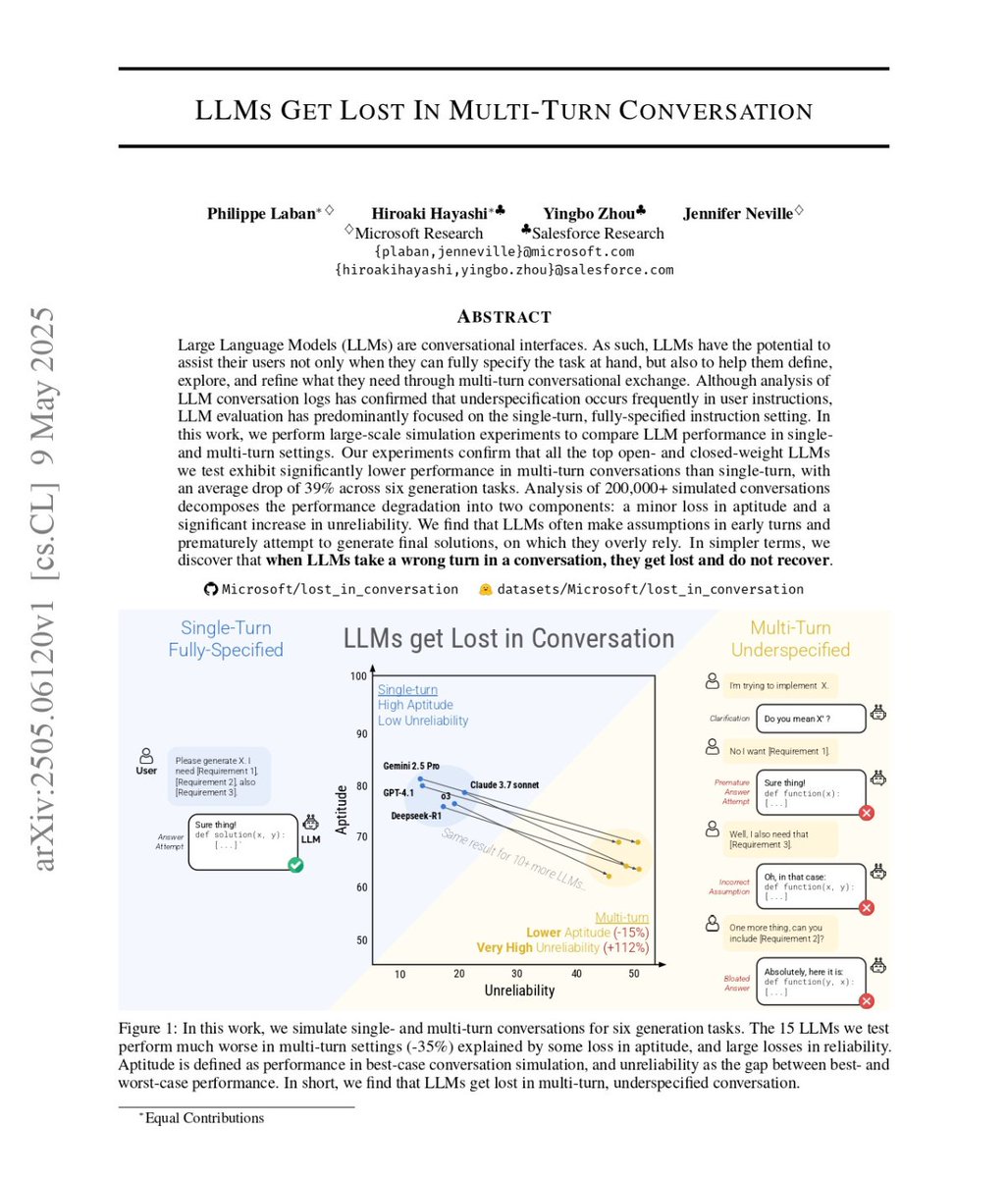
🚨BREAKING: Microsoft Research + Salesforce just dropped a paper that should scare every AI builder.
They tested 15 top LLMs GPT-4.1, Gemini 2.5 Pro, Claude 3.7 Sonnet, o3, DeepSeek R1, Llama 4 across 200,000+ simulated conversations.
Single-turn prompt: 90% performance.
Multi-turn conversation: 65% performance.
Same model. Same task. Just... talking normally.
The culprit isn't intelligence. Aptitude only dropped 15%.
Unreliability EXPLODED by 112%.
→ LLMs answer before you finish explaining (wrong assumptions get baked in permanently)
→ They fall in love with their first wrong answer and build on it
→ They forget the middle of your conversation entirely
→ Longer responses introduce more assumptions = more errors
Even reasoning models failed. o3 and DeepSeek R1 performed just as badly.
Extra thinking tokens did nothing.
Setting temperature to 0? Still broken.
The fix right now: give your AI everything upfront in one message instead of back-and-forth.
Every benchmark you've seen was tested on single-turn prompts in perfect lab conditions.
Real conversations break every model on the market and nobody's talking about it.
Solid talk at #churconf by @jbaruch on using SBE and BDD to reduce garbage out from AI generated code. He calls it #intentintegritychain Humans in the loop with accountability and verification, using SBE
#GenAI loves unstructured data, but complex, structured databases are a tougher challenge.
Discover how to:
🔹 Model hierarchies in a #GraphDatabase
🔹 Chat with your graphs via embeddings
🔹 Compare LLM accuracy
🔗 Watch now: https://t.co/icwlIVNyGO
#AI#LLMs#database#InfoQ
So rather than actual exercise, I started looking for a VR friendly treadmill. However, I'm now fascinated by this amazing build. Essentially a mouse taped to a treadmill, with a bunch of elastic for safety. Genius. https://t.co/VnTA37tjC7
Dearest @Spotify I want to thank you for getting me into listening to my fave O'Reilly books whilst running. Further, running out of designated minutes helped me rediscover the joys of Audible, who were cheaper than the 10 hour top up. They are also grateful.
How can data eng teams align with long-term goals and drive business impact? Check out my @InfoQ coverage of recent insights shared by @liorb and Gaëlle Seret on shaping an impactful data product strategy through collaboration, vision, and a data-product mindset.
"database engineers are some of the best programmers in the world." Andy Pavlo kicking off 2025. Learnings on everything from rap to redis alternatives, DuckDB integrations, Larry Elison's personal life + a spectrum of databases to look out for in 2025.
https://t.co/qO9YAmKmyt