Scientists have created what they call a "ghost heart" — and it may be the most important medical breakthrough of our lifetime.
Here is how it works. They take a pig heart, wash it gently with a mild detergent until every single cell dissolves away. The blood drains out. The color fades. What is left behind is a ghostly white protein scaffold — the architectural skeleton of a heart, perfectly intact, right down to the tiniest blood vessel channels.
Then they inject it with the patient's own stem cells.
The cells find their way into the scaffold, settle in, and begin to grow. Scientists have already watched these hybrid hearts start beating in the lab.
The reason this changes everything is rejection. Every year, thousands of transplant patients die not because they did not get an organ — but because their body attacked it. With a ghost heart rebuilt from your own stem cells, there is nothing foreign for your immune system to fight. No rejection. No lifelong anti-rejection drugs.
Right now, over 103,000 Americans are on the transplant waiting list. 13 people die every day waiting for an organ that never comes. One in three heart patients dies before a donor heart even becomes available.
And here is the part that should be on the front page of every newspaper. In June 2025, this technology was used on a real human patient for the first time — not the heart yet, but a bioengineered liver built using the exact same method. It worked. The organ performed all the functions of a healthy liver in a patient who had no other options.
The heart is next. Researchers say a fully transplantable ghost heart could be ready within the next 6 to 7 years.
We may be the last generation that dies waiting for a donor organ.
"The Indian state was never able to achieve China's social modernization or its dramatic improvements in human capital. When India opened its economy, its people were simply not prepared the way China’s were. China invested in its people; India did not."
(https://t.co/gOXqGJ8QkE)
New data and analysis provides an answer to:
How much oil is Iran still selling?
How much is this worth?
How long before this dries up?
Many people in the United States believes that, due to the US Blockade that has been imposed on the Strait of Hormuz since April 13th, Iran is not making any money from oil sales.
This is not true.
According to new data from Kpler, and reported by Reuters today, Iran STILL has ~79 million barrels of oil OUTSIDE the US Blockade line. This reporting also highlights that Iranian oil:
"Is being offered at a discount of 50 cents to $1 per barrel to ICE Brent contract for delivery to China's eastern province of Shandong this month, three traders said, down from premiums of $1 to $2 in the past two months."
Now... it's worth highlighting some quick context as to why this specifically is the case. "Down from premiums of $1 to $2 in the past two months". Why is this specifically worth addressing? Because, on March 20th, the United States Treasury authorized General License U, which UNSANCTIONED ~160M barrels at sea at the time. As a result of this being unsanctioned, more countries were able to purchase Iranian oil. This increased bidding competition (see: supply and demand) drove up prices on Iranian oil.
What would be a better point of comparison to use as a reference? Great question. Data published by Bloomberg shows that on March 27th, the day prior to the US strikes, Iranian oil was trading at a $10/barrel discount to Brent. So yes, while Iranian oil is slightly down from its peak pricing under General License U, it is still trading at a $9 premium from where it was prior to the War.
But wait a minute... hold up. It's not "just a $9 difference". That would be the case IF global oil prices stayed exactly the same... which they haven't. Brent Crude prices, which we can utilize to calculate Iranian pricing at the $9/barrel discount, was trading at $72.29/barrel. Therefore, we can calculate that prior to the war, Iranian oil was trading at a price of ~$62.29/barrel. Now, Brent crude prices are trading at ~$88/barrel, and Iranian oil is trading at a $1 discount, thus $87/barrel.
Why do we care about this? Because this increase in both discount price and oil price buys additional time for the Iranian economy currently under siege from an economic warfare campaign and blockade.
By utilizing the aforementioned data, we can calculate the approximate value of Iranian oil that still exists on the water OUTSIDE the US blockade line by using the equation:
$87 (per barrel) X 79,000,000 = $6.87B
Ok. So Iran has ~$6.87B of oil still able to be sold, with an overwhelming share of the sales going to China.
But hold on to your hat, because there is still more that needs to be accounted for.
Due to trucking routes into Pakistan, and rail lines into China, it is estimated that Iran is still exporting ~250,000 barrels per day.
($87 x 250,000) x (30 x 2.5) = ~$1.8B
(We'll get to the "why x 2.5" below)
Therefore, the full math would be: $6.87B + $1.8B = $8.67B of total revenues...
BUT WAIT THERE'S MORE!
A good estimate for Iran's annual oil revenues is ~$45B per year. If we divide this $45B figure by the $8.67B figure, we can reasonable estimate that Iran has ~2.5 months of available oil revenues that can still be sold. But, and there's a big but here, Iran's oil payment settlement speed generally runs on "up to" a two month delay from delivery. Therefore, we can reasonably estimate that Iran still has ~4.5 months until they would BEGIN to feel the full impact of the US blockade and economic warfare campaign.
$8.67B of oil at sea. 4.5 months until Iran is feeling the full brunt of the US blockade and economic warfare campaign.
So while yes, the economic warfare campaign and US blockade are hurting Iran's ability to get oil OUT of the Strait of Hormuz... They still have about 4.5 months of available oil at sea + land-based exports until they are "actually" feeling to full pain...
That's not a timeline that is viable for the global economy.
The jewish Marks, Sieff and Sacher Families (Marks & Spencer Dynasty) were the primary architects of the economic and institutional pro-'israel' network in the UK.
After they ousted the son of English co-founder Thomas Spencer from the company, they used their wealth to fund 'israel's' development and the IOF.
They were tightly interwoven through marriage: Israel Sieff and Harry Sacher married the sisters of Simon Marks—son of M&S co-founder and Polish immigrant Michael Marks—Rebecca and Miriam, respectively. Together, they formed the core of the 'Manchester School of Zionism' and:
- Acted as the primary handlers and aides to Chaim Weizmann, the Russian jew who went on to become 'israel's' first president.
- Built the political machinery that lobbied the British War Cabinet, directly resulting in the 1917 Balfour Declaration.
- Created a London headquarters at Great Russell Street, noted by historians as the physical 'heart of the UK's pro-'israel' lobby'.
After the Nakba in 1948, they systematically worked to repair the diplomatic damage left by the jewish terror on Britain during the Palestine Mandate by leveraging the immense economic clout of Marks & Spencer.
Michael Sacher became the primary financial force behind the creation of early political briefing groups. He bankrolled the British 'israel' Public Affairs Committee (BIPAC), which directly laid the logistical and structural foundation for what would become the Conservative Friends of 'israel' (CFI) in 1974.
M&S built 'israel's' modern textile and agricultural industries through exclusive massive supply contracts with 'israeli' firms like Delta Galil. This injected hundreds of millions of vital foreign currency effectively making the British high street a major financial pillar of early 'israeli' entity survival.
Former M&S corporate spokespersons have said 'We have a history and a background with "israel" that we are very proud of'.
M&S executives direct personal connections to 'israel':
- Simon Marks (Lord Marks) was a close lifelong friend of Chaim Weizmann. During World War I, the British military officially detached Marks to direct Weizmann's London headquarters, effectively allowing him to run early zionist political operations alongside his growing corporate empire.
- In 1948, 'israel's' first Prime Minister, David Ben-Gurion, personally requested Lord Marcus Sieff (the future chairman of M&S) to help defend the new entity. Sieff temporarily joined the IOF, advising the 'israeli' Ministry of Defence on logistics, transportation, and supplies. He openly coordinated M&S goods and corporate finances to bolster the colony during its early aggressions on Palestinians and surrounding countries.
- In his 1990 book, Management: The Marks and Spencer Way, Sieff explicitly wrote that one of the fundamental corporate objectives of M&S was to 'aid the economic development of "israel".'
They used their wealth to build the settler colony and to influence British politicians to forget the massacres of the British troops and civilians by jewish terrorist groups and become pro-'israel'.
Boycott M&S.
A great many Europeans, and others, have "moved on" from America. Have accepted that our country has dramatically changed course. What comes next? This is the theme of a piece of mine about the Copenhagen Democracy Summit. https://t.co/Am2KIbPE2G
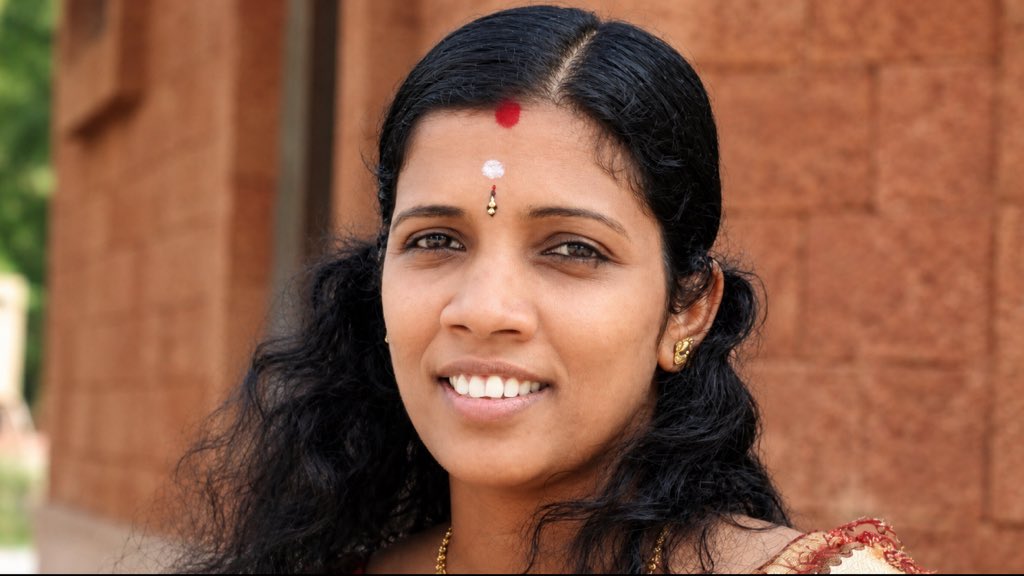
Her name was Lini Puthussery.
She was 31 years old. A nurse at the Perambra Taluk Hospital in Kozhikode Kerala. She had been working there for six years.
She had two sons. Ritul was five years old. Sidharth was two years old.
In May 2018 the Nipah virus arrived in Kerala. Two brothers and a relative were brought to the hospital with symptoms nobody had seen before.
Lini was on night duty when they arrived. She cared for them through the night.
They died soon after. Confirmed Nipah positive.
By Friday Lini herself had fallen ill.
She was shifted to the ICU at Kozhikode Medical College Hospital.
When she learned she had contracted the Nipah virus she asked the hospital not to allow her two sisters to visit. She did not want them exposed.
From the ICU she wrote a note to her husband Sajeesh.
“Sajeesh I am almost on my way. I don’t think I will be able to see you. Sorry. Please look after our little ones and take them to the Gulf. They should not be alone like our father. Lots of love.”
She died on May 21, 2018.
Her body was cremated quickly to prevent the spread of infection. Her family could not say a proper goodbye.
She did not hesitate when the patients arrived.
She did not ask who would care for her sons if she fell ill.
She showed up for her shift and did her job.
Today is International Nurses Day.
Her name was Lini Puthussery. She deserves to be remembered.
A Mayo Clinic-developed artificial intelligence (AI) model can help specialists detect pancreatic cancer on routine abdominal CT scans up to three years before clinical diagnosis. It identifies subtle signs of disease before tumors are visible, when curative treatment may still be possible. The findings, published in Gut, mark a milestone in Mayo Clinic's multiyear research effort to enable earlier detection of one of the deadliest cancers.
Learn more: https://t.co/EJySSkaW3P