@Firelightfi Firelight holders, take a moment to vote for the next rewards schedule.
Voting qualifies you for an increased 1.25x power on reward claims
Learn more: https://t.co/tCaMXkjphG
@Firelightfi Firelight holders, take a moment to vote for the next rewards schedule
Voting qualifies you for an increased 1.25x power on reward claims
Learn more: https://t.co/tCaMXkjphG
@Firelightfi Firelight holders, take a moment to vote for the next rewards schedule
Voting qualifies you for an increased 1.25x power on reward claims.
Learn more: https://t.co/tCaMXkjphG
@Firelightfi Firelight holders, take a moment to vote for the next rewards schedule
Voting qualifies you for an increased 1.25x power on reward claims
Learn more: https://t.co/tCaMXkjphG
@Firelightfi Firelight holders, take a moment to vote for the next rewards schedule
Voting qualifies you for an increased 1.25x power on reward claims.
Learn more: https://t.co/tCaMXkjphG
@Firelightfi Firelight holders, take a moment to vote for the next rewards schedule.
Voting qualifies you for an increased 1.25x power on reward claims
Learn more: https://t.co/tCaMXkjphG
@Firelightfi Firelight holders, take a moment to vote for the next rewards schedule
Voting qualifies you for an increased 1.25x power on reward claims
Learn more https://t.co/tCaMXkjphG
@Firelightfi Firelight holders, take a moment to vote for the next rewards schedule
Voting qualifies you for an increased 1.25x power on reward claims
Learn more https://t.co/tCaMXkjphG
@Firelightfi Firelight holders, take a moment to vote for the next rewards schedule.
Voting qualifies you for an increased 1.25x power on reward claims.
Detalis: https://t.co/tCaMXkjphG
Financial products scale when downside is bounded.
DeFi’s “risk-it-all” model may work for innovators, but it does not for broader financial applications. With insurance covering less than 2% of the market, DeFi still lacks the risk layer required for institutional scale.👇
The good news is @FlareNetworks has been building the XRPFi consistently for over a year now, and the concept has proven itself.
Over 150m $XRP are now present on Flare, making Flare the only network to secure the XRPFi ecosystem.
What has been live on Flare?
+ FAssets that turn XRP into FXRP - the composable version of XRP within DeFi
+ A wide adoption ecosystem partnering with @Firelightfi, @kinetic_xyz, @Morpho, @squidrouter, @DCENTWALLETS, @XamanWallet, @upshift_fi and many other
+ Latest upgrade of FAsset v1.3 that speeds up the process of minting FXRP
+ FIP.16 passed, leading to a $FLR inflation drop from 5% to 3%
All seem to prove that Flare is on the right path to connect every piece in the bigger picture - involving the institutions in the XRPFi race. To make it come true, Flare 2.0 is the answer.
1. Flare 2.0 - the path to institutional XRPFi
The current state:
@XRPLF has quietly become one of the biggest venues for real-world asset issuance with billions in tokenized treasuries, credit, and other RWAs.
However, XRPL was never built to be programmed.
➜ That's the gap Flare is mending, as the cofounder of Flare, Hugo Philion, mentioned: "XRPL is the layer where assets get issued, Flare acts as the compute layer."
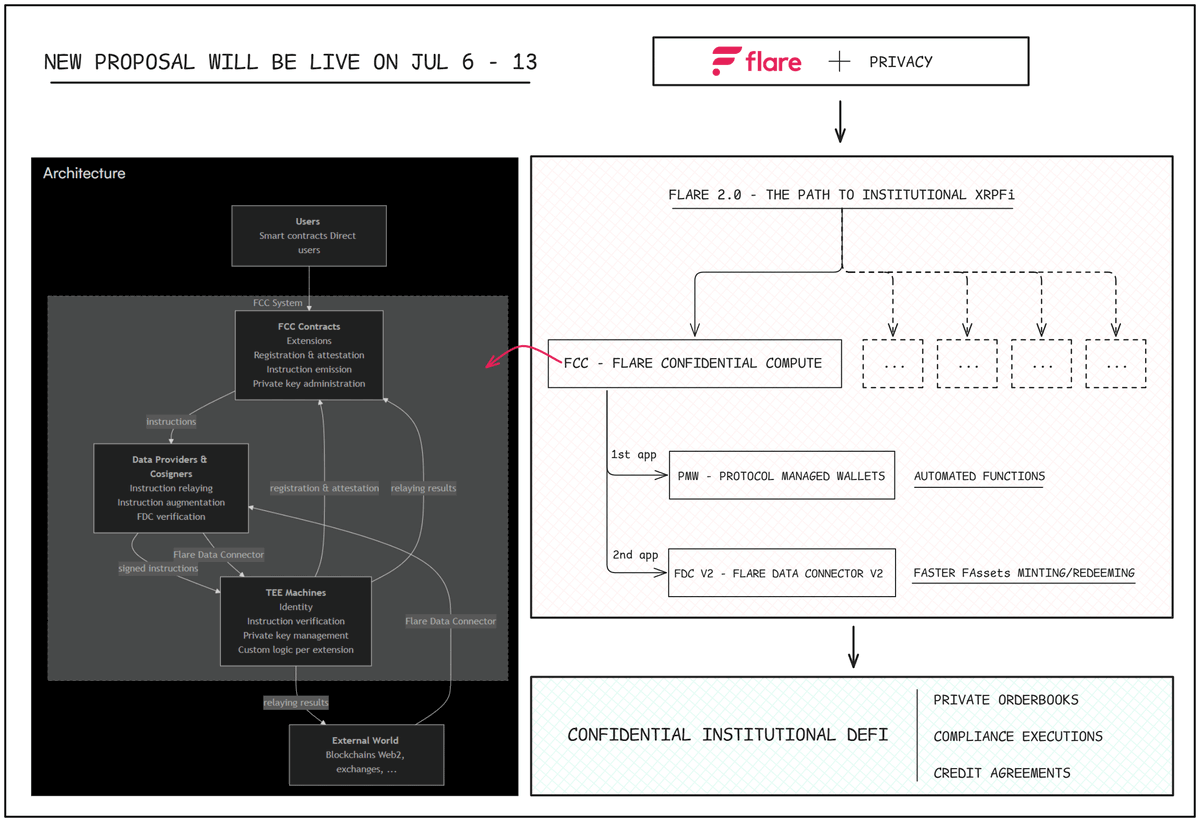
Flare 2.0, is the solution of Flare to solve this problem, starting with a major infra upgrade - Flare Confidential Compute (FCC).
2. Flare Confidential Compute
In short, FCC introduces privacy on Flare, giving institutional funds a guarantee.
FCC is the infra layer that gives on-chain apps access to TEEs - the hardware-isolated environments that can run confidential logic, hold secret keys, and handle heavier compute than smart contracts alone can manage.
Flare will first land FCC on Songbird (their canary network) as the first end-to-end deployment of what they call Flare 2.0.
What is FCC shaped with?
+ smart contracts that coordinate TEE execution on-chain
+ data providers acting as relayers through FDC-V2, Flare's upgraded attestation layer
+ TEE machines that run the confidential workloads and return signed, verifiable results
Skip the raw tech side; let's shift your focus to the real use cases that common users can experience.
3. Upcoming primitives on Flare 2.0
3.1. Faster FAssets minting and redeeming (FAssets v2)
There're 2 factors that affect this speed:
+ FDC-V2 (Flare Data Connector V2) replaces batch-based attestations with individually handled requests
+ FCC removes collateral trust, enabling TEE-enforced correctness; minting/redeeming time reduces from minutes to seconds (10-20s)
➜ more efficiency in time and in capital usage.
3.2. Confidential DeFi
Large funds (from institutions, banks or any giants) will love Flare 2.0 due to:
+ Private orderbooks
+ Compliance execution
+ Favored agreement on large dep
This is why Flare 2.0 is friendlier for institutional funds.
3.3. Expandable options for ledgers
Higher privacy opens the gate for automated dApps to run on users' wallets, using the Protocol Managed Wallets (PMW) applications.
fyi, this primitive is still under development on EVM wallets, now wallets on Flare are able to catch it up.
In conclusion, here're the key takes:
+ Flare 2.0 is one of the biggest update so far on the XRP-centric network.
+ It starts with FCC, delievering the framework on Songbird first.
+ The 2 first applications that run on FCC are PMW (focusing on in-wallet automated functions) and FDC-V2 (focusing on FAssets minting/redeeming)
And the FIP will be opened for voting from Jul 6 to Jul 13. Stay focused.
An independent Risk Consortium, votes on whether a reported incident qualifies under the published cover terms.
The consortium consists of independent domain experts applying published coverage criteria to on-chain evidence.
Firelight coverage will run over fixed 30-day periods.
Pricing, capacity, and cover all align to those boundaries, which keeps things predictable: each quote reflects the risk view for that period, and pricing parameters refresh when the next one begins.
The vault that backs Firelight coverage is built on the ERC-4626 tokenized vault standard, which makes the staked position composable across DeFi.
At the MVP it holds a single collateral, $stXRP, and issues a token representing each staker's share of the backing pool.
Clear trust assumptions are critical for DeFi insurance primitives.
Staked liquidity + transparent payout mechanisms create a stronger foundation for sustainable onchain coverage. @Firelightfi 🔥
Proud to bring Hypernative’s real-time threat intelligence and incident analysis to the Firelight Risk Consortium, helping make DeFi claims assessments more independent, evidence-based, and transparent!
Firelight Risk Consortium Announcement:
Hypernative joins as a key partner, contributing real-time threat intelligence
and expert analysis to enable transparent, independent, and technically rigorous claims assessments in DeFi.
Solid one here, @Firelightfi
Central to the Firelight Risk Consortium is an independent panel of leading security and risk firms.
@HypernativeLabs brings industry-leading threat intelligence and security monitoring capabilities to support claims assessments.
Learn more about this integral partnership. 🤝