During the 1995-2000 dot com melt-up there were five 10-20% corrections in Nasdaq. In addition, there was a final 30% 3-month bear market in Nasdaq (1998), just prior to the final parabolic move higher.
Our call remains: This generational bull market is being led by an Innovation Revolution and will be stronger, broader and much longer lasting than dot-com.
10% + drawdowns will remain buying opportunities well into the 2030’s.
Long and adding to our positions in semis/tech, small caps, housing, gold/silver/miners and Bitcoin/TAO.
Blink and you'll miss it.
No sensors, no rigs, no five figure per match install. Just broadcast footage and SN44 (see the video below).
Nobody has tried to replace Hawk-Eye this way before. The models are good enough to present back to our partner now, though not yet good enough commercially.
Other updates:
- Full weights, no burn, starting now.
- Every public element gets +1% rewards, with the remainder going to Football Action Detection.
We need a stronger model there before the season starts, so the boost stays until the private tracks and new public challenges land.
- Pokémon Card Grading is postponed. Most of the annotated cards turned out to be public already, so our partner is building a new private data set.
- Runner stability update is live.
The gap between broadcast video and sensor hardware is closing faster than anyone expected.
For my first post, I’m sharing a letter @NVIDIA signed on why open models matter.
AI will transform every industry, power every company, and be built by every country.
Open models strengthen safety and cybersecurity, accelerate innovation and diffusion, and enable sovereignty.
The world needs both frontier closed models and frontier open models.
https://t.co/AUKzoQ5Ikb
One of the world's smartest AI investors just validated the market Score is building in with a $15 billion valuation.
But almost nobody in the $TAO ecosystem seems to be talking about it.
Applied Intuition announced Dana, its Physical AI platform, alongside news that the company itself had raised fresh capital at a $15 billion valuation, led by Andreessen Horowitz.
On the surface, that sounds like another well-funded AI company raising another large round.
I don't think that's the story here.
The story is what investors are actually valuing, because if you look beyond the headline, Dana is building remarkably close to what Score has been building with Manako.
Both are trying to solve one of the hardest problems in AI: giving machines the ability to understand the physical world. Making machines (Dana) or cameras (Score/Manako) intelligent.
They both do this by combining information from multiple sensors into one coherent understanding of reality. This is the intelligence layer that sits between raw sensor data and real-world decision making.
That is an incredibly difficult problem to solve.
And now one of the world's largest venture capital firms has effectively said they believe one company in this market is worth tens of billions of dollars, imagine the market value.
I don't see how this is not bullish for Score and Manako.
Look, Manako didn't suddenly became worth $15 billion, I know that, but it validates the direction they're taking.
What's even more impressive is how different the journeys have been.
Applied Intuition has been building toward Dana for almost nine years, Score has been building Manako for roughly one.
Nobody knows today which platform is better but we all know by now how fast a subnet can optimise outcomes through constant competition.
It's still far too early to make that comparison, but the gap in time makes one thing very clear:
Manako has reached an incredibly advanced stage in a remarkably short period and I don't think that's a coincidence.
Instead of relying on one internal engineering team, Score is turning global competition into its R&D department.
And unlike a company that ships a major update every few months, this process never really stops. As more miners join, more ideas are tested. As more ideas are tested, better models emerge. As better models emerge, Manako continues improving.
It's a flywheel where competition is the product development process.
That flywheel becomes even more interesting when you add the next piece of the puzzle.
Score is now building its own Vision Language Model.
At first glance, that might sound like just another foundation model, but I think its importance goes much further than that.
For customers, it dramatically simplifies integration. Instead of stitching together different perception models, language models and APIs, they gain access to a much more complete platform that is easier to deploy and easier to build on.
For Score, it creates another compounding layer.
A better subnet improves perception. Better perception improves the VLM. A stronger VLM makes customer applications more valuable. More customers generate more real-world feedback and revenue, which ultimately feeds back into improving the subnet itself.
The entire system starts reinforcing itself.
That's why, when I read about Dana's funding round, I wasn't thinking about Applied Intuition.
I was thinking about what it means for Score.
Because this is confirmation that some of the smartest investors in the world believe Physical AI will become one of the defining software categories of the coming decade.
If they're right, then the companies building the intelligence layer for that future could become incredibly valuable.
And Score is building exactly that.
"score / manako is just marketing"
"why vision bricks?"
"vision is already solved"
"a vlm, a vla, wtf is he doing"
fair questions. this answers all of them in one minute.
the market we're building for is bigger than most people can model.
this isn't vision ai. it's rewiring how work itself gets done.
summer business dev update:
avia (fuel stations) → converted
reading fc (football) → converted
mettle data (cricket, ex card) → converted
eyeball (youth football) → converted
lavance (car wash) → in progress
cémoi (chocolate) → to be launched
two-a-day (fruit) → on hold
converted = 1 or multi-year agreement signed
remember the ✍️? that was this, plus partnerships we're now finalising with aws (thank you pwc), and integrations of our models and vision skills by leading security and tech companies.
we'll announce each one properly. there's a lot more in the pipeline.
can't stop, won't stop.
We're building the frontend that will host the decentralised VLM miners will train on sn44.
The model will be monetised from day one, at subnet level.
Users will try it free, then subscribe, through the interface or via API.
Payments will be done at subnet level too.
Note: product branding might change to Score, so it's clearly attached to the subnet and less confusing, this interface is just vibe coded but the scaffolding works.
bittensor:native = ai sovereignty
Please buy just one $tao on @coinbase for two reasons:
1. “bet to to learn” while…
2. … you support “a third way” to protect sovereign intelligence
This is financial and philosophical advice.
Worst case you lose $200, best case you help support a movement and make a 2-3x
Pure speculative bet
So again, I’m explicitly telling each of you to vote $200 on a $TAO future — not to make money necessarily, but to support “the third way!”
You will provably lose all $200
Please hit like to confirm you understand this terrible financial advice I’ve given you!!! 😂😂😂
I have 750k bet on $tao
I think it’s the most inspiring open source crypto project since solana:So11111111111111111111111111111111111111112 and bitcoin:native
48 hours of MoE autofrontier on satori-8B.
the setup: ten vision primitives, each its own crown-gated frontier.
one big call first: dropped cosmos as the starting point and went straight to a qwen base. cleaner foundation for what comes next, more on that another day.
my agent proposes and codes the training angles; a gain only counts if it beats the reigning king on a held-out split it never trained on.
after 48hrs, unattended:
10/10 primitives running, 8 crowns, 4 specialist SOTA bars met or beaten.
counting: 0.79 → 0.98, past the specialist's 0.94
grounding: 0.85 → 0.92, closing on 0.93
description: 0.40 → 1.42 CIDEr, chasing 1.45
segmentation: 66.5, honestly nowhere near the 78.7 bar yet
every number gated. no crown for anything that didn't replicate.
board + repo in comments.
from perception to action
our VLM takes pixels and words and gives you understanding: detect, segment, describe, reason, count.
a VLA takes the same pixels and words and gives you motion, the actual robot commands to get something done
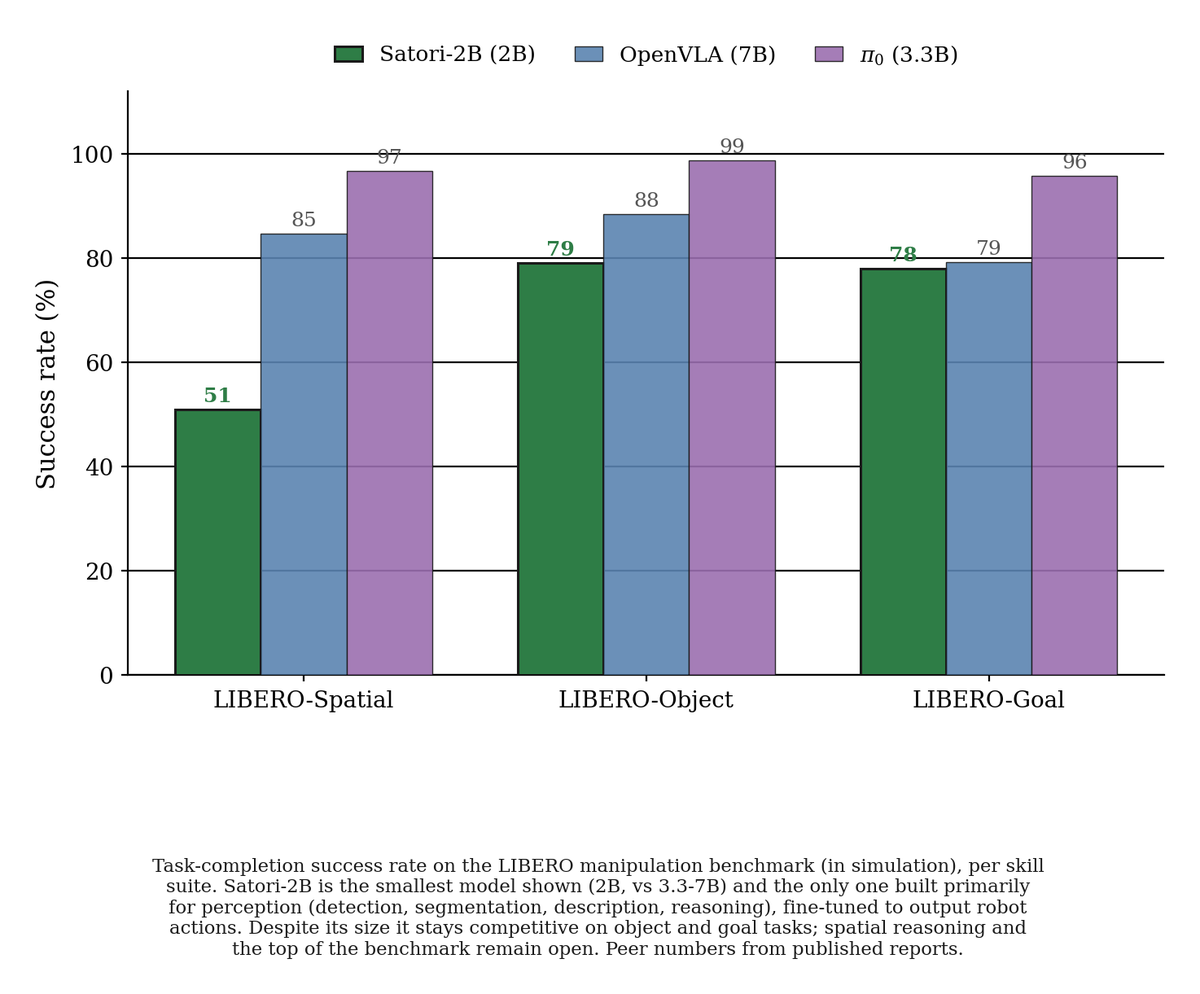
we're now turning satori-2b, a 2b VLM, into a VLA.
same model now takes one camera view and a plain sentence, "put the bowl on the stove," and drives a robot arm through pick-and-place, drawer-opening, multi-step tasks it never saw, closed-loop, self-correcting until it's done.
from language alone.
at 2b it's landing in the neighborhood of openvla, a 7b model built for this from the start
here's why that matters: a VLM understands the world but can't touch it.
a VLA closes the loop, the same model that reads a scene can now change it. you stop programming robots and start telling them what you want, in plain language, any arm, any task it's never seen, described in a sentence.
and at 2b it's small enough to run on the robot itself and cheap enough to deploy everywhere. that's when a benchmark number turns into real-world work
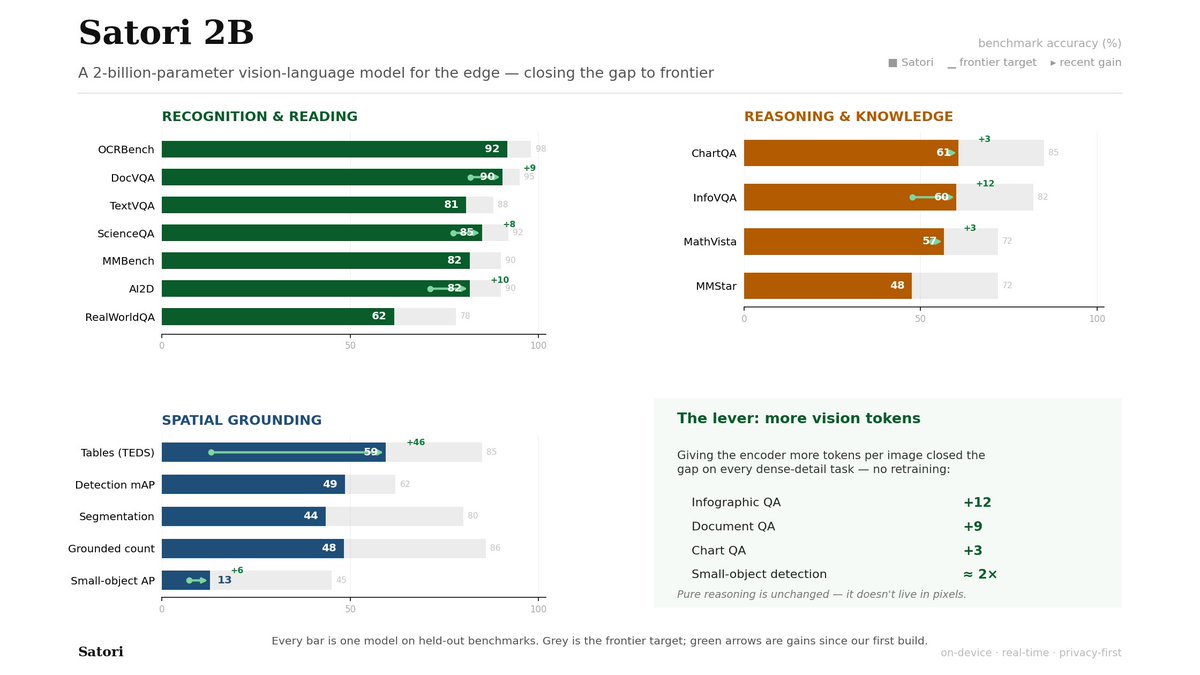
satori's spatial grounding is moving.
tables +45, detection +7, small-object AP nearly doubled. the panel that was furthest from frontier is closing fastest now.
2B is moving fast locally. time to get more ambitious and train something bigger on SN44.
72B would make us run a market leading SOTA vlm.
would SparseLoCo work for this? asking for a friend
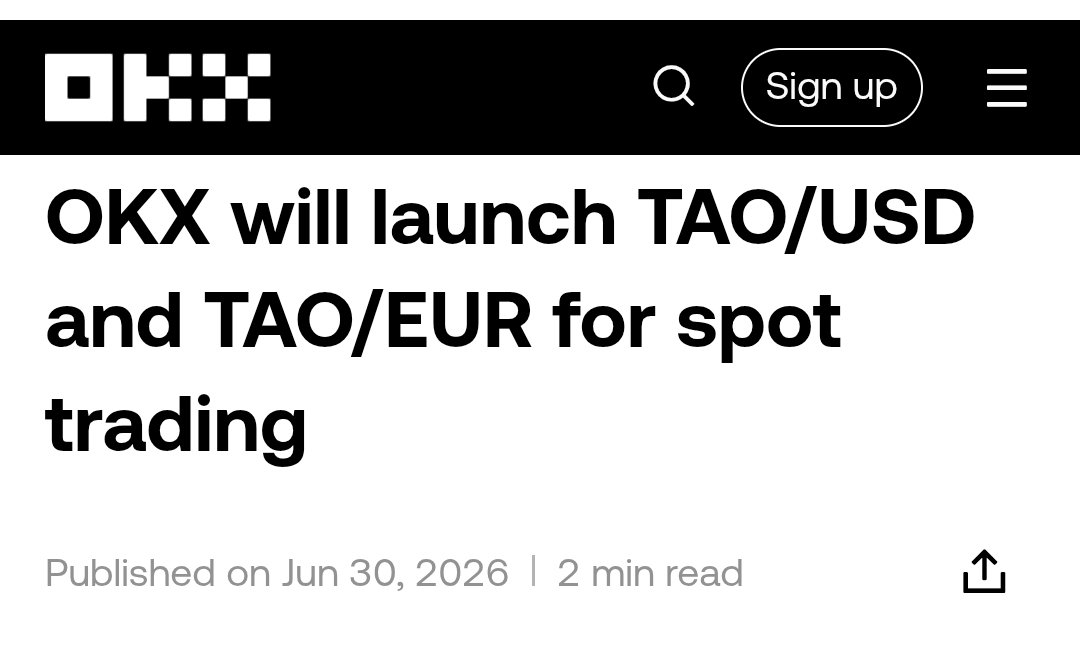
🚨 $TAO just landed on @okx with direct EUR and USD spot pairs. Buyers do not have to route through USDT extra steps. European buyers, TAO/EUR taps the fiat market directly.
Wait, there is more:
OKX isn't a mid-tier exchange chasing listings for volume. It's consistently top 2-4 globally by trading volume, capturing 6-11% of total market share. It handles $1.7-2.2B in daily spot volume, holds $17-30B in verified reserves, and serves over 60-100 million registered users depending on the source.
Behind Binance, it's the closest thing crypto has to a second pillar of centralized liquidity. When an exchange this size lists something, it's not a rumor event. It's a distribution event.
But, days before this listing, OKX launched OKX AI, an onchain marketplace where AI agents discover work, hire each other, and get paid entirely onchain. The OF @opentensor confirmed official support for it.
Also, Kraken became the first major centralized exchange to list Bittensor subnet alpha tokens directly, including Chutes AI (SN64) and Targon Compute, etc....This is the part people are sleeping on.
Make sure to READ that AGAIN.
Put those three together, and you get a completely different picture.
• OKX validated the token.
• Kraken validated the subnets
• OKX AI validated the utility case
That Bittensor isn't just a speculative asset, it's infrastructure other systems are choosing to build on.
Most saw the listing post, scrolled past it. What they missed here, is that in the same week, two of the largest centralized exchanges in the world made three separate moves that all point in the same direction.
• $TAO the asset
• Subnets as investable units
• Bittensor as agent infrastructure
• All validated by tier-1
$TAO isn't getting adopted by crypto. It's getting adopted by the infrastructure crypto runs on.
$TAO
DYOR.
🔗 Sources:
https://t.co/1JLbXcY8pZ
https://t.co/xgm4Ed9EM4
.@OKX unveiled OKX AI, with support from Opentensor Foundation.
OKX AI turns agent capabilities into onchain services, tasks, and reputation.
And Bittensor subnet APIs are coming soon, bringing subnet intelligence directly into the OKX AI Marketplace.