Time saved. Money saved. Revenue earned. A custom build moves all three, because it is shaped around how your firm actually runs, not bolted on beside it. Run the math on your own firm. The numbers are usually bigger than partners expect. https://t.co/gVg1dkS2Zo
Every firm asks the same thing before a custom build: what do I actually get back? Three numbers move. Time saved, money saved, revenue earned. Here is how each one adds up, with real math you can run on your own firm. A thread.
NUMBER THREE: revenue earned. This is the one firms miss. Capacity you free up does not just save cost, it sells. The same headcount can take on more matters. One hour a day per attorney, billed instead of burned, is six figures of new revenue at most firms.
What the agent posts to your billing channel on a Thursday:
@FirmBrain in #billing: "May pre-bills drafted across 38 matters. Narratives pulled from real activity. 4 entries flagged for thin description. 2 matters over budget, partners notified. Ready for your review."
No Friday-night reconstruction.
https://t.co/MvPpzvUJAC
@QuietWealth_UK The £500 clause prices the symptom. A client running their lease through a model is free signal about what confuses people in a firm's own documents. Some firms will bill those questions as a nuisance. The ones that get cheaper to ask will keep getting asked.
@a16z The 'more software' point lands hardest in professional services. Law firms ran on Word and email for thirty years because their processes were too firm-specific for shelf products to capture. That long tail of software nobody could afford to write just got cheap to build.
@lex_node The speed gains will hold. The catch: an agent told to represent party A only knows the version of A's interests someone wrote down. Most of a real negotiation is discovering what each side actually values as terms move. Pareto-optimal against a bad spec is still a bad deal.
@pukerrainbrow Bundling would commoditize exactly what the $1,200 seat charges for: generic review, drafting, summarizing. The layer a $30 Copilot can't ship is one firm's templates, precedent and playbook. Generic legal AI goes to zero and the firm-specific layer becomes the whole product.
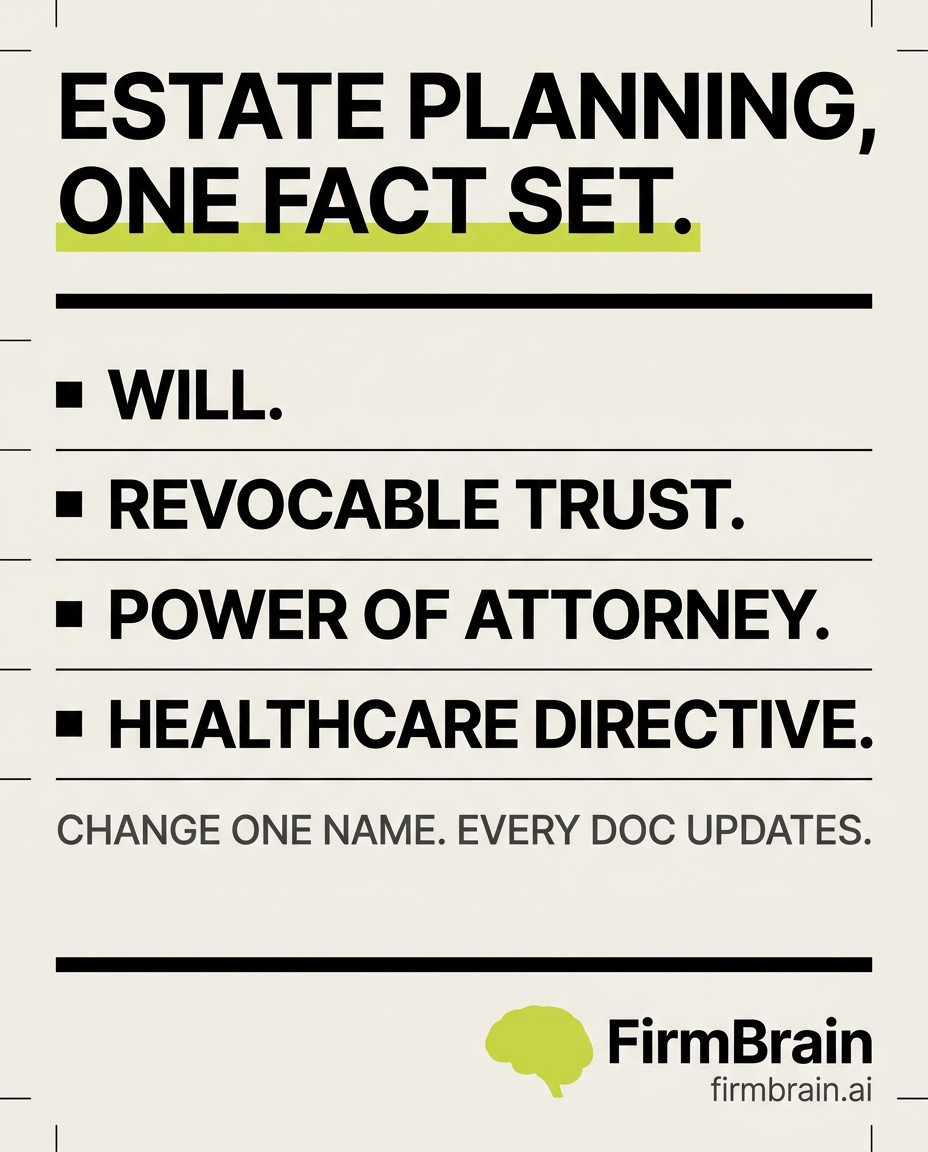
Estate planning runs on one fact set drafted forty ways. Names, fiduciaries, assets, contingencies, repeated across will, trust, POA, healthcare directive.
We rebuild it so the fact set lives once. Change a successor trustee and every document updates. The whole package drafts itself in your format.
https://t.co/MvPpzvUJAC
Every firm leaks billable time. Not because the work was not done. Because it was reconstructed Friday from memory.
Capture as it happens and you recover 6 minutes per attorney per hour. Ten attorneys, 6-hour days: 720 hours a year. At $350, that is $252K.
Same work. Now it gets billed.
https://t.co/MvPpzvUJAC
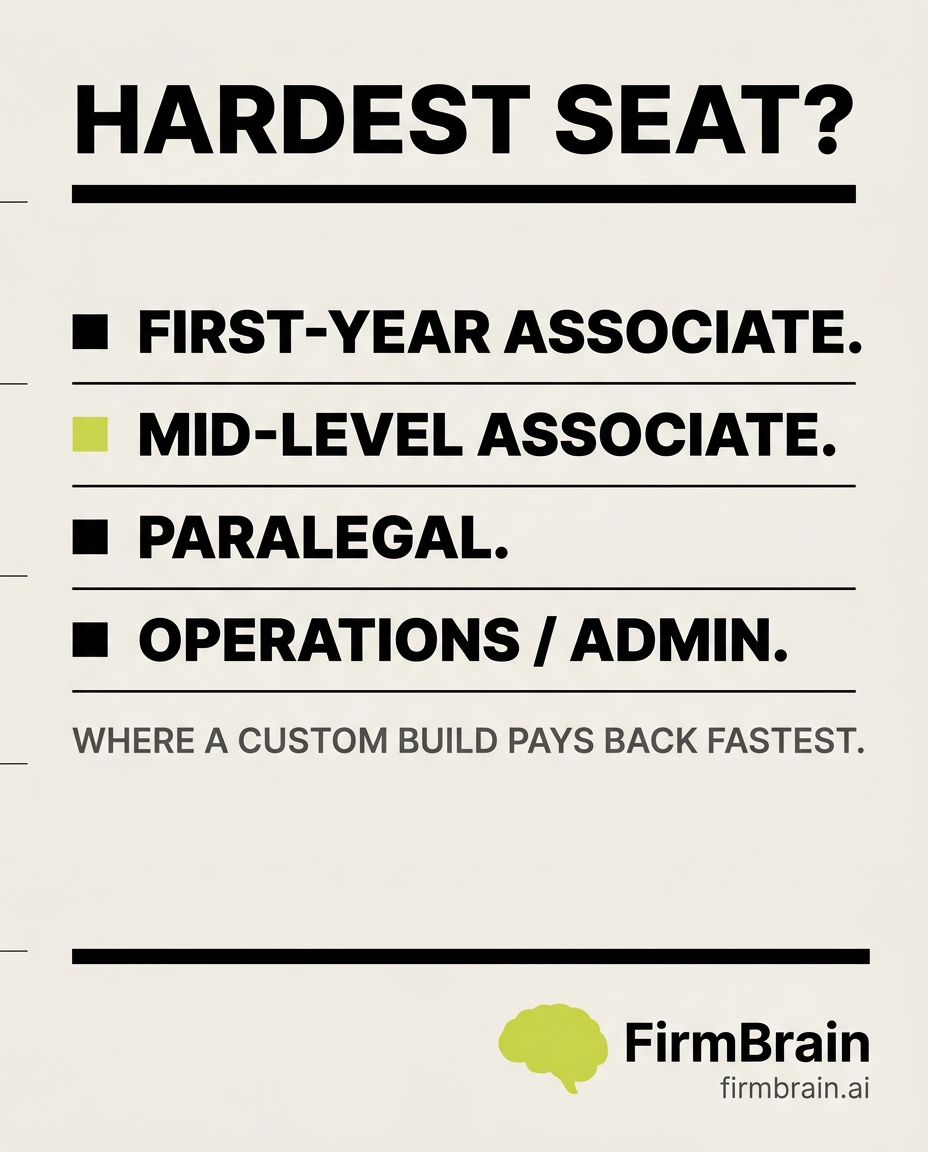
Managing partners: which seat is hardest to hire and keep right now?
· First-year associate
· Mid-level associate
· Paralegal
· Operations / firm administrator
Tell us the hardest one. That is where a custom build pays back fastest.
https://t.co/gVg1dkS2Zo
Your firm is already an AI company.
It just was not built like one.
The expertise is there. The matter history is there. The templates are there. What is missing is the system underneath that turns all of it into leverage.
We do not hand you a tool. We rebuild the firm around what it already knows.
https://t.co/MvPpzvUJAC
The convergence runs both ways and the second direction is underpriced. Vendors drift toward services. Firms turn their own matter history into software — and keep the one asset a vendor can't resell to its next client. Watch which way the talent moves.
It's a matter of time before Harvey/Legora start providing legal services directly and use their tech to take on their current client base.
Tech companies and law firms are converging. Law firms are seeing the writing on the wall. Kirkland is developing their own technology. Other law firms are switching to Claude Enterprise to avoid giving Harvey/Legora proprietary knowledge of their workflows.
The valuations of Harvey/Legora (11b/5.6b) are surpassing the total addressable market for legal software. The tech world is excited about the services market for a reason.
The legal services market is enormous (3trillion) and AI is allowing for it to be disrupted in a meaningful way for the first time. K&E's move here should be a signal to all lawyers about what is going to happen to big law in the future.
@Carles_Reina Underrated item on that list: the buyers changed. A decade ago European law firms wouldn't pilot startup software at all — now one of the continent's fastest-growing companies sells AI to them. When the most conservative buyers move first, the shift is structural, not narrative.
@fitz_keith The pattern across those three is the story: a law firm, a builder, an insurer — each encoding decades of internal judgment into software. The asset isn't the platform, it's the tradecraft that sat unstructured until now. Every expertise business is a latent software business.
Friday, 4:11pm.
The week's matter activity ran through the agent the whole time. Calls logged, drafts marked, emails categorized to matters.
4:47pm the pre-bills are ready. Narratives drawn from real activity. You read, you approve, you go home.
No reconstruction. No Sunday catch-up.
https://t.co/MvPpzvUJAC
A year from now there will be two kinds of firm.
One bought a subscription and works a little faster. One hired a consultant, rebuilt its workflows, structured its data, and now runs on a system no competitor can buy.
1.8x output per attorney. 0.6x cost per matter. The difference compounds every month.
https://t.co/MvPpzvUJAC
@business Billable hours aren't really what's changing — what counts as billable work is. The hours model survives. It just gets pointed at higher-order judgment instead of document assembly. Rates go up, time sink moves up the stack, headcount looks different.