As AI adoption accelerates, managing privileged access is becoming more complex. 😵💫
Learn how to modernize access management across hybrid cloud and AI environments, reduce reliance on long-lived secrets, and strengthen security posture.
https://t.co/VQxARXBMKx
Something I have been thinking about: in the past, the best engineers I knew spent a lot of time automating their work in various ways. Better vim/emacs automations, writing lint rules to catch repeat code issues, building up a suite of e2e tests so they don't need to smoke test the app manually. These kinds of things were the highest leverage activities an engineer could do, because it multiplied their own output, which in turn meant they could build more things.
I think many of these automations have become even more important now. This is true for a number of reasons.
First, infra and DevX automation speeds you up. And if you are running an army of agents, each of those agents will be sped up also. More automation == more output per unit of time.
Second, moving things to code improves efficiency. Your agent could fix an issue every time it sees that issue happen, but that uses tokens and might miss cases. If Claude instead writes a lint rule, CI step, or routine, that class of issue can be fully automated forever. This is really what people are talking about when they talk about loops -- it's about automating entire types of busywork rather than solving them one off. This isn't a new idea at all. Engineers have been doing this for a long time!
Third and most importantly, automation makes it possible for others to contribute to the codebase more easily. Increasingly what I am seeing is engineers are contributing to codebases on day one because Claude can navigate the codebase for them, and that non-engineers are able to contribute to a codebase as effectively as engineers can. What gets in the way of both of these is domain knowledge that lives in peoples' heads rather than in automation -- the stuff you used to have to learn when ramping up. What has changed thanks to agents is the domain knowledge that can be encoded as infrastructure is no longer limited to what is expressible in lint rules and types and tests; it can now capture nearly all domain knowledge, encoded as code comments and skills and CLAUDE.md rules and memories. If I put up a PR for an iOS codebase I don't know and a code reviewer rejects it because it doesn't use the right framework, or if a designer builds a new feature and it gets rejected because it doesn't follow the right architectural patterns, these are failures of automation.
Every team should be writing the CLAUDE.md's, REVIEW.md's, skills, and docs that enable agents to productively work in their codebase with zero additional context from the prompter. This sounds crazy, and at the same time is a natural extension of the stuff engineers have always done: automate, and encode domain knowledge as infrastructure. As the model gets smarter and as the harness matures, this task becomes easier. In the meantime, it is on every team to look for ways to convert their domain knowledge to infra so that Claude can write code better, so that code review catches issues automatically, and so the next person working on your codebase can contribute more easily.
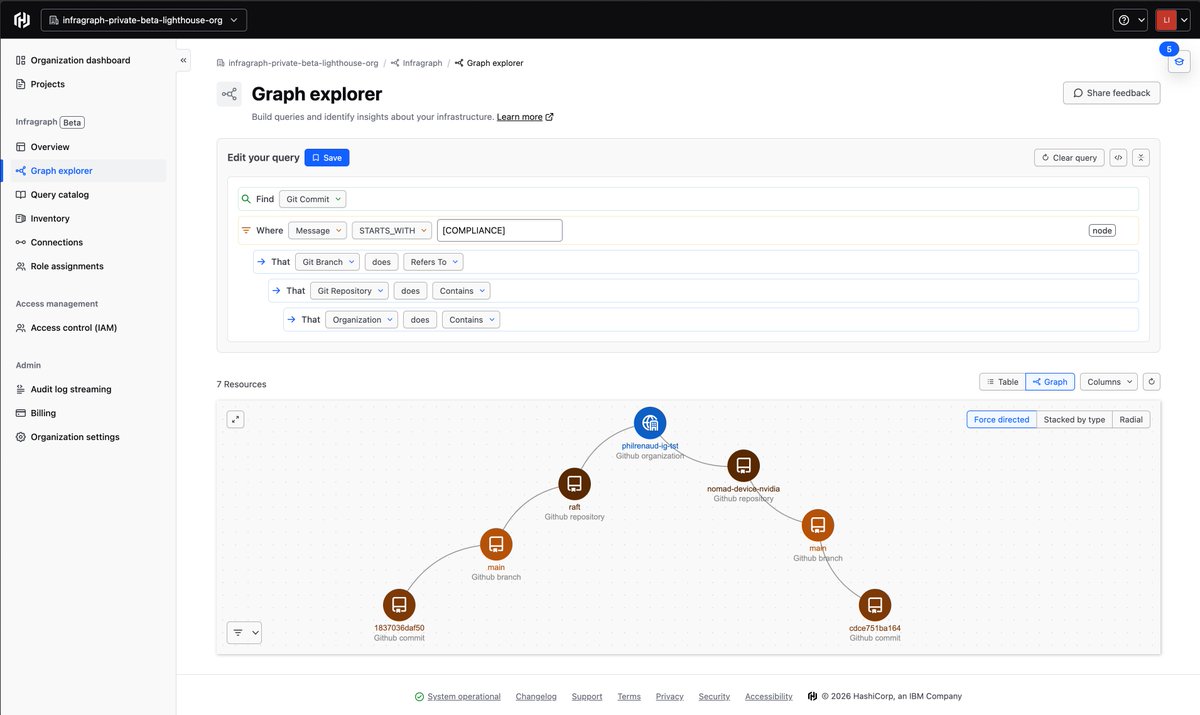
HCP Terraform powered by Infragraph uses a query interface to allow users to view and search through their data. It enables users to build queries to gain insights about their infrastructure estate through low code and JSON queries with future support for NL2Q.
Teams are already using Infragraph queries to answer critical operational questions in seconds. Read more: https://t.co/K7pT6qSZhW
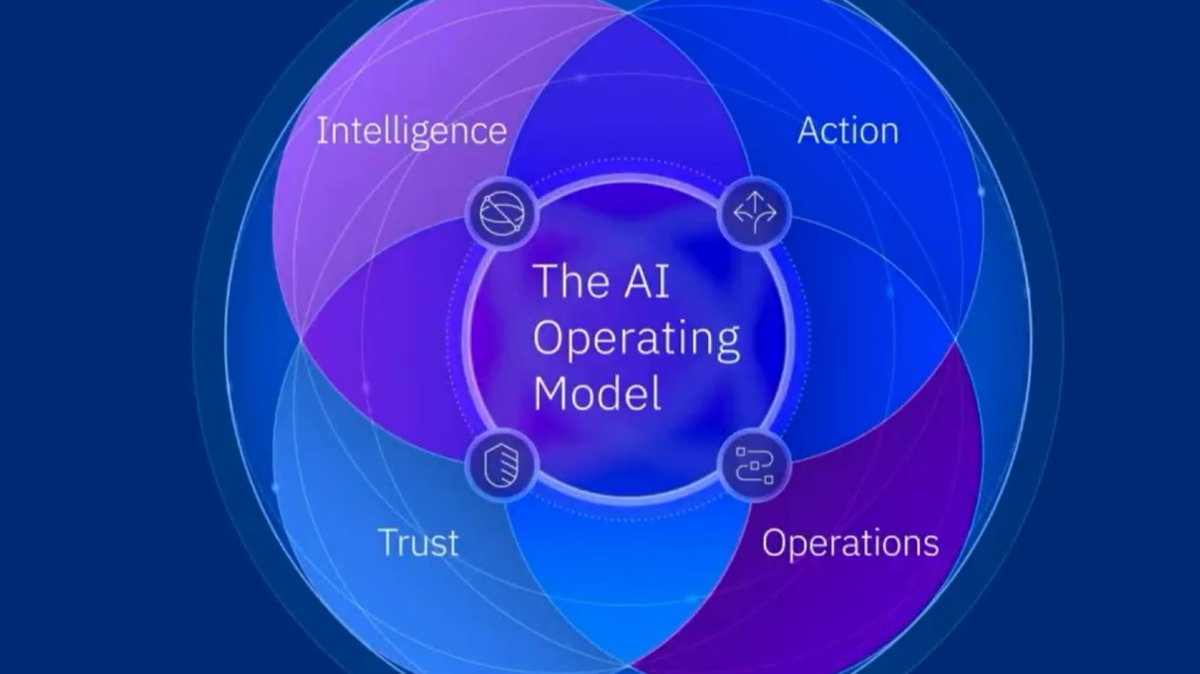
Most AI narratives in infrastructure start with technology: models, prompts, copilots, and code generation. 🤖
However, that framing is backwards. 😵💫
The right framing is workflow-first: What do teams need to do across the lifecycle, and where can AI safely remove toil without increasing risk?
💡 Learn how to redefine your cloud operations with agentic workflows and guardrails in this white paper: https://t.co/kkrGoa9L7c
Resilient recording framework. Stronger auditability. Less operational pain. See how Boundary helps teams maintain trusted, durable records of privileged activity. https://t.co/ek0wwYmbCw
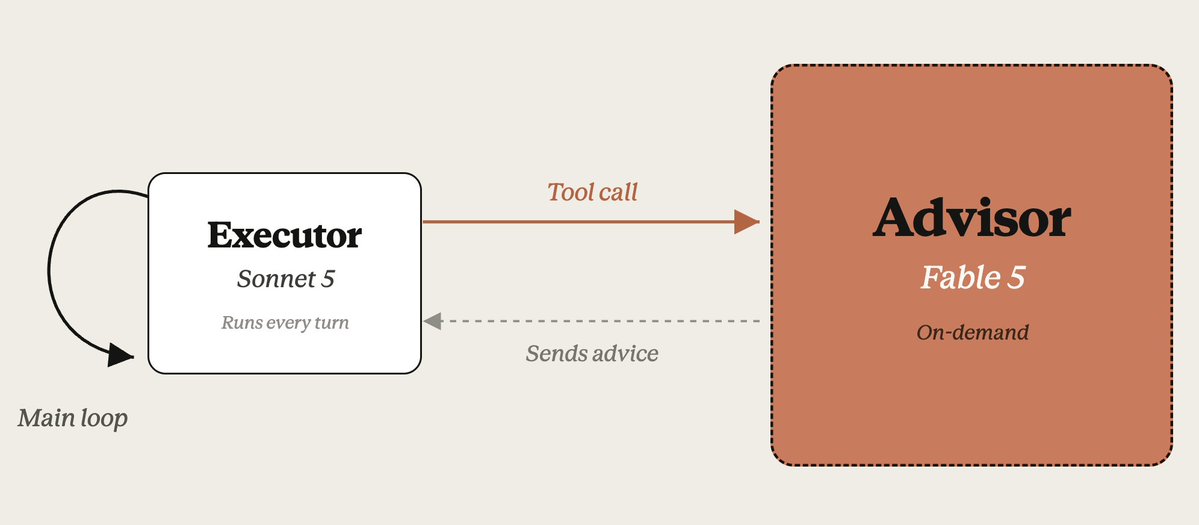
A few patterns we frequently use with Fable 5:
Use Fable 5 as an "advisor."
An executor (Sonnet 5) calls Fable 5 for guidance.
Most tokens are billed at the lower executor rate.
back on air on @AppleMusic radio this morning! playing some tunes and chatting with the boys from Whatmore. hit the radio tab in your app to tune in live 👊
Today we're launching @soffi_dev.
I spent most of my career shaping products but relying on others to build them. Then AI changed that.
Soffi lets designers and PMs work directly on real, deployed software alongside engineers.
Not mockups. Not prototypes. The actual product.
HCP Packer now supports enforced provisioners — helping platform and security teams maintain image integrity and compliance across downstream image builds. https://t.co/HX7GMgNywV
Infrastructure is getting more complex as organizations scale AI and hybrid cloud.
HCP Terraform powered by Infragraph is designed to bring clarity back.
It creates a real-time infrastructure graph that connects infrastructure, applications, services, and ownership into a single system of record.
With unified context across environments, teams can:
• Understand relationships across their stack
• Make faster, more informed decisions
• Power automation and policy with greater precision
• Prepare for agent-driven workflows
This is a step toward more intelligent infrastructure operations. Explore the latest updates: https://t.co/X6DrkonIDT
Most companies aren’t failing at AI — they’re stuck in pilots. Learn why powering the agentic enterprise means turning real-time intelligence into coordinated action at scale. ➡️ https://t.co/X7TyjnSgoJ
@armon@HashiCorp@mitchellh Thank you for everything Armon. The reason I joined HashiCorp was from yours and Mitchells vision and I hope your legacy lives on internally. I’m very proud to represent the company you created. I wish you all the best on your future endeavours💙
Microservices trade coordination for velocity. 🏃♀️➡️
HashiCorp CTO @Armon Dadgar explains how to keep that speed without drowning in complexity: https://t.co/DJA7W1nSmk
Project infragraph will help organizations connect the dots in complex cloud environments to solve major visibility and remediation challenges. Learn more about our vision for AI. https://t.co/Cgdvef4dJp
Vault Enterprise 1.21 is now available. 🎉
This release introduces new capabilities to strengthen security controls, support compliance needs, and reduce operational overhead.
Highlights include:
◾ Self-service TOTP MFA
◾ Granular secret recovery
◾ FIPS 140-3 Level 1 crypto
◾ WIF-based secret sync (no long-lived creds)
◾ Containerized plugin execution
◾ Automatic rotation of local system passwords
Read more: https://t.co/iO4Si8lcHa
Guess who’s back on the HashiConf stage? 🎉
Mitchell Hashimoto, one of our co-founders, just made a surprise appearance alongside Armon Dadgar! It’s a special moment celebrating how far we’ve come and the journey ahead.