New to actually posting, but I wanted to share our recent work on speech in noise testing in the routine audiogram! Special thanks to my co-authors, including @StevenGianakas , Jason Qian, Steven Losorelli and Austin Swanson.
https://t.co/lE3UuoZkFM
Big thank you to my collaborators @StevenGianakas, Michael Smith, @matt_with_ears Kristi Ward, Jason Qian, Michael Smith, Nik Blevins and Austin Swanson!
Here we demonstrate that hearing thresholds and speech in noise abilities are related to perceived hearing handicap. In contrast, traditional measures of word recognition in quiet have no predictive power for when a patient is likely to report a problem.
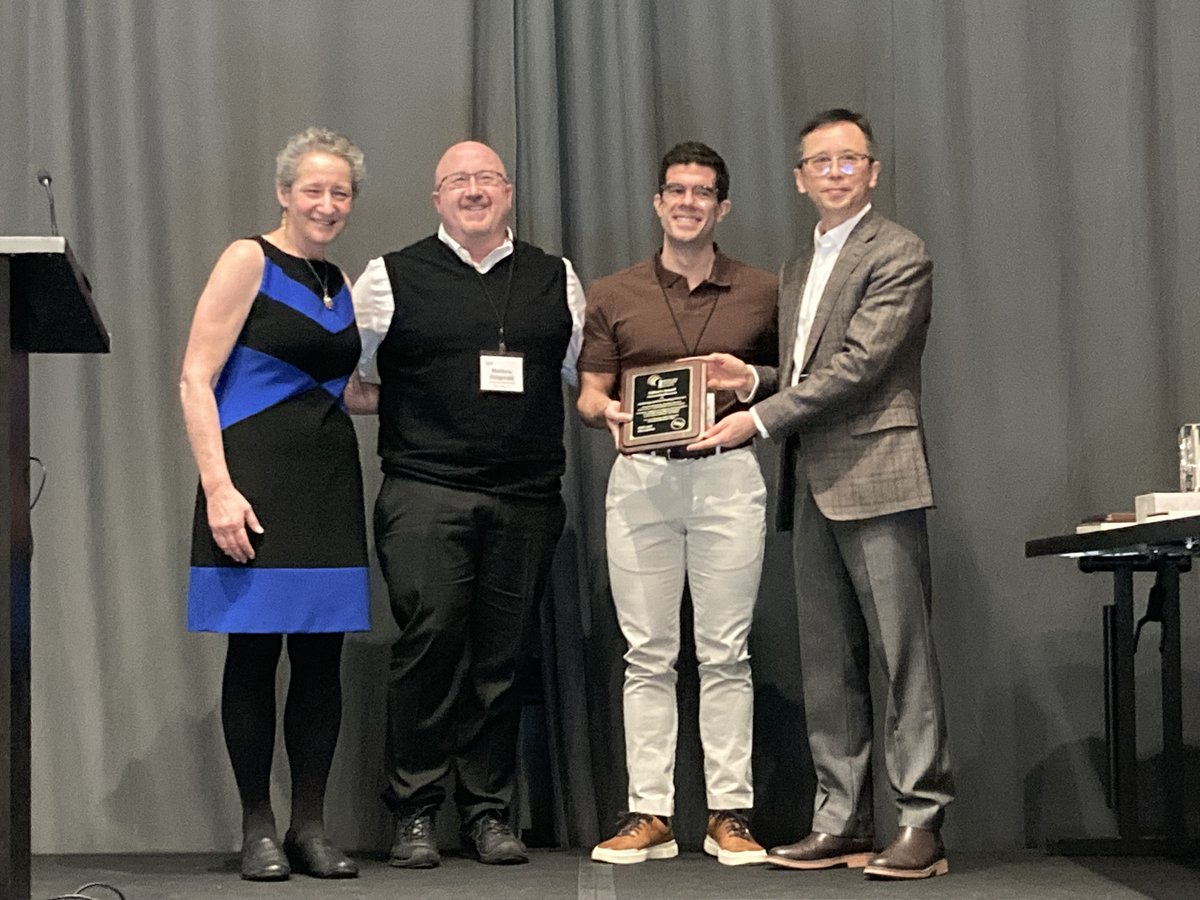
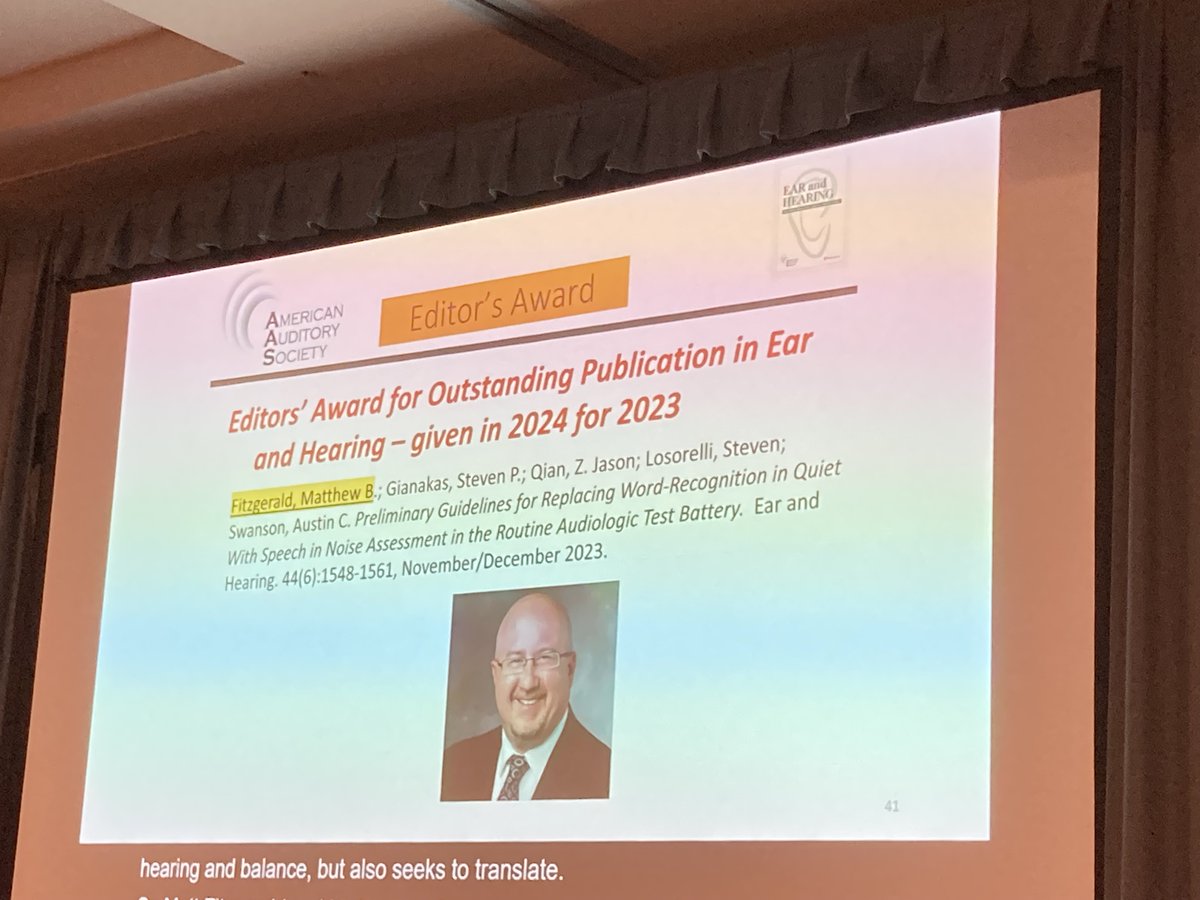
The Editor's Award for Outstanding Publication in Ear and Hearing was awarded to Dr. Matt Fitzgerald and colleagues at our awards ceremony yesterday for their Ear and Hearing paper on rethinking how we tests speech recognition clinically.
@lintoinette Now that's very kind of you! In all seriousness, this was the product of years of work, and I'm proud of everything we've done so far. More to come though - this is just the beginning!
Honored to announce that my colleagues and I will be receiving the Ear and Hearing Editors' Award at the 2024 meeting of the American Auditory Society! This is for our work on implementing measures of speech in noise in the routine audiogram.
https://t.co/xenoRR7gh3
Big thanks to my co-authors @StevenGianakas, Jason Qian, Steven Losorelli and Austin Swanson! This is the first of several articles, all focused on helping audiologists to place equal weight on suprathreshold auditory function, particularly speech in noise abilities.
@NicoleJiam Many thanks Nicole! I agree completely, which is what motivated this work. We're just trying to provide data-driven guidelines from large numbers of patients to make this long-overdue transition. Thanks for reading!
@VDTejani Thanks Viral! We're just trying to provide data-driven guidelines from large numbers of patients. I'm excited by this work, and I'm glad that you are too!
In addition to predicting categories of word-recognition scores from speech in noise abilities, we also demonstrate that asymmetries in SIN are more accurate at identifying patients with a vestibular schwannoma.
https://t.co/V5qwFOGtbt
@BKConePhD Many thanks to you Barbara! We're just trying to give data-driven guidelines to audiologists to make this long-overdue transition. I personally am very optimistic about this work and its implications - thanks for reading!
These are the first of many papers in which we argue that speech in noise should become standard in the routine audiogram. Doing so gives audiologists vital information about suprathreshold function, and helps ensure that the audiogram is more sensitive to patient concerns!
@tmcrackan Thanks! On our end, we're all very excited by this work. This reflects a simple, but vital step to move things forward. As you know, the arc of progress can be long...