One thing that stood out to me during the @Appreciators_IO campaign:
The leaderboard never really stopped moving.
Even near the final day, creators kept posting, new ORIGINALS kept getting minted, and the community remained active.
Most campaigns rely on rewards alone.
This one gave creators and holders reasons to participate together.
Top creators are competing for 10,000 $APE
Holders get a 2x multiplier and access to exclusive NFT rewards.
But what kept the momentum alive was the constant flow of new ideas, artwork, memes and community contributions.
That is harder to manufacture than engagement.
And easier to recognize when you see it.
Mint → https://t.co/P7XdAMjbsz
BE ORIGINAL.
@RoccoXBT Triage contracts versus surgical contracts is the cleanest example of per-contract equivalence. Triage needs speed and accepts "emergency yes/no." Surgery needs precision and demands exact procedure code. One network hosting both is what makes this usable.
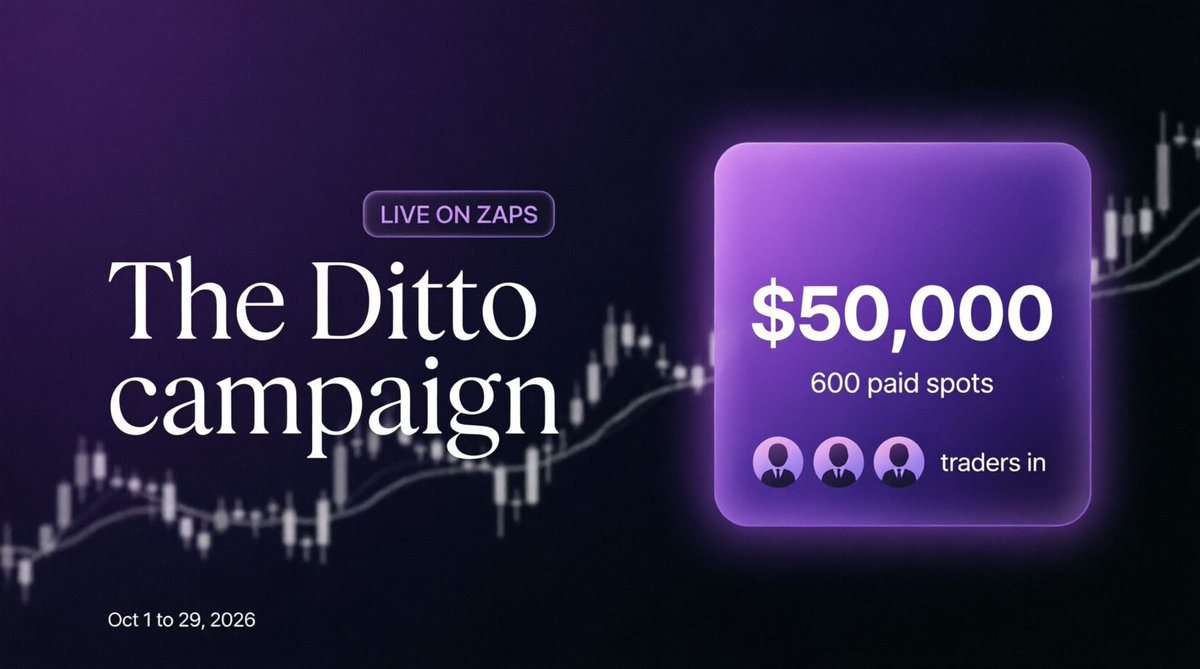
The ZeruAI x Ditto trading competition is live on Zaps, and it pays six hundred traders, not just the top three.
Window: Oct 1 to Oct 29, 2026.
Pool: $50,000.
Paid spots: 600.
Three steps from the campaign page:
Register on Zaps
Trade perps through your Ditto trade tab
Orders execute on Hyperliquid exactly as usual while Zaps verifies the activity and builds your rank
The prize ladder:
1st: $12,000
2nd: $7,000
3rd: $4,500
Paid all the way down to 600th place at $10
Clan leaders receive a 5 percent leader share of member rewards
The pool grows with verified volume and the full $50K unlocks at $50M.
One clarity note before you enter. These competition rewards are separate from the future Zeru token airdrop that @zerufinance plans around zaps points. Two lanes with two rulebooks.
Final review lands about 24 hours after the close and rewards stay claimable for 30 days.
Rules and registration: https://t.co/HMC52DNu9h
@Web3Boss311 This explanation makes the Equivalence Principle much easier to follow. Does GenLayer have a live Intelligent Contract demo where two differently worded answers are assessed against the same acceptance criteria?
@hey_zenn I love the concept, but "failure mode" can be subjective. One person thinks a slight idle roughness is fine, another thinks it is a misfire. How does the Intelligent Contract mathematically define the threshold for "gone" without reverting to the exact string matching problem?
@Akhil3921793144 A smoke alarm that rings for burnt toast and for a real fire is still a good alarm. Your hash is the same: just as loud for a missing full stop as for ‘someday’. The trouble starts when the alarm alone decides whether to call the fire brigade.
@YMLibrary@2FactorFinance Bringing this capital architecture to commodity tokens is the next logical step. Gold at 15 percent volatility fits the wider productive band perfectly, avoiding the brutal decay seen in traditional commodity futures.
My grandmother never wrote a recipe down. When I finally collected two cards for the same dish, my aunt's said "simmer until it smells right" and my mother's said "twenty minutes on low."
Zero matching sentences. Same dish every single time.
The trick nobody in my family ever noticed: we never compared the cards. We compared the plates.
Blockchains spent fifteen years comparing cards. Every node had to return the same bytes or the transaction died, and AI, which never writes the same card twice, stayed locked out of the kitchen.
The Equivalence Principle from @GenLayer moves the check from the card to the plate: a leader cooks first and proposes the dish. Each validator then reruns the recipe with its own model and asks whether the result is the same meal.
Every Intelligent Contract writes its own rule for equal before anyone cooks, so a price feed and a delivery report never have to share one definition of same.
My favorite part: nobody has to trust the leader because everybody can rerun the recipe. Trust moved from the cook to the kitchen.
What does your family make "the same" every time without ever following the same steps twice? Tell me in one line.
@Marufhassan76 The coffee example beats every other explainer because you feel three honest answers before anyone mentions consensus. That is how you teach someone who has never thought about how blockchains agree.