Engenheiro agrônomo, ScD, MBA em Gestão e Administração de Empresas, Economia e Finanças, Comunicação e MKT, conservador, pela família, contra a corrupção
Mucha gente se asusta al ver fuego, pero el "flame clipping" es puro bienestar animal. 🔥🐄Miller Angus Cattle
En razas como el Angus, el pelo largo acumula parásitos y suciedad. Pasar el soplete de forma controlada elimina piojos y garrapatas al instante, sin dañar la piel. Un toro limpio es un toro sano que no sufre por el calor ni por las plagas. ¡El manejo bien hecho no tiene sustituto!
#NotasVet
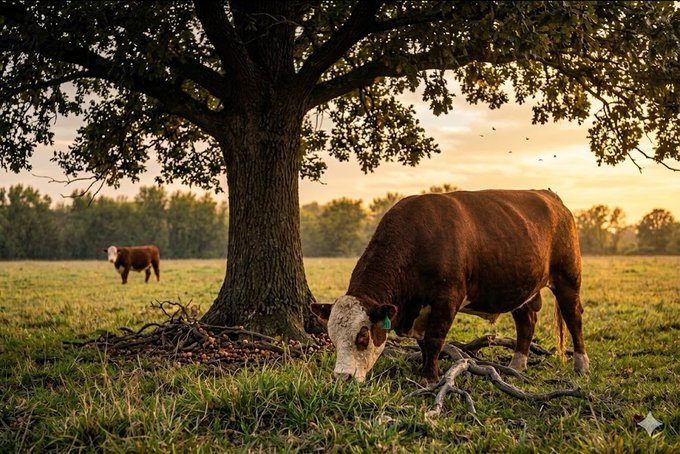
You walk past a field. There is a bull in it. That is what you see. A bull. In a field.
Have a closer look.
The grass under his hooves is deeper-rooted than it looks. Two, three feet down in places, because his grazing has been stimulating root growth for the six years he has been in this field. Those roots are pulling atmospheric carbon into the soil at a rate the climate modellers would weep over if they ever thought to measure it.
The soil itself is alive. A single teaspoon from beneath Gerald contains more microorganisms than there are humans on earth. Bacteria. Fungi. Protozoa. Nematodes. A functioning microbial civilisation built by his manure, year after year, pat after pat, feeding a soil structure that holds rainwater like a sponge.
The earthworms are working. Roughly 400 per square metre under a well-grazed pasture, which is approximately ten times the count in the arable field two hedges over. They are aerating the soil, cycling nutrients, and feeding the badger who patrols the field at night.
The dung beetles are on duty. Up to a hundred species compete for a fresh cowpat in a British summer. They bury it. They break it down. They aerate the ground as they go. Without them the pasture would stop functioning within a year.
The cowpat itself, fresh, supports roughly 300 species of invertebrate in its first week of existence. Flies. Beetles. Wasps. Parasitic nematodes. A small, smelly ecosystem the size of a dinner plate, which Gerald produces ten to fifteen times a day.
The hedgerow around his field is dense because Gerald keeps eating the shoots that try to grow outwards. It supports, in turn, around 2100 species of invertebrate, bird and wildflower. The skylark is nesting in it. The wren is hunting it. The hedgehog is using it as a corridor to the next field.
The yellowhammer is on the gate. The pipit is on the wall. The swifts are working the air above Gerald's head, because the flies around him are what they eat. The barn owl quarters the field at dusk, because the short-grazed grass lets her see the voles.
The wildflowers along his field boundary number, at last count, 31 species. Tormentil. Eyebright. Bird's-foot trefoil. Self-heal. Red clover. The wildflowers support the bees. The bees support the pollination of the next farm's orchard. The orchard supports the apples being pressed in the village.
A horseshoe bat was recorded feeding over the field last August. First record in the parish in thirty years.
The soil beneath Gerald has gained approximately 1.5 tonnes of carbon per hectare per year since he arrived. His field alone has offset the annual emissions of about forty British households.
Gerald does not know any of this.
Gerald is eating grass.
He has been eating grass, continuously, for four years, on the same 12-acre field, and in that time he has supported more biodiversity, more carbon sequestration, and more ecological complexity than most conservation projects with a salaried team and a press office.
He has done it for free. He requires only rain and grass. He has asked for nothing.
People are trying to cancel Gerald for this.
Um Novo Olhar Deslumbrante da Lua 🌓
A imagem mais nítida já registrada da Bacia Orientale é de tirar o fôlego.
A Bacia Orientale, uma das crateras de impacto mais bem preservadas da Lua, agora aparece com uma clareza impressionante, com um nível de detalhe sem precedentes, muito mais nítido do que qualquer registro anterior, oferecendo aos cientistas uma nova oportunidade de estudar sua estrutura, sua formação e a história geológica do nosso satélite natural.